Chinese Jizhou ware: begin with a varied kiln tradition
The Palace Museum locates Jizhou at Yonghe, near Ji’an in Jiangxi, and also records the name Yonghe ware. Its account lists several kinds of decoration, including leaf designs, paper-cut patterns and tortoiseshell effects. The regional name therefore does not identify one surface technique alone.
The works below range across bowls and a vase. They also have different catalogue dates. Reading the form, medium and date together keeps the diversity visible, while giving a clear basis for comparing how an image was produced.
A leaf bowl preserves a fired impression
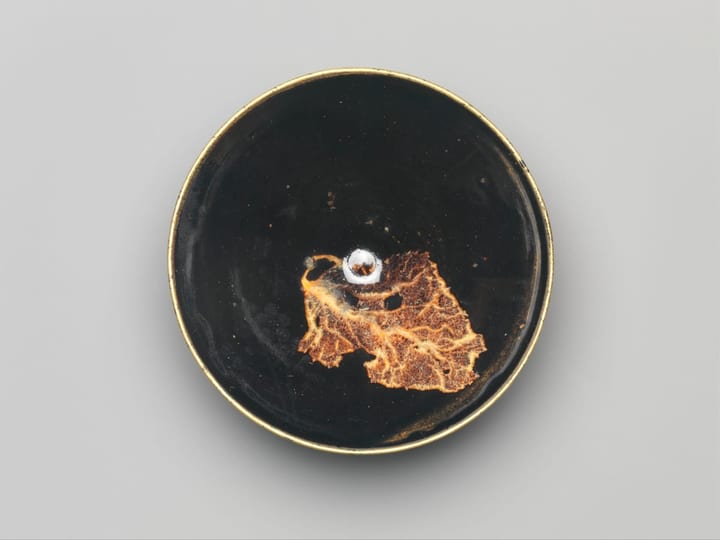
The Met’s Tea Bowl with Leaf Decoration, 29.100.220, is dated to the twelfth–thirteenth century, Southern Song. Its medium is stoneware with black and brown glaze and pigment, Jizhou ware. The contrast between the leaf design and the surrounding surface invites attention to its placement inside the bowl.
Cleveland explains a leaf-decorating method in which real leaves were dipped in glaze, placed on a vessel and burned away during firing. The surviving effect is not an intact leaf permanently sealed inside the bowl. Distinguish the leaf used in making from the fired impression that remains.
What a detailed museum record can and cannot explain
Osaka’s Museum of Oriental Ceramics describes its Southern Song leaf bowl, 00598, as a thinly potted Jizhou example with a small foot. Its account points to the natural leaf silhouette and minute veins imprinted during firing. This offers a focused comparison with the Met’s bowl, without requiring their manufacturing details to be identical.
The Osaka record presents the proposed association of a mulberry leaf with Zen as something thought to have been believed. That interpretation should retain its uncertainty. A leaf image does not establish the exact tree species, preparation method or religious intention for every Jizhou vessel.
Paper-cut patterns work through contrasting glaze layers
The Palace Museum describes paper-cut decoration made by placing a cut pattern over an iron-rich base glaze, then applying a brownish-yellow glaze with less iron before firing. Its Song small bowl, 新00059733, has three groups of dark, diamond-shaped paper-cut patterns against a varied glazed interior.
The Met’s Tea bowl with paper cut decoration, 23.183.2, is catalogued separately as twelfth–late-thirteenth-century Southern Song stoneware with paper-cut decoration and tortoiseshell glaze. Together these records connect a named method with particular objects. They do not require every paper-cut design to use the same motif or arrangement.
Tortoiseshell names a visual effect on glaze
Cleveland’s Teabowl with Tortoiseshell Glaze, 2020.177, is dated to the 1100s–1200s, Southern Song. The museum specifies brown-glazed Jizhou stoneware with a tortoiseshell pattern and describes splashes resembling a shell’s mottling. The name concerns the appearance of the glazed ceramic.
Compare a mottled field with the bounded silhouette of a leaf or cut-paper design. Where does the surface offer an identifiable outline, and where does a pattern spread without one? This distinction makes the decorating approaches easier to discuss without assigning every brown patch to a particular resist process.
Painted waves carry the design around a vase
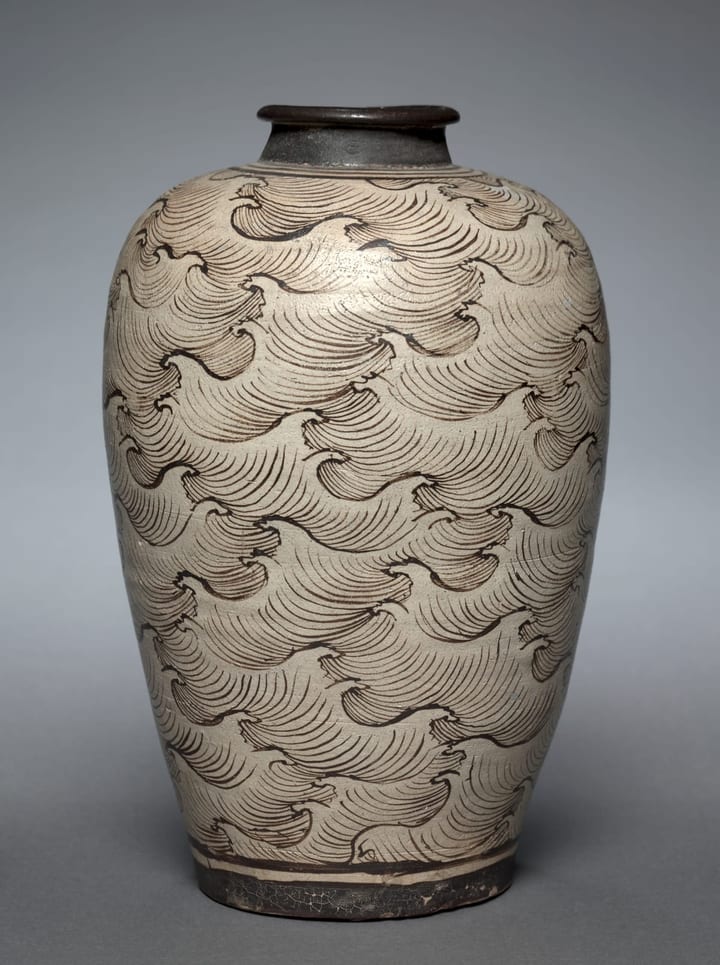
Cleveland’s Vase (Meiping) with Waves, 1980.186, is dated to the 1200s–1300s and attributed to Yonghezhen in Jiangxi under the Yuan dynasty. Its medium is glazed stoneware with slip-painted decoration, Jizhou ware. The museum describes a white-slip surface bearing bold painted designs.
Here the painter organises the whole vase as rolling water with cresting waves. Follow one curving mass toward the shoulder, then compare it with the next. The image responds to the swelling body and narrowing neck. This example expands the discussion beyond bowl interiors, leaves and paper-cut patterns.
Choose the right comparison for the technique
Our Jian ware guide provides a separate context for dark-glazed tea bowls. A shared bowl function or dark colour does not make Jian and Jizhou interchangeable. Our Cizhou guide is useful when comparing the roles of slip, cutting and painting, while the Yaozhou companion follows carving and moulding beneath celadon glaze.
Across these traditions, ask where the design was established: in the body, through a temporary pattern, in applied brushwork or through the glaze itself. That question turns a visual comparison into a discussion of making, while the object records keep each answer grounded.
Museum photographs and credits
Tea Bowl with Leaf Decoration, China, Southern Song dynasty, 12th–13th century; stoneware with black and brown glaze and pigment (Jizhou ware). The Metropolitan Museum of Art, 29.100.220. CC0.
Vase (Meiping) with Waves, Yonghezhen, Jiangxi, China, 1200s–1300s, Yuan dynasty; glazed stoneware with slip-painted decoration, Jizhou ware. The Cleveland Museum of Art, 1980.186. CC0.