Chinese Cizhou ware: distinguish a kiln center from a wider family
The Palace Museum identifies Guantai and Pengcheng in Hebei as important locations associated with the historic Cizhou name. Hebei's cultural heritage authority likewise discusses Guantai as a major Song–Jin–Yuan center and Pengcheng's later prominence. These places anchor the history without exhausting the name's broader use.
The Met describes Cizhou as domestic wares produced and used across northern China. For its Vase with Abstract Scroll Decoration, 26.292.56, it suggests a northeastern origin from the decoration, rather than assigning a specific Hebei kiln. Such distinctions between a regional attribution, a kiln center and a related ware family are useful parts of the label.
Read the surface as body, slip, decoration and glaze
The Palace Museum explains white slip as a layer of fine clay mixed with water and applied to a ceramic surface. On its black-on-white floral meiping, the lighter coating provides a working ground over the body. It is a material layer, not simply a word for white porcelain.
The National Museum of China describes painting on a white slip ground followed by transparent glaze in its account of Cizhou fish decoration. Separating these stages helps explain the visible contrast: body and ground need not have the same color, and a painted image sits within a deliberately prepared surface.
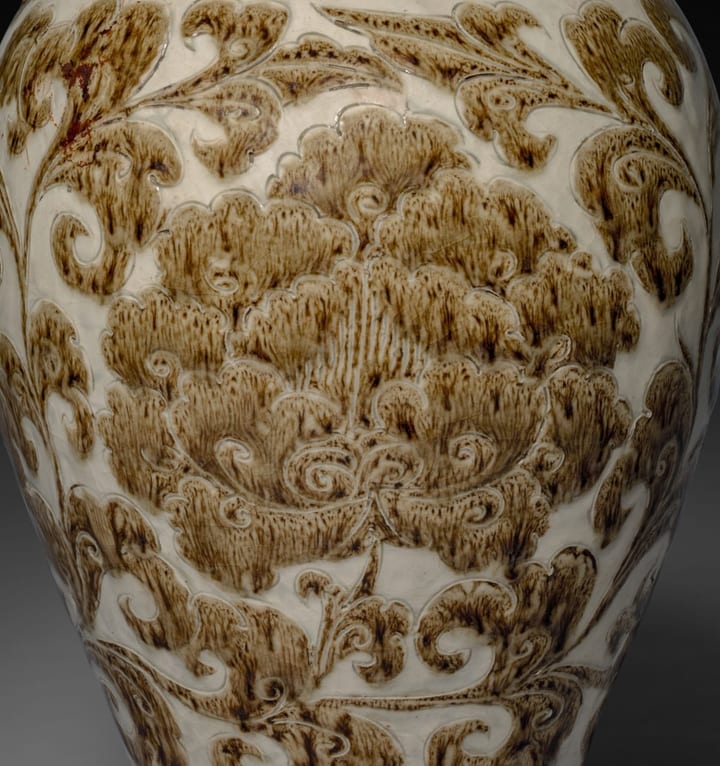
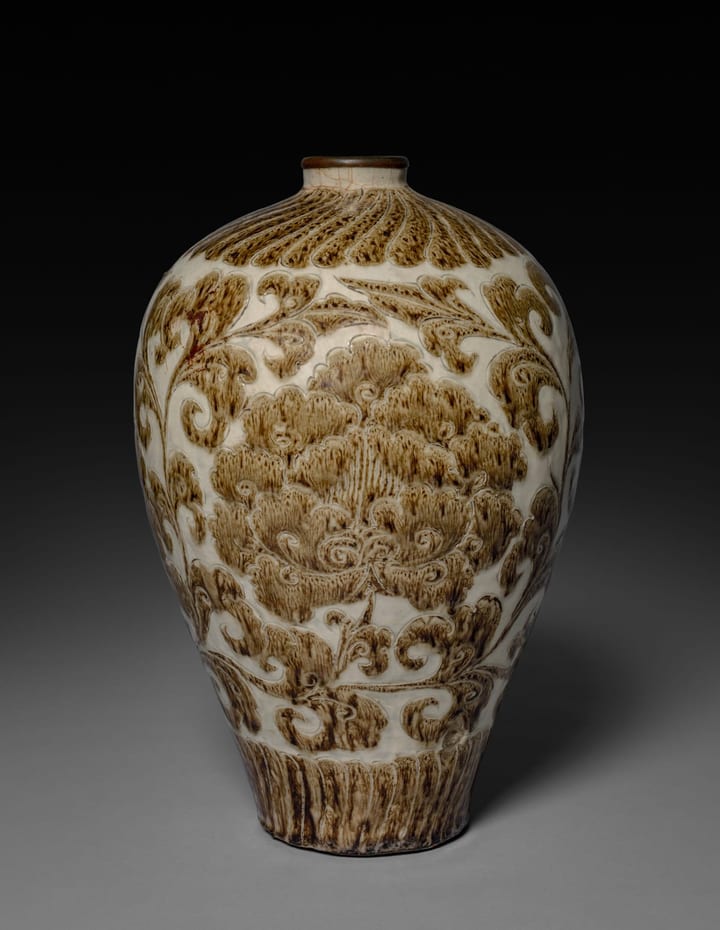
Carved slip decoration makes a pattern through removal
Cleveland Museum of Art's Meiping Vase, 1940.52, is dated to the 1100s and catalogued as Northern Song buff stoneware with carved underglaze slip decoration. Its material description distinguishes the body from the worked coating.
Follow a flower edge and a scrolling passage, then look at how the surrounding area sets off the motif. Cutting and carving make boundaries in a surface layer, while brush painting adds marks to a prepared ground. The Met's eleventh–twelfth-century scroll vase is explicitly described as sgraffito decoration, offering another documented case of worked rather than simply painted surface design.
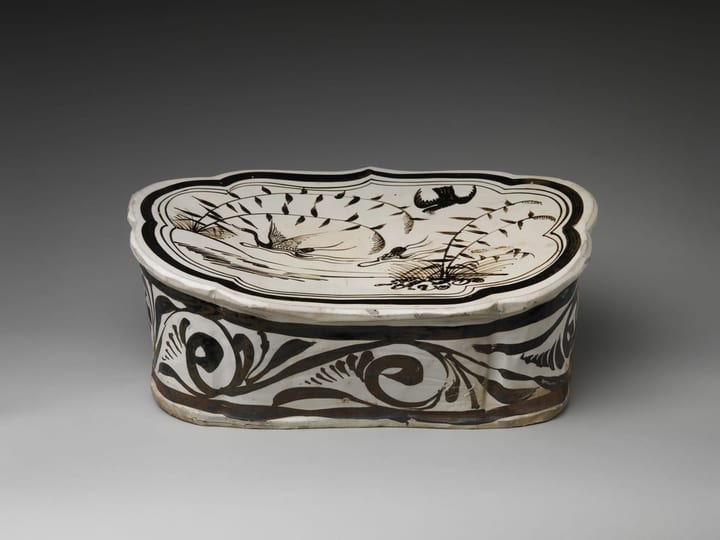
A painted pillow joins material layers with a particular subject
The Met's Pillow with a Falcon Attacking a Swan, 1985.214.132, dates to the twelfth–thirteenth century, in the Jin dynasty. Its medium records brown and black pigments on white slip beneath transparent glaze. Here the layer sequence is stated directly in the object record.
The museum connects the hunting motif with the Jurchen seasonal hunting cycle and notes its appearance in jade, textiles and ceramics. Keep that interpretation with this scene. Looking at the birds' relative scale, their meeting point and the surrounding open space helps explain the composition without turning every bird design into the same narrative.
Cizhou decoration extends beyond a black-and-white image
Cleveland's Lady Holding a Vase, 1957.56, is dated to the 1100s–1200s. Its account describes a molded clay figure covered with white slip and transparent glaze, with red, green and ocher colors applied above. The museum suggests it may have served as a toy; that proposed use remains an interpretation.
The figurine demonstrates why a ware name should not be reduced to one palette or one vessel shape. Its molded volume and separately applied colors ask different questions from a carved vase or painted pillow. The National Museum also lists several decorative variants within the broader tradition, reinforcing the value of an individual material description.
Look for the choices that organize a useful object
On a vase, compare the shoulder, main wall and lower border. The Palace Museum's floral meiping divides its decoration into bands, with a principal scrolling design on the body. On a pillow, the broad upper field and the side walls offer another arrangement of space.
Choose one area and ask how a line begins, turns or meets another shape. Then return to the complete form: does the pattern emphasize the curve, frame an image or connect separate fields? These questions connect surface technique with composition and use while leaving the catalogue's attributions intact.
Compare Cizhou with neighboring craft questions
Our Ding ware guide considers another pale-surfaced northern tradition through incised and molded designs and firing arrangements. The Jun guide follows glaze color and firing effects; the Jingdezhen guide provides a different production setting.
Use those connections to compare body, coating, decoration and glaze in a consistent order. Cizhou and Cizhou-type labels are evidence to read carefully, rather than permission to group every dark-painted pale ceramic into a single kiln or a single recipe.
Museum photographs and credits
Meiping Vase: Cizhou Ware, China, Northern Song dynasty, 1100s; buff stoneware with carved underglaze slip decoration. The Cleveland Museum of Art, 1940.52. CC0.
Pillow with a falcon attacking a swan, China, Jin dynasty, 12th–13th century; stoneware painted with brown and black pigment on white slip under transparent glaze (Cizhou ware). The Metropolitan Museum of Art, 1985.214.132. CC0.
Detail cropped from the same photograph of the Northern Song Cizhou meiping vase shown above; carved underglaze slip decoration, 1100s. The Cleveland Museum of Art, 1940.52. CC0.