Chinese celadon censers vary in profile
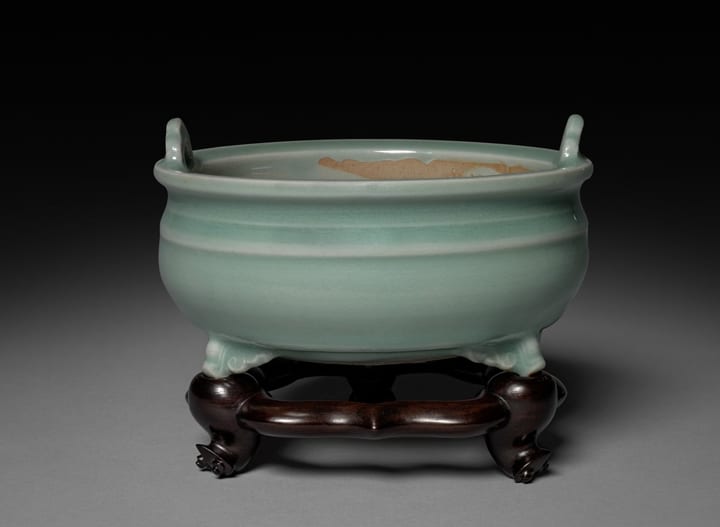
The illustrated Longquan burner is catalogued by the Cleveland Museum of Art to the thirteenth or fourteenth century. The body is low and rounded, with a broad opening and two upright handles. Horizontal bands wrap the body. The photograph presents the vessel on a dark display stand.
A Song Longquan burner in the Palace Museum offers a straighter profile. It has four raised horizontal bands and a broad rim above nearly vertical sides. Three cloud-shaped feet and a circular foot reach the same level. A view from underneath explains how the feet are organized.
Potters worked from different bronze shapes
The Freer Gallery’s thirteenth-century Longquan censer takes its cue from a bronze li. A raised fin stands above each of its three legs. The museum identifies Chinese scholars as one market for this type and records that many examples went to Japan.
The Palace Museum links its fish-handled burner, catalogued as Song Ge ware, to a different bronze vessel, the gui. The sides curve inward near the opening and swell lower down. Two fish-shaped handles sit across from each other above a continuous ring foot. The pale gray-green glaze carries a web of crackle.
A miniature censer preserves a separate cover
The National Palace Museum dates its miniature Longquan burner to the fourteenth or fifteenth century. It stands just over four centimeters tall. Three spreading feet support a slightly rounded wall with two rows of attached chrysanthemum ornaments. The larger flowers sit above the smaller ones. The catalogue also lists a wooden lid with a jade top.
Read the vessel and the cover as separate parts when consulting a catalogue. Dimensions can describe one part or an entire assembly. A description of a surviving cover tells you what accompanies the burner today. A record of the cover in use would answer a different question.
Use records can tell a later chapter
Tokyo National Museum identifies a thirteenth-century Longquan incense burner with plovers as a vessel used at tea gatherings in Japan. That entry gives a specific context for incense across the life of a Chinese object. The place of manufacture and the place of its documented use appear separately.
The fish-handled Ge burner has a different later history. The Palace Museum records that the Qianlong emperor composed a poem for it and that a palace artisan engraved the poem on its underside. The area beneath the burner preserves both kiln marks and evidence of later court collecting.
Our Yaozhou ware guide follows a different regional tradition and its carved ornament. When comparing the incense vessels across the two guides, look first at the rim, handles and feet. Then read the records for the named ware and any specific evidence of use.
Images and credits
Incense Burner, Longquan ware, China, thirteenth to fourteenth century. Glazed porcelain. Cleveland Museum of Art, 1957.55. John L. Severance Fund. Shown on a display stand. CC0. Complete photograph, resized.