Striking strings rather than plucking them
A yangqin player brings a pair of beaters into contact with the strings. The Singapore National Youth Chinese Orchestra’s introduction emphasizes this hammered action. It also explains that several individual strings can be tuned together to one pitch, forming a set rather than one string representing one separate note.
Its description gives sets of four or five strings. Treat that as the form being introduced there: it is not a string-count rule for every museum instrument or modern model. When watching a player, follow the two beaters and the set of strings they address.
An older instrument makes the string sets concrete
Grainger Museum’s early-twentieth-century yangqin, 00.0109, has fourteen sets of three twisted-brass strings. Two wooden bridges support them, and the catalogue records forty-two pegs on each side. This supplies a specific historical contrast with the youth orchestra’s example.
The black-lacquered wooden instrument has a decorated lid and a small drawer holding a tuning key. Two bamboo hammers survive, one broken. These details link the instrument’s appearance with the implements kept alongside it, without making its decoration or string layout a universal design.
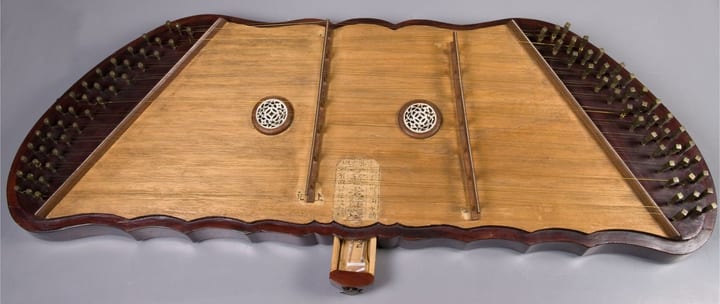
The photograph shows a nineteenth-century Guangzhou example
The pictured yangqin is The Met’s 89.4.18a, b, made by the Shop of Refined Tones in Guangzhou and dated to the nineteenth century. Its catalogue lists wood and brass. The full photograph shows the body, strings, bridges and tuning pegs.
This surviving object belongs to a particular place and period. It does not establish the bridge arrangement or pitch range of every present-day yangqin, and the photograph is not a demonstration of a named performance.
A larger modern instrument changes the working layout
Powerhouse’s 2004/41/2 was made by Beijing HsingHai Musical Instruments Corporation between 1970 and 1990. It has rows of small bridges and hinged side flaps covering the tuning hardware. The collection describes a collapsible stand, beaters, tuning key and travelling case.
The museum relates this larger form to designs developed for ensemble and orchestral work after the 1950s. Comparing these named examples makes the need for instrument-specific study clear: dimensions, string layout and adjustment points are practical features, not merely changes in decoration.
Why yangqin appears in a plucked-string section
Hong Kong Chinese Orchestra uses plucked-string instruments as a broad section name. Its own explanation separates finger- or plectrum-plucked instruments from strings struck with bamboo sticks. Yangqin sits within that shared section alongside pipa, ruan, sanxian and zheng.
The section label therefore describes an orchestral grouping rather than one identical hand action. The related pipa and ruan guides explain fretted lutes; the guqin–guzheng comparison concerns different plucked zithers. Identifying the initial gesture is a useful starting point when comparing them with yangqin.
Learning joins hand control, reading and listening
The Hong Kong Music Office syllabus revised in February 2021 starts with instrument structure and care, sitting posture, holding the beaters, rhythm and score reading. Later stages introduce ornaments, rolling notes, two-part playing and basic tuning.
The progression connects the two hands with musical understanding. A repeated-note exercise, a melody with ornaments and a two-part passage ask different things of the performer. This is evidence of that dated teaching programme, rather than a promise that every course follows identical levels or that a short written guide replaces instruction.
Sichuan yangqin names a narrative tradition
The national heritage register lists Sichuan yangqin, also called Sichuan qinshu, as a quyi storytelling-and-singing genre. Its name comes from using yangqin as a principal accompanying instrument. The 2008 entry concerns that regional performance tradition.
The record describes performers taking character roles while speaking, singing and supplying instrumental accompaniment. An instrument guide and a genre listing answer different questions: recognizing the dulcimer does not explain the complete storytelling practice, and that listing should not be transferred to every yangqin concert.
A dated concert gives a focused listening example
For Virtuosic Plucked Strings on 27 February 2026, Singapore Chinese Orchestra credited Qu Jianqing on yangqin. Its programme presents Xiang Zuhua’s Summer·Lotus and relates it to Lotus Emerging from Water from Guangdong Hanyue, with a characteristic rhythmic treatment.
The note supplies a starting point for listening to a specific work: attend to how the melodic line is embellished and shaped, rather than hearing every rapid stroke as an isolated effect. The composer, performer and source tune identify this example; they do not define the whole yangqin repertoire.
Images and credits
Yangqin, Shop of Refined Tones, Guangzhou, nineteenth century; wood and brass. The Met, 89.4.18a, b, The Crosby Brown Collection of Musical Instruments, 1889. CC0/public domain. Complete museum photograph, uncropped and resized for display.