A fretless neck can still have a fingerboard
Yale’s sanxian, accession 4405.1985, is described as a three-stringed, fretless, long-necked lute with a wooden fingerboard. Fretless means that raised frets do not divide the playing surface into positions. It does not mean that the instrument lacks a fingerboard beneath the strings.
This is a useful contrast with the fretted pipa and ruan in the related guides. Look at the neck as well as the body outline: similar-looking long-necked instruments can ask the left hand to work with different physical references.
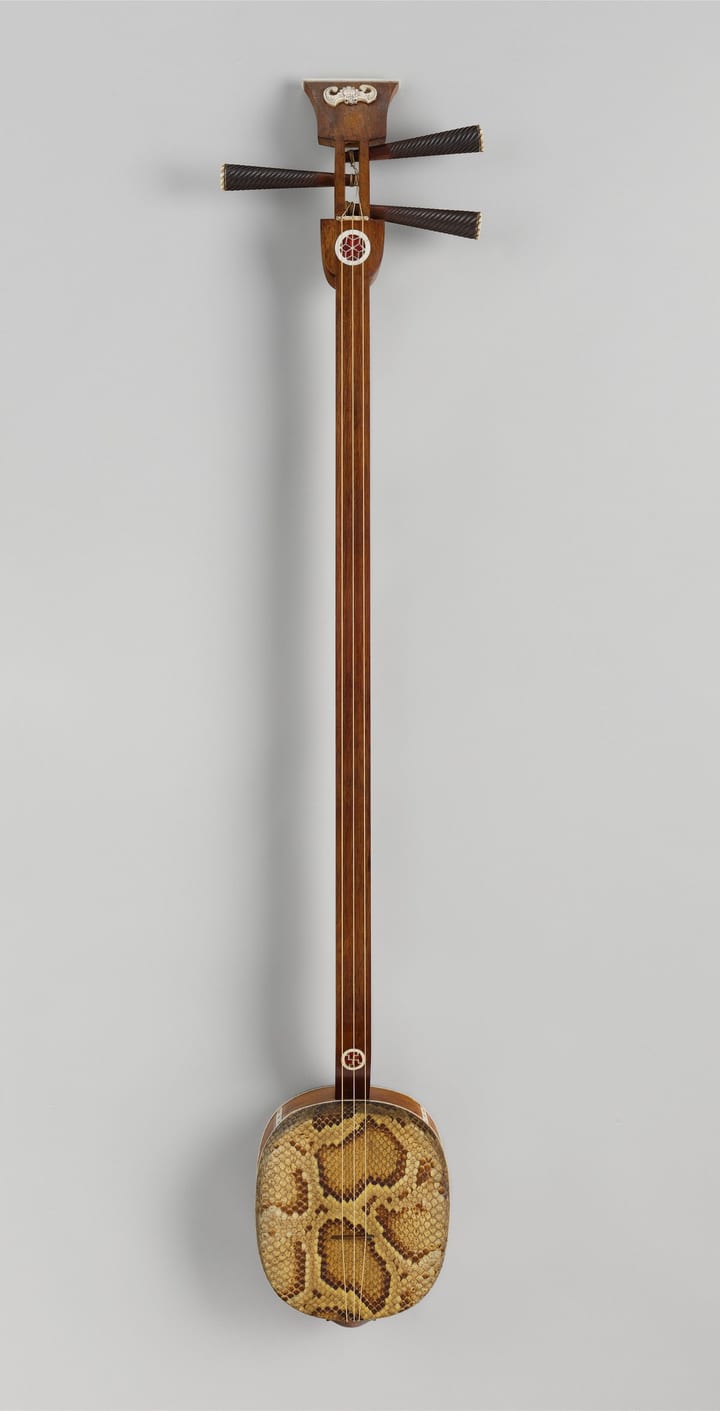
The photograph records one historical sanxian
The pictured Chinese instrument is The Met’s 89.4.38, dated to the nineteenth century. The collection lists its materials broadly as wood and various other materials and gives an overall length of 123 centimetres. The whole photograph preserves the three pegs, long neck and small resonator.
Its decorative details belong to this surviving object. The image documents its appearance, without establishing a particular performer, regional repertoire or modern standard tuning for it.
Large and small forms serve different settings
Singapore National Youth Chinese Orchestra’s introduction distinguishes a large sanxian associated with northern narrative singing and a small form used in Suzhou pingtan and sizhu ensembles. It identifies the large form as the one usually used in a Chinese orchestra.
The same introduction connects the fretless long neck with expressive glissando, a slide between pitches. Size, reach and the musical setting therefore matter alongside the three-string name. Identify the actual instrument before comparing recordings or treating one model’s dimensions as compulsory.
Suzhou tanci joins the lute to the storyteller
China’s national heritage record describes Suzhou tanci as a singing-and-storytelling form using Suzhou dialect. In a customary two-person arrangement, the upper performer handles sanxian and the lower performer pipa; both play and sing. The account also identifies solo and three-person forms.
This places the small sanxian within a complete narrative practice. Listen for the relationship between the words, the sung passage and the instrumental continuation. The heritage entry concerns regional performance genres, rather than listing every sanxian or modern concert under one blanket designation.
Nanyin places sanxian within a different musical group
The official Nanyin record describes a Quanzhou performance arrangement with pipa and sanxian on one side, dongxiao flute and erxian on the other, and the singer holding clappers in the centre. Sanxian belongs to an interlocking instrumental and vocal setting here.
The record connects this music with Minnan communities and Quanzhou-language singing. The related Nanyin guide explains that wider tradition. Sharing an instrument name does not make this setting interchangeable with Suzhou tanci: language, repertory and the relationships between performers give each its own context.
Learning develops both positions and musical phrasing
Hong Kong Music Office’s sanxian syllabus, revised in February 2021, begins with structure, care, posture, basic hand techniques, rhythm and numbered notation. It then develops changes between positions, vibrato, rolling techniques, harmonics and slides.
Later stages work with regional styles including Guangdong music, Jiangnan sizhu, Henan music and northern narrative genres. The progression links physical control with style and repertoire. These are stages in that dated teaching programme, not current course enrolment instructions or one universal timetable for learning.
An orchestral family contains different sound-producing actions
Hong Kong Chinese Orchestra groups sanxian with pipa, ruan, zheng and yangqin in its plucked-string section. Its explanation separates strings plucked by fingers or a plectrum from strings struck with bamboo sticks. A section name can therefore gather instruments whose hand actions differ.
For sanxian, begin by following the plucked line. Then notice whether it answers another part, reinforces an ensemble passage or comes forward. The actual instrument credit explains more than the broad phrase Chinese strings, especially when a concert combines several members of the section.
A concert can move between narrative and solo roles
For As the Strong Winds Blow on 10–11 February 2023, Hong Kong Chinese Orchestra credited Zhao Taisheng on sanxian. Its programme included Wu Hua’s Strings and Drum in Harmony and Ng Cheuk-yin’s Over the Mountains, listed as a commissioned world premiere.
The same programme named works for sanxian, narrative singing and orchestra. These different combinations show what one concert asked the instrument to do. A concerto part and a singer-accompanied passage create different listening relationships, while the instrument remains recognizably a three-stringed lute.
Images and credits
Sanxian, China, nineteenth century; wood and various materials, as catalogued. The Met, 89.4.38, The Crosby Brown Collection of Musical Instruments, 1889. CC0/public domain. Complete museum photograph, uncropped and resized for display.