Chinese wucai porcelain: why five is not a color limit
The Palace Museum explains wucai as multicolor and distinguishes overglaze wucai from blue-and-white wucai. Its definition describes a decorating category, rather than a rule requiring the same five colors on every vessel.
The Asian Art Museum makes the point especially clearly in its account of a Jiajing-period lotus-pond jar: that wucai example includes seven color tones. Look at the relationships between hues and the space they occupy. Counting only broad color names can conceal differences among green passages, warm tones, outlines, and the white ground.
Two routes through the decorated surface
In the Palace Museum's account, one route adds enamel painting to fired white porcelain; another begins with a partly painted underglaze-blue design and completes the composition with colors above the glaze. These routes explain why blue-and-white wucai is a useful, more specific description.
For an object combining both, the blue painting must be planned before its covering glaze, while the later enamel painting works on the fired glazed surface. An overglaze-only description does not justify inventing an underglaze-blue stage simply because a photograph contains a blue-looking detail.
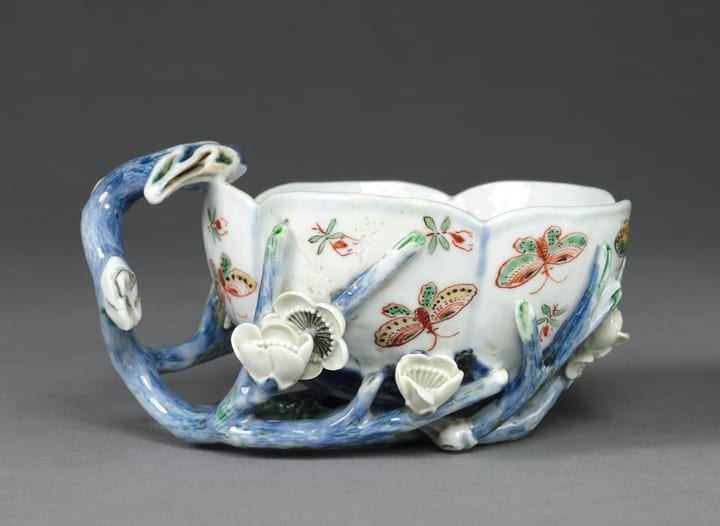
A plum-blossom cup records both layers explicitly
Cleveland Museum of Art's Plum Blossom Cup, 1989.295, is dated 1621–1627, the Tianqi reign, and attributed to the Jingdezhen kilns. Its medium explicitly combines underglaze blue with wucai overglaze enamel decoration. This is firm evidence for discussing two decorating layers on that particular object.
Use the cup to connect a technical description with scale and form. Follow the decoration around the wall, notice where motifs approach the rim, and compare the colored passages with the remaining white surface. Those observations ask how a composition fits its vessel, without claiming that appearance alone can identify the technique on an unrecorded cup.
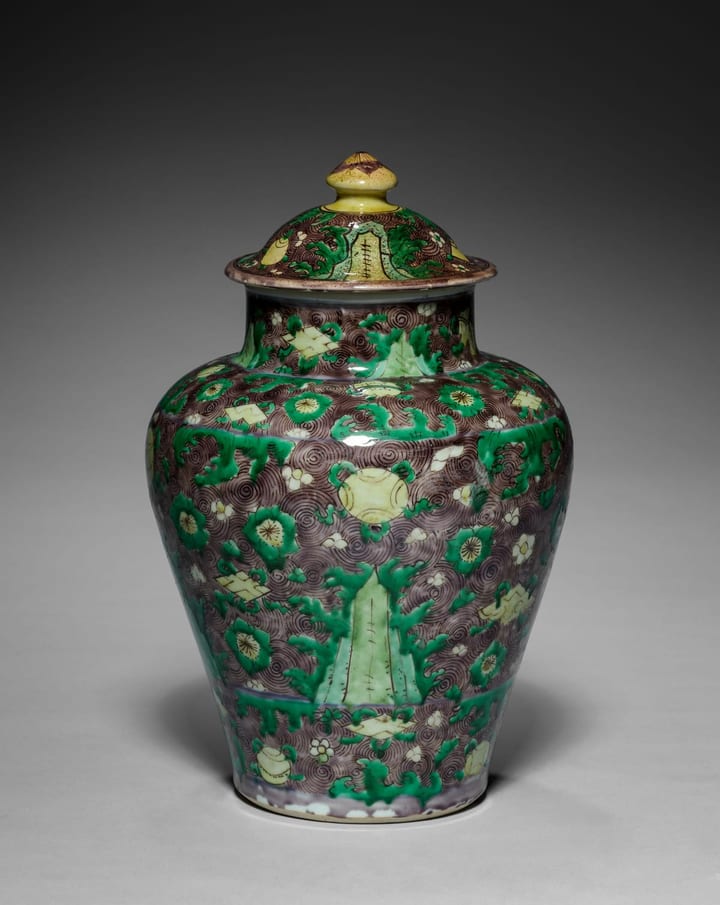
A covered jar asks different questions about color and form
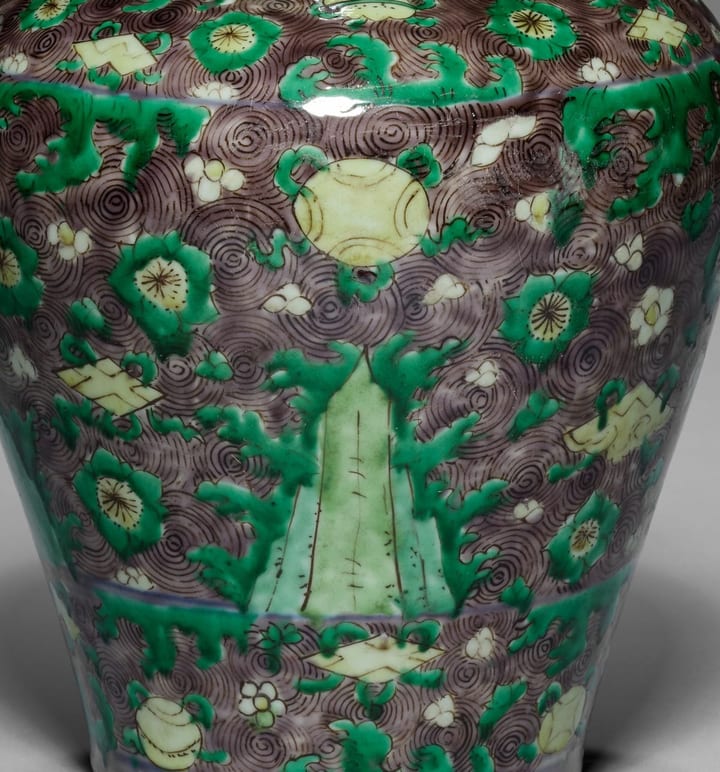
Cleveland's Baluster Jar and Cover, 2020.179, is catalogued as porcelain with wucai enamels, dated 1600–1650. The record preserves a Ming-or-Qing attribution. Its material field does not specify underglaze cobalt, so that detail should not be added to its description.
The museum identifies a mountain rising from the sea and interprets the central motif through Buddhist and Daoist cosmology. Its account also notes the surviving original cover. Look at how decoration continues between body and lid, and how a broad shoulder changes the space available for a motif. Keep the museum's symbolic interpretation attached to this jar.
A lotus-pond jar explains the sequence at a larger scale
The Asian Art Museum's Lidded Jar with Design of a Lotus Pond, B60P78+, is attributed to Jingdezhen and the Jiajing reign, 1522–1566. Its account describes cobalt painting beneath a clear glaze and additional enamels applied above it for subsequent lower-temperature firing.
The same museum identifies a seam where two parts of the large body were joined. This makes a useful connection between forming and decorating: the painted pond occupies a vessel built through its own demanding stages. Its finished surface should be read alongside its construction, rather than treated as a flat colored illustration.
Compare wucai with doucai and famille rose carefully
Doucai also joins blue below the glaze with colors above it. The Met's documented doucai dish provides a more particular example of enamel filling within blue outlines. Consequently, blue plus several colors is not enough to distinguish these categories; the object's terminology and described method matter.
Our doucai guide follows that outline-and-fill relationship. The blue-and-white guide isolates the underglaze-cobalt method, while the famille rose guide considers its named enamel palette and tonal painting. Continue to Jingdezhen porcelain for the broader craft setting. Comparing the questions those terms answer is more useful than arranging them as grades of quality.
Museum photographs and credits
Jingdezhen baluster jar and cover, 1600–1650, catalogued as porcelain with wucai enamels. Cleveland Museum of Art, 2020.179; CC0.
Jingdezhen plum blossom cup, Tianqi reign, 1621–27, catalogued with underglaze blue and wucai overglaze enamels. Cleveland Museum of Art, 1989.295; CC0.
Detail crop from the same 1600–1650 wucai jar photograph, showing its mountain and wave decoration. Cleveland Museum of Art, 2020.179; CC0. This is the same object as the main image.