Chinese blue-and-white porcelain: follow the layers
The V&A describes cobalt-blue pigment on a white body, usually brushed beneath the glaze. The Met likewise explains Chinese blue-and-white as cobalt decoration under a transparent glaze. The defining relationship is between body, painted image, and covering glaze, rather than simply the presence of two colors.
This makes underglaze a useful catalogue word. It identifies where the decoration sits. A photograph may suggest the appearance, but a museum's material record provides firmer evidence for construction than the color scheme alone.
Read lines, washes, and reserved white
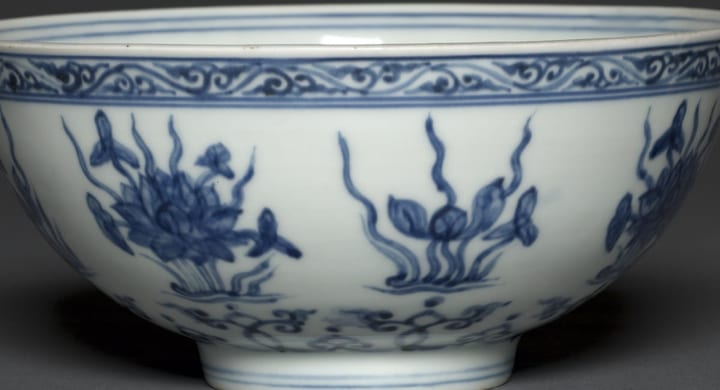
A restricted palette still permits different visual decisions. The V&A points to contrasts between dark and light blue, fine outlining, and areas left white against a painted blue background. Look for these differences before treating the design as a single flat blue pattern.
Choose one small passage, then return to the whole vessel. Does a darker line define an edge? Does a lighter area suggest volume? Does the white ground separate dense ornament? These questions help connect brushwork with composition without turning a visual impression into a dating test.
A Ming bowl shows pattern around a usable form
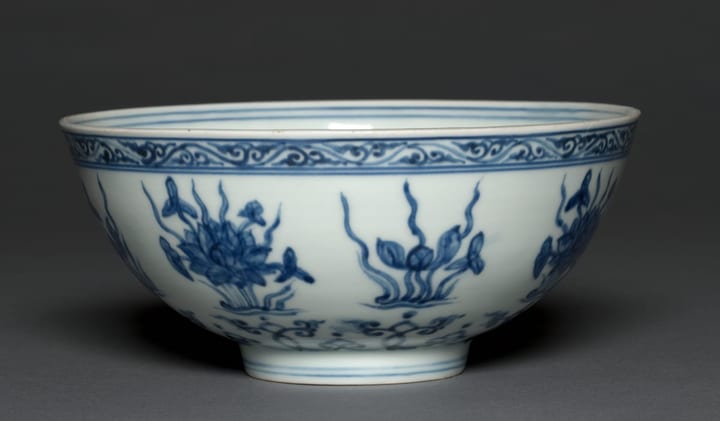
Cleveland Museum of Art's Bowl with Water Plants and Arabesques, 1957.359, is catalogued to the Jingdezhen kilns and the Zhengde mark and reign, 1506–1521. Its curved wall gives the painted pattern a different setting from a flat picture.
The museum connects its arabesque vocabulary with Middle Eastern ornamental ideas. Keep that interpretation attached to the documented object. When studying the bowl, consider how a border, a scrolling line, and the central or surrounding space organize the surface; decoration and vessel shape are working together.
A Qing jar separates porcelain from its accessories
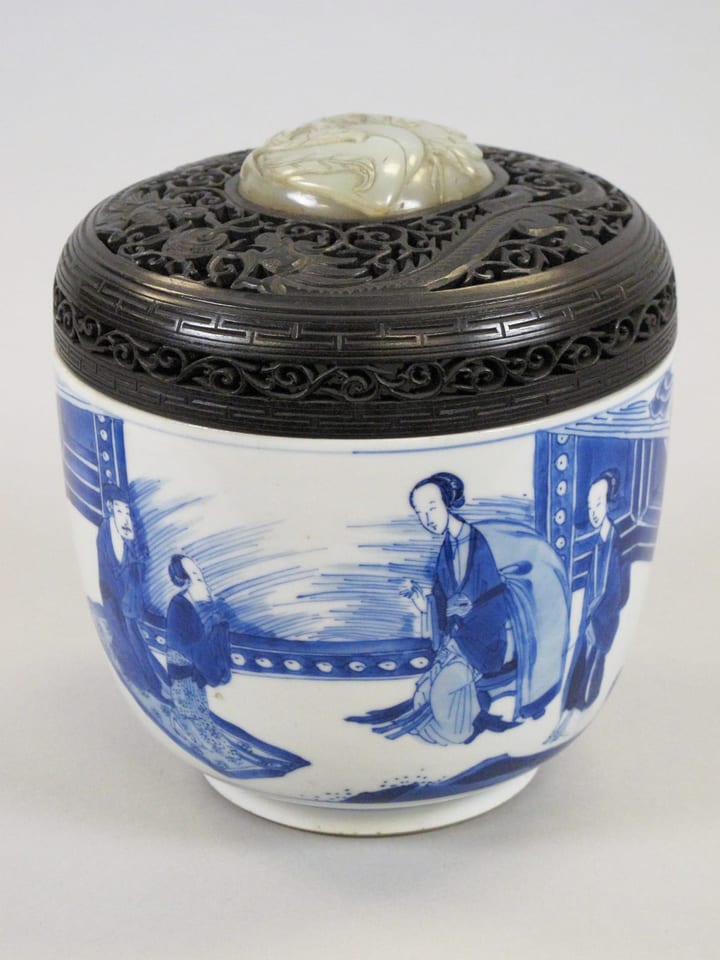
The Met's Jar with Theatrical Scene, 29.149.22a, b, is dated 1668–1722 and identified as Jingdezhen porcelain painted in underglaze cobalt blue. Its catalogue also records a wooden lid with a jade knob. The whole assembled object therefore contains more than one material.
That detail is useful when reading museum photographs. A lid or fitting should not automatically be described as porcelain, and its visible appearance should not be used to guess the ceramic body's date. Read the material description for each part before comparing objects.
How it differs from famille rose enamelling
Underglaze blue is placed beneath the glaze. Overglaze color is added above a previously glazed and fired surface, then fixed at a lower temperature than the original glaze firing, as the Fitzwilliam Museum's terminology explains.
Our famille rose guide follows that other decorating sequence and its expanded palette. The comparison concerns the position and working of color, not a ranking of one method above the other. A blue detail in an enamel-painted vessel also needs its own material description; blue color alone does not prove an underglaze layer.
Jingdezhen matters, but the colors do not prove origin
The Met's account of Chinese ceramics identifies Jingdezhen as a major center in the development of blue-and-white porcelain. The V&A also documents production elsewhere in China and responses to Chinese blue-and-white in other countries. Place remains an attribution to verify, rather than something to read directly from the blue-and-white palette.
Use our Jingdezhen guide for the broader craft setting and the Longquan-versus-Jingdezhen comparison for a different relationship between body, glaze, and appearance. These connections help keep this decorating method within a larger ceramic landscape.
Museum photographs and credits
Jingdezhen bowl with water plants and arabesques, Zhengde mark and reign, 1506–21. Cleveland Museum of Art, 1957.359; CC0.
Jingdezhen jar with a theatrical scene, 1668–1722, painted in underglaze cobalt blue; its lid is wood with a jade knob. The Met, 29.149.22a, b; public domain/CC0.
Detail crop from the same 1506–21 bowl photograph, focusing on the blue-painted decoration. Cleveland Museum of Art, 1957.359; CC0. This is the same object as the main image.