Chinese famille rose porcelain: a palette, not a single pink pattern
Cleveland Museum of Art explains the famille rose palette through the arrival of pinks and the use of opaque white to vary the tonal values of colors. This made possible a painterly range of effects beyond a simple outline filled with one unchanging shade.
The museum's Chinese titles for the floral bowl and peach vases use fencai, 粉彩. Keep the collection's terminology with its material description. A pink blossom in a photograph is a subject and a color; the catalogue tells you more about the actual decorating technique.
Overglaze color comes after the fired glazed surface
The Fitzwilliam Museum defines overglaze material as applied to an already glazed and fired surface, followed by firing at a lower temperature than the original glaze. This sequence is central to understanding enamel-painted porcelain: the decorative layer is above the earlier glaze.
Preparing the body and painting its enamel surface involve different decisions. The vessel's form sets the available space; the later painted composition must work around that shape, its rim, and its base.
Look at tonal transitions and the white ground
Choose a petal or a piece of fruit and follow a passage from light to dark. Then look at the whole vessel: where does its white ground remain visible, and where do stems, leaves, and flowers overlap? Such questions help explain how painted color organizes a curved surface.
The palette's opaque white is a material feature described by the museum, not merely an effect of bright lighting in a photograph. Observation and documentation work together. A soft-looking color should not by itself establish the object's date, authenticity, or full pigment composition.
A Yongzheng bowl brings painting and writing together
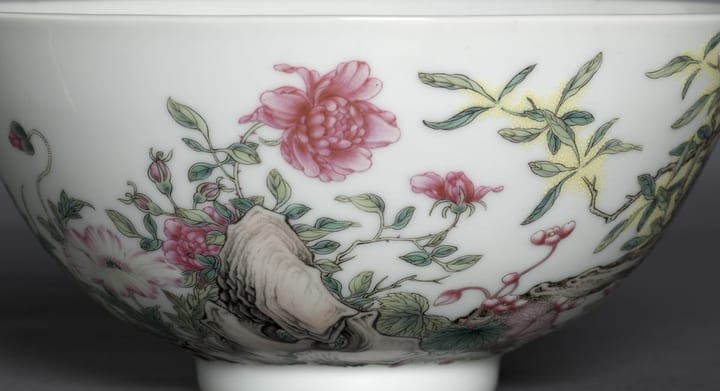
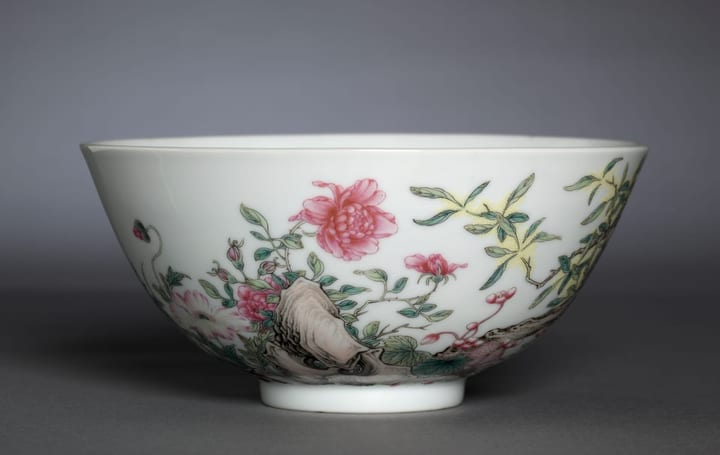
Cleveland's Bowl with Poppies, Tree Peony, and Flowering Mimosa, 1964.201, is catalogued to Jingdezhen and the Yongzheng mark and reign, 1723–1735. Its medium is recorded as overglaze enamel decoration, and the accompanying museum explanation explicitly names the famille rose palette. The floral image is accompanied by a poem.
This gives a more useful description than calling it a pretty pink bowl. The object combines a usable vessel shape, a planned floral composition, and writing. Examine how those elements share the available surface, while keeping the museum's identification of the plants and text distinct from your own first impression.
Peach vases provide an object-specific symbolic reading
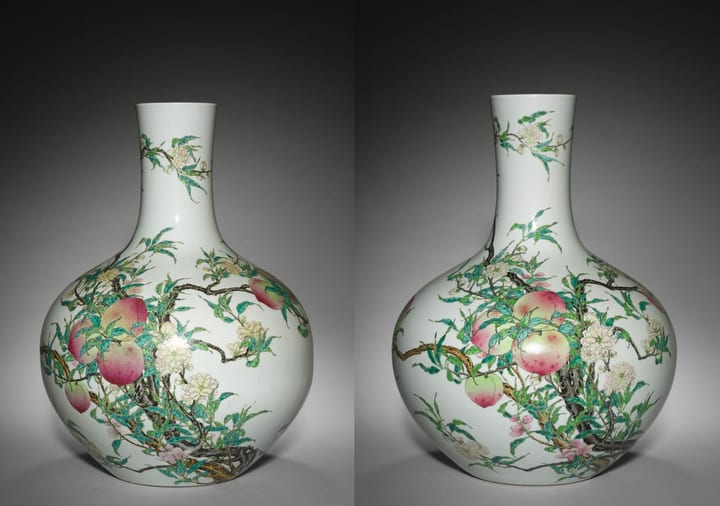
The same museum's Pair of Vases, 1944.184, is dated to the Qianlong mark and period, 1736–1795, and attributed to Jingdezhen. Its medium explicitly identifies famille rose overglaze enamel decoration. The catalogue relates the flowering and fruiting peach trees to wishes for affluence and long life.
Treat that as the museum's reading of this design. It does not mean every vessel with a peach has the same intended occasion or recipient. A pair also raises questions about the relationship between objects: repeated shapes and related designs can be considered together without confusing two vessels with two views of one.
Compare decorating layers before comparing color schemes
The Met describes Chinese blue-and-white porcelain as cobalt painting beneath a transparent glaze. That differs from the enamel layer above fired glaze considered here. Our blue-and-white guide follows that other sequence and its use of lines, washes, and reserved white.
A palette comparison should not become a quality ranking. Nor should a blue detail in an enamel-decorated object automatically be called underglaze cobalt. Read the medium for the particular vessel and identify each decorating stage when the record supplies it.
Keep the object record beside the image
Useful museum descriptions separate place, date, medium, dimensions, and interpretation. Those fields help distinguish a historical object from a later work using a related palette. They also show why a reign-mark statement in a catalogue is different from guessing a date from color alone.
For the wider material setting, continue to our Jingdezhen porcelain guide and the Longquan-versus-Jingdezhen comparison. These pages distinguish the porcelain body, the covering glaze, and its decoration, helping readers see famille rose as a particular way of working a ceramic surface.
Museum photographs and credits
Jingdezhen bowl with poppies, tree peony and flowering mimosa, Yongzheng mark and reign, 1723–35. Cleveland Museum of Art, 1964.201; CC0.
Museum collection image of a pair of Jingdezhen vases with famille rose overglaze enamels, Qianlong mark and period, 1736–95. Cleveland Museum of Art, 1944.184; CC0.
Detail crop from the same 1723–35 bowl photograph, showing the floral enamel decoration. Cleveland Museum of Art, 1964.201; CC0. This is the same object as the main image.