Chinese susancai porcelain: begin with the prepared body
The Palace Museum describes low-temperature coloured glazes on fired, unglazed porcelain with incised designs. Its account locates development at Jingdezhen in the Ming Chenghua period, followed by further development under Kangxi. The porcelain body belongs to this particular decorating history.
The museum emphasises yellow, green and purple, with black and white also present, and connects su with the omission of red. Read that account beside the particular catalogue rather than identifying any ceramic that happens to display three colours.
A Kangxi dish puts two designs on the same surface
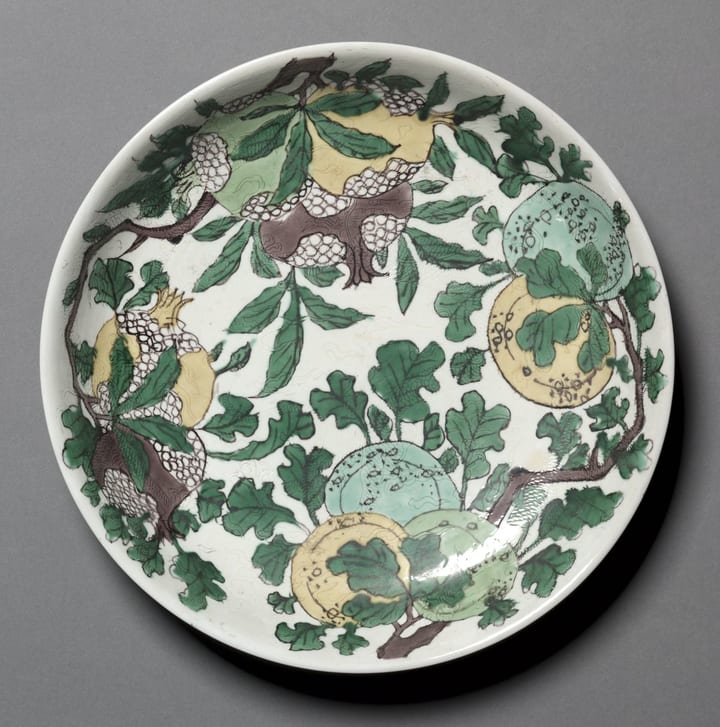
Cleveland Museum of Art’s Dish with Dragons, Pomegranates, and Peaches, 1930.313, is attributed to Jingdezhen and catalogued as Kangxi mark and period, 1662–1722. Its medium explicitly combines incised and enamel decoration, susancai ware. The museum describes dragons cut into the body beneath painted fruit and flower sprays.
Black outlines define the painted design, with yellow, green, turquoise and purplish-brown enamels. Ivory enamel fills the ground over unglazed clay. The incised dragons and painted branches therefore ask for different kinds of attention: one image depends on shallow lines, while another depends on colour and graphic outlines.
Small dishes organise colour differently
The National Museum of History’s Kangxi dried-fruit dish, 08440, supplies another arrangement. Its hexagonal form has black geometric and plum-blossom outlines, a green ground in selected areas and yellow on the wall. The smaller, angular vessel organises the colour differently from Cleveland’s broad circular dish.
Compare the open interior with the sloping wall and turned rim. A change in the vessel’s geometry changes the fields available to the decorator, even within the same named category.
A painted jar makes the outlines especially clear
Cleveland’s Jar with Flowers, Rocks and Pheasants, 2003.258, is dated 1662–1722 and catalogued as Kangxi mark and reign. Its description identifies light green, purple and yellow without red. A pair of pheasants face one another among flowering plants.
The museum notes fine dark outlines defining the motifs and describing small details, including weathered leaves and rock textures. Compare the weight of these lines with the larger coloured areas. On a tall vessel, the painter must also relate the main scene to the shoulder, neck and lower border.
An interior and exterior can receive different treatments
The Palace Museum’s three-footed basin with toad decoration, 故00145705, records a Zhengde reign mark. Its interior has a pale glaze, while the outside carries incised toads among water. The tripod form and its decorated surfaces expand the discussion beyond flat dishes.
This example encourages reading an object area by area. Interior, rim, exterior and base can have different treatments. A term describing the principal decoration need not mean that every visible surface was prepared in an identical way.
Follow the sequence without confusing neighbouring categories
The National Museum of History describes incising the planned design, firing the dried porcelain body without glaze, applying the ground colour and clearing selected areas before filling them with other colours. Another firing fixes the lower-temperature colour treatment. This detailed account connects the final pattern with decisions made before and after the body firing.
Our wucai guide follows other relationships between fired glaze and enamel painting. Fahua makes raised clay boundaries central, while the Tang sancai guide follows its own pottery body and flowing glazes. Jingdezhen supplies regional context. These connections clarify what each name explains, rather than turning overlapping colours into interchangeable categories.
Images and credits
Dish with Dragons, Pomegranates, and Peaches, Jingdezhen, China, 1662–1722, Kangxi mark and period. Porcelain with incised and enamel decoration, catalogued as susancai ware. The Cleveland Museum of Art, 1930.313, Charles W. Harkness Endowment Fund. CC0. Uncropped museum photograph, resized for display.