Chinese doucai porcelain: what the name helps explain
The Met translates doucai as joined colors when describing its dish with the God of Longevity. The useful idea is collaboration between decorating stages: an earlier blue structure and later enamel painting contribute to the finished image.
The name also needs historical care. The Met notes that the application now called doucai was not given that specific term in written documents of the period it discusses. Use the museum's terminology to understand an object, rather than assuming a modern category was always its original name.
Follow an outline through the making sequence
The Palace Museum describes drawing outlines with blue material on the porcelain body, covering the design with transparent glaze, and firing it before adding colors above the glaze. A subsequent lower-temperature firing fixes the enamel decoration.
This creates a practical planning problem. The decorator must consider the finished colored image while making the first blue drawing. A contour can help organize a leaf, a robe, or a floral motif before the later color is present. The blue stage is therefore part of the composition, rather than a separate blue-and-white picture decorated at random.
A Chenghua wine cup makes the sequence concrete
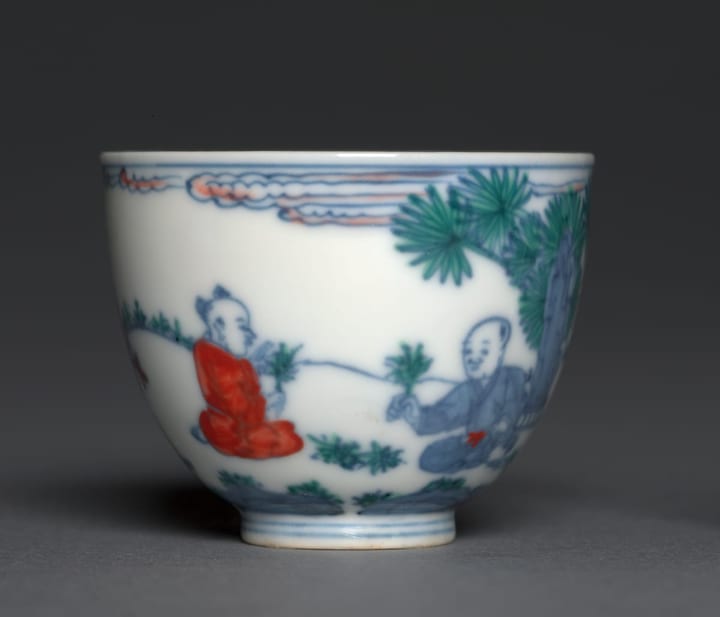
Cleveland Museum of Art's Wine Cup with Children at Play, 1957.61, is attributed to Jingdezhen and the Chenghua mark and period, 1465–1487. Its Chinese title identifies it as a doucai cup. At 4.8 centimeters high, it places a narrative subject on a small curved surface.
The museum explains its construction directly: cobalt outlines were glazed and fired, then completed with enamels above the glaze and fired again. Look at how the figures share the limited space and where unpainted white separates them. That is a way to study the relationship between drawing, color, and vessel form without treating small size as a definition of all doucai.
A Yongzheng dish shows revival through technique
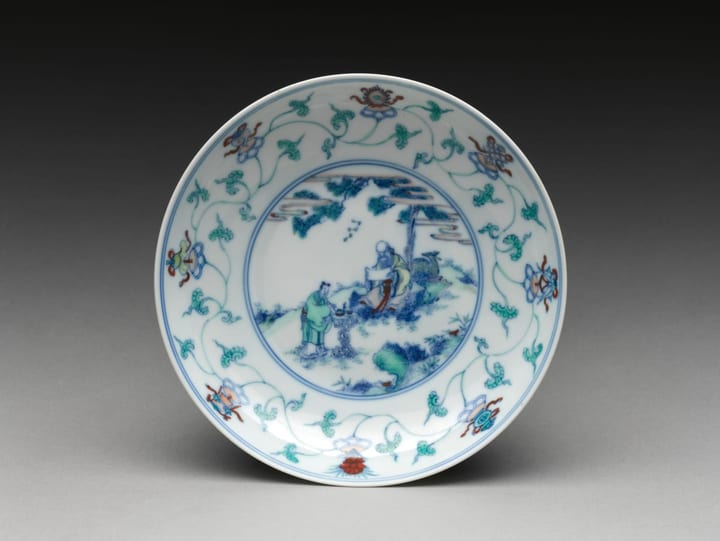
The Met's Dish with God of Longevity and an Attendant, 25.35.4, dates to the early eighteenth century, in the Yongzheng period. Its medium specifies Jingdezhen porcelain with underglaze cobalt blue and overglaze polychrome enamels.
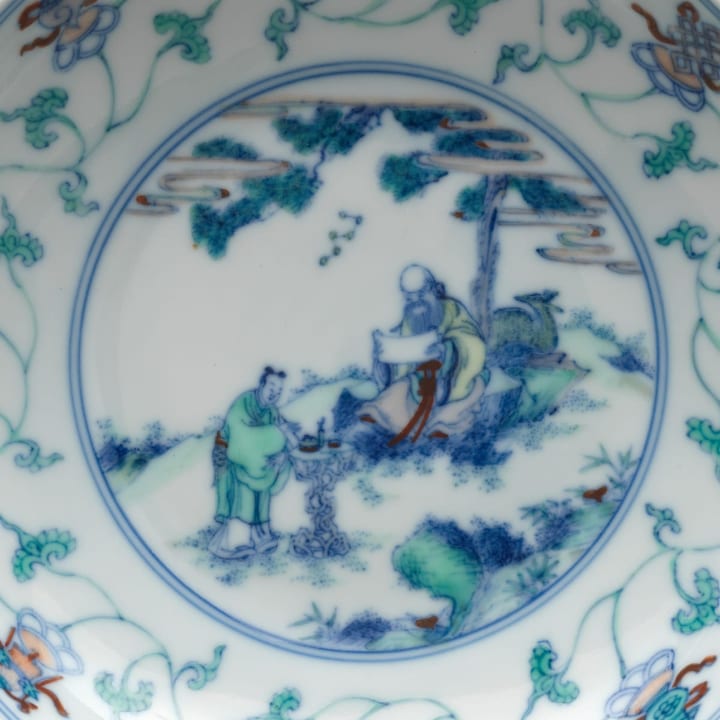
The museum explicitly describes enamel filling within blue outlines and interprets the revival of the earlier technique as continuity with admired past traditions. Compare the dish's broad interior with the wine cup's wall. The same question about joined painting stages can be explored across different shapes, subjects, and periods.
How to look closely at the joined design
Start with one motif rather than scanning the whole object for a color count. Follow its contour, then look at the colored area it contains. Notice whether a blue line remains visually prominent, how adjoining shapes are separated, and where the white porcelain is allowed to show.
Next step back to the whole vessel. Borders, central scenes, and exterior decoration may ask for different viewing distances. A photograph helps with composition; the catalogue supplies the technical identification. Neither a blue edge nor a colored flower by itself establishes the complete making method.
Place doucai beside other decorating terms
Our blue-and-white guide explains cobalt decoration beneath transparent glaze. Doucai adds a coordinated overglaze painting stage to that layered relationship. Our wucai guide considers a broader multicolor category that can also combine underglaze blue and overglaze colors, so the presence of both layers alone is not a sufficient label.
The famille rose guide approaches another question: the enamel palette and its tonal effects. Keep each term beside the particular object record. For the wider craft setting, continue to the Jingdezhen porcelain guide; these decorating names describe aspects of making within that larger ceramic practice.
Museum photographs and credits
Jingdezhen dish with Shoulao and an attendant, Yongzheng period, early 18th century. The Met identifies its decoration as doucai. The Met, 25.35.4; public domain/CC0.
Jingdezhen wine cup with children at play, Chenghua mark and period, 1465–87. Cleveland Museum of Art, 1957.61; CC0.
Detail crop from the same Yongzheng dish photograph, showing its central figures and colored decoration. The Met, 25.35.4; public domain/CC0. This is the same object as the main image.