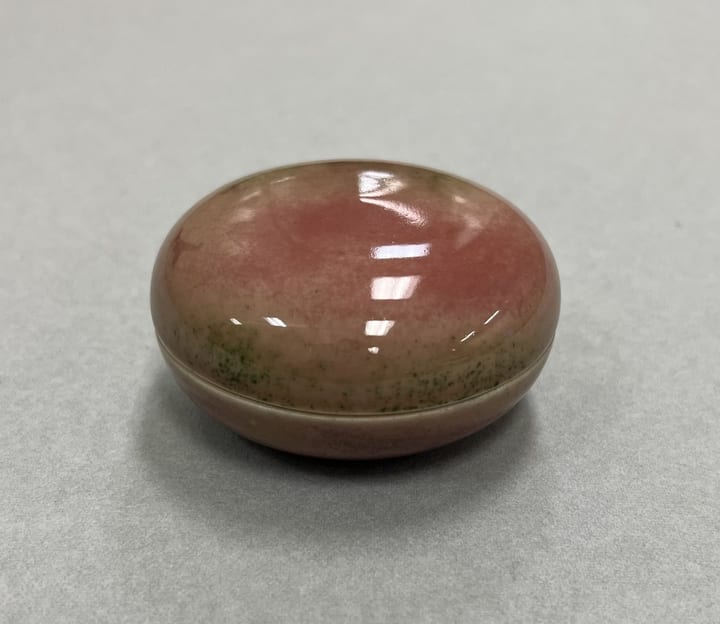
The pictured box is shown closed
The Met’s Seal-Paste Box, 29.100.358a, b, is catalogued with a Kangxi mark and period, 1662–1722. Its material is porcelain with peach-bloom glaze. The whole photograph shows the lid seated over the lower part.
Pink-red colour and green mottling organize the exterior. This view shows a covered object, not the paste or the condition of its interior. That distinction matters when comparing exterior decoration with evidence of use in an opened vessel.
Interior residue gives a different kind of evidence
The Walters’ Box for Seal Paste, 49.153, is dated to 1710–1722. Its description identifies a rounded covered porcelain container for vermilion paste and records red staining inside the otherwise white interior.
The museum relates small peach-bloom objects to imperial desk sets made at Jingdezhen late in the Kangxi reign. The stains are evidence recorded for this particular box. They give a different point of attention from the smooth exterior in the Met photograph: a surface can preserve use as well as decoration.
Cloisonné changes the material comparison
LACMA’s Yinnihe, M.75.18a-b, has a Qianlong mark and period, 1736–1795. Its catalogue identifies cast bronze with cloisonné enamel decoration and names lotus blossoms and floral scrolls in the title.
The object is 4.1 centimetres high and 9.5 centimetres in diameter. These are measurements of one paste box, not a standard size. Compare its recorded metal body and enamel decoration with a glazed porcelain example before grouping both simply as colourful ceramics.
An incomplete lid still records a container’s purpose
Tsinghua University Art Museum preserves a blue-and-white lid dated to the Qing Kangxi period. The record explicitly says its base is missing. The surviving piece is 1.3 centimetres high, with a mouth diameter of 8.2 centimetres.
On white glaze, blue painting shows an older man and a child seated on rocks, enjoying a winter garden. The museum identifies the former container’s purpose as storing seal paste. A surviving cover can therefore preserve both the function assigned by the catalogue and a decorative scene, even when the complete box is no longer present.
Unglazed carved porcelain offers another surface
The National Museum of History’s Qing paste box, 07807, is an unglazed, flattened round vessel on a ring foot. Its catalogue describes relief dragons and clouds, movable porcelain rings at the dragons’ eyes, and movable tongues.
The account explains that this kind of decoration generally begins with moulded forms and patterns followed by finishing. It also notes porcelain’s resistance to oil penetration as a reason for its use in paste containers. These observations belong to the museum’s ceramic account; they are not instructions for preparing the paste.
The scale could follow a different working setting
In its account of Qing palace desk equipment, the Palace Museum describes small, refined paste boxes in varied materials. It contrasts them with broad, flat, round tin boxes used with larger seals for government business.
The distinction makes size and use meaningful companions to material and ornament. A small writing-desk vessel and a large official-seal container answer different practical settings, even though both hold colouring material for stamping.
Keep the vessel distinct from neighbouring desk tools
The related water-dropper guide follows controlled water delivery; the seal-impression guide follows lettering cut into a matrix. This page instead compares containers, covers and catalogued contents. Following the part’s actual job gives a clearer comparison than treating every small round desk object as interchangeable.
Images and credits
Seal-Paste Box, China, Kangxi mark and period, 1662–1722; porcelain with peach-bloom glaze. The Met, 29.100.358a, b; H. O. Havemeyer Collection, Bequest of Mrs. H. O. Havemeyer, 1929. CC0. Complete photograph, uncropped and resized; shown closed.