A washing vessel serves a different task from a dropper
The Palace Museum’s account starts with the brush after writing: the remaining ink is washed from its hairs so it can be used again.
The related water-dropper guide follows controlled water delivery to an inkstone. Here the emphasis is an accessible water vessel around the brush. The distinction explains the different forms without requiring every historically named washer to have only one use.
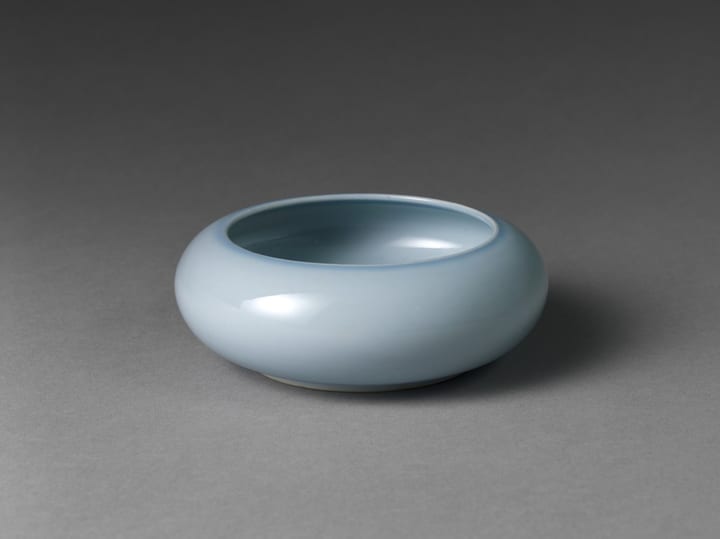
The photograph shows a pale-glazed Qing vessel
The Met’s Brush Washer 64.279.2 is dated to about 1700–1722, with a Kangxi mark and period attribution. Its porcelain body has clair de lune glazes. The catalogue gives a diameter of 11.7 centimetres and a height of 4 centimetres.
The complete photograph shows a broad opening within rounded shoulders and a low, smooth profile. Compare the rim with the visible inner surface. These features belong to this particular surviving vessel; they do not establish the original water level or how an individual writer handled a brush.
A lotus can combine sculpted form with painted detail
Henan Museum’s blue-and-white lotus washer is identified as Ming Jingdezhen porcelain bearing a Wanli mark. The museum describes hand modeling and painting, with petals forming the body and Sanskrit characters among the decoration.
The vessel is 5.5 centimetres high and has a 19-centimetre opening. Its shaped petals and painted surfaces offer two kinds of detail to follow: the outline of the container and the imagery placed over it. The lotus interpretation is an account of this documented form, rather than a fixed meaning for every flower-shaped vessel.
A jade washer can imitate a ceramic form
The Palace Museum’s jade washer 故00103441 belongs to the middle Qing period. It has four short feet, black markings in its green material, and decoration combining clouds, bats and a rounded longevity character. A wooden support accompanies it.
The museum explicitly reads this jade object as an imitation of a ceramic washer, serving the writing desk rather than bodily washing. That identification depends on this catalogue and object. It does not make every old vessel called a xi the same size, material or implement.
An oil-spotted glaze records another ceramic approach
Asia Society’s washer 1979.144 is northern Chinese stoneware dated to the late eleventh or early twelfth century. Its account places the vessel at a kiln producing Cizhou and northern black wares.
The museum explains the oil-spotted effect through iron in the glaze rising to its surface during firing. This gives a specific material explanation for its appearance. It is a different glaze and historical setting from the pale Qing porcelain in the photograph. A catalogue’s firing explanation is useful evidence, but it is not a complete workshop formula or a reason to combine the two glazes into one recipe.
A copper-alloy vessel broadens the recorded uses
The Met’s fourteenth-century washer 2014.767 is copper alloy, with two sinuous dragons along the rim. Its description says the vessel held water for dampening brushes or diluting ink during writing and painting.
This is a useful reminder to read the particular account beside the general object name. Rinsing, supplying moisture and adjusting ink are related activities around the brush, but a catalogue can emphasize different actions. The rim decoration also shows how a working vessel could invite close attention without losing its water-holding purpose.
Images and credits
Brush Washer, China, about 1700–1722; porcelain with clair de lune glazes. The Met, 64.279.2; Gift of Edwin C. Vogel, 1964. CC0. Complete museum photograph, uncropped and resized.