What the name sweet white describes
The Palace Museum defines tianbai as a white glaze developed at the Jingdezhen imperial kilns during the Yongle reign. The sweetness is a sensory comparison, not a claim about an ingredient. It names a valued visual quality within the longer history of Chinese white ceramics.
The name also has a history distinct from the objects. The Met’s Defining Yongle exhibition traces the term to a sixteenth-century author, while the Hong Kong Palace Museum describes late-Ming writers using it for the admired surface. A later descriptive name can therefore refer to earlier porcelain.
A white body and a glaze work together
The British Museum explains the technological change through the relationship between body materials, glaze and firing. Its guide describes more kaolin in the clay and less limestone in the glaze than in earlier white wares, enabling higher-temperature firing. Whiteness was a coordinated material result rather than simply a painted white layer.
The Kimbell Art Museum describes especially fine examples with a pure white body and a clear, glossy glaze. It also notes very thin walls. These are useful observations about the admired wares; a photograph cannot establish a vessel’s wall thickness or the composition of its glaze.
Anhua: decoration that does not announce itself
At the Kimbell, an early-fifteenth-century Bowl with Secret Decoration, APx 1971.20, makes the idea concrete. Its interior combines radiating petals and a wave border in molded slip; an incised floral vine and key-fret border decorate the exterior. The record distinguishes those operations even though the finished surface is monochrome.
The Met’s Yongle exhibition offers another arrangement: an Asia Society flask, accession 1979.156, with a lightly incised six-pointed medallion beneath the glaze. Follow a motif across the vessel rather than expecting the immediate contrast of cobalt blue. Anhua describes the discreet design, while tianbai describes the white-glaze category.
Court taste and specific ceremonial meanings
The Smithsonian’s National Museum of Asian Art dates stem bowl F1998.7 to 1403–1424 and locates its production at Jingdezhen. Its description records incised dragons inside the bowl and a Yongle seal-script mark. The label connects the emperor’s preference for white with Tibetan Buddhism and its association of white with purity.
The museum considers this stem bowl a likely Buddhist altar vessel at the Chinese court. That qualified interpretation should remain attached to this object. The British Museum gives a different, specific setting for monk’s-cap ewers: ceremonies commissioned by Yongle to mourn his parents. A shared glaze could participate in more than one ritual context.
A later jar keeps the chronology visible
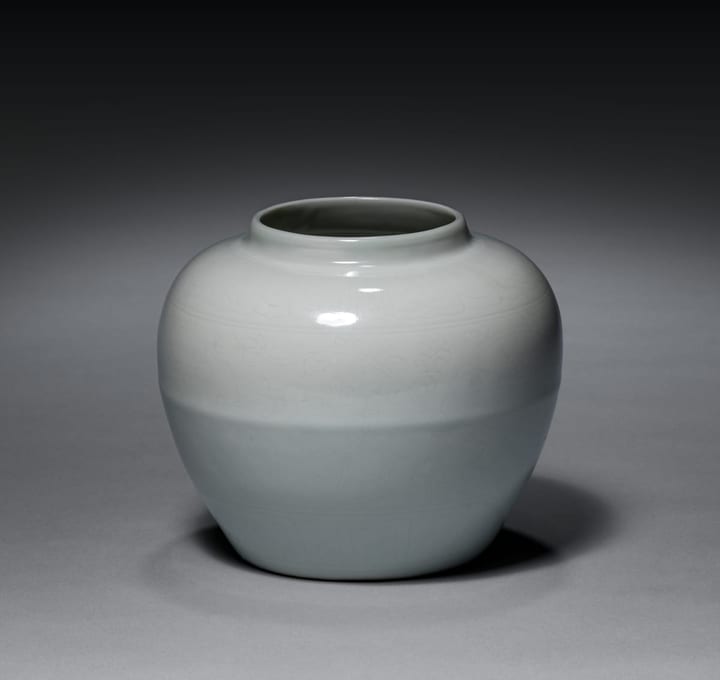
The photographed Cleveland jar, accession 2020.185, is dated to the 1500s–1600s and attributed to the Jingdezhen kilns. It is a later example, not a Yongle-period object. The museum identifies sweet-white glaze over two joined molded halves, with floral scrolls and petals in hidden decoration.
Its proposed uses include flowers, planting or incense on a domestic altar; none is certain. Compare the broad curved body, the line around its middle and the faint motifs. The catalog supplies the construction and attribution that appearance alone cannot establish.
Compare named traditions rather than color alone
Our Dehua guide follows white porcelain from Fujian, including modeled religious figures. Qingbai follows bluish-white glazed ceramics, including earlier Jingdezhen examples. Ding follows a northern kiln tradition associated with Quyang in Hebei. These are different historical categories, even when all three can offer pale surfaces and delicate ornament.
For a useful comparison, retain the object’s place, date, medium and recorded decoration together. Begin with its profile, then look for a design in the light and read the catalog’s construction notes. This keeps a material tradition, a decorating method and a proposed use from becoming interchangeable labels.
Images and credits
White-Glazed Jar with Hidden Design, Jingdezhen, China, 1500s–1600s. Porcelain with sweet-white glaze. The Cleveland Museum of Art, 2020.185, Nancy F. and Joseph P. Keithley Collection Gift. CC0. Complete photograph, uncropped and resized for display.