What the Shufu name identifies
The Palace Museum expands Shufu as Shumiyuan, the Yuan military institution. Marked wares are generally interpreted as commissions for that office. This association belongs to the inscription, not every white bowl.
The related name luanbai describes an egg-like white glaze, with a slight bluish cast. It refers to appearance, rather than egg as a recorded ingredient.
Chinese Shufu ware without the inscription
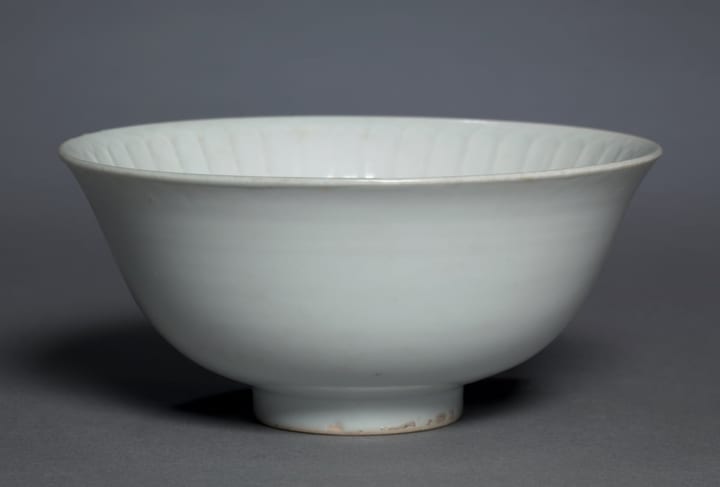
Cleveland’s illustrated Bowl with Flower Petals, 1953.122, is dated to the 1300s and attributed to Jingdezhen. Its catalogue explicitly identifies Shufu ware although it lacks the inscription. The classification rests on the bowl’s material, construction and decoration together.
This makes a useful distinction when reading labels: a ware name can cover more objects than the group bearing its namesake mark. Look at the whole vessel before looking for two characters.
Molded form beneath the glaze
The Ashmolean’s White ware bowl with fluted decoration, EA1956.1436, is dated to the first half of the fourteenth century and assigned to the Jingdezhen kilns. Its record places molded decoration under a thick white Shufu glaze.
The fluting organizes the wall into a repeated pattern. Follow one unit from the rim toward the base, then compare its rhythm with the bowl’s outline. Decoration here is built into the shaped surface before the covering glaze completes its effect.
A different inscription on a dragon dish
A Palace Museum dish, 新00134714, carries Taixi rather than Shufu. Its record connects Taixi with the Yuan institution responsible for court ancestral rites. Molded dragons and lotus-supported Buddhist emblems appear within the pale-glazed dish.
The same record distinguishes molded interior work from incised lotus petals outside. A single vessel can therefore combine techniques and several kinds of information: an institutional inscription, a pictorial motif and a carefully divided decorative field. None should be replaced by a general assumption about all white porcelain.
The category extends beyond low bowls
Cleveland also catalogues Stem Cup with Buddhist Emblems: Shufu Ware, 1969.303, as a fourteenth-century Chinese work from Jiangxi. Its medium specifies porcelain, molded decoration and white glaze. The stem changes the relationship between the vessel’s open bowl and its base.
Comparing a bowl with a raised cup keeps form visible within the ware category. Ask where the container holds its volume, how high the rim sits, and which surfaces carry the pattern. Those questions reveal differences that a shared pale color can obscure.
Compare Shufu with Qingbai and Sweet White
The Qingbai guide follows earlier bluish-white wares, including carved and molded examples. The Sweet White guide examines tianbai associated especially with the Ming Yongle kilns, as well as later examples. Shufu supplies a separate Yuan whiteware context between those discussions.
For comparison, keep four entries from each label together: date, production attribution, glaze category and recorded decoration. Similar whiteness does not erase those distinctions. A catalogue’s named ware and an actual inscription answer related, but different, questions.
Images and credits
Bowl with Flower Petals, Jingdezhen, China, 1300s. Glazed porcelain with molded decoration, Shufu ware. Cleveland Museum of Art, 1953.122; Anonymous Gift. CC0. Complete photograph, resized.