Chinese Qingbai porcelain: a glaze category with regional variety
The Met translates qingbai as bluish-white and identifies it as an important Jingdezhen product in the twelfth and thirteenth centuries. Jingdezhen is therefore central to the story, but the name is not an exclusive guarantee that an object was fired there.
The Palace Museum also records qingbai production in places including Anhui, Fujian and Hubei. Cleveland’s silver-mounted bowl is attributed broadly to South China, whereas its conical floral bowl is specifically assigned to Jingdezhen. Those different levels of geographic precision should remain visible.
The glaze helps shallow decoration become legible
Cornell’s Wine ewer and warming bowl, 81.110 a–c, is a Southern Song porcelain set with pale blue-green glaze. Its label explains that lightly incised lines allow glaze to thicken and reveal a delicate floral pattern on both components.
This is a useful way to understand decoration that can seem elusive in a photograph. A shallow line does not need a painted outline: its effect can come from the interaction of the cut surface and glaze above it. Compare an undecorated area with an adjacent groove before judging the whole pattern from a single reflection.
A bottle gives carving a larger field
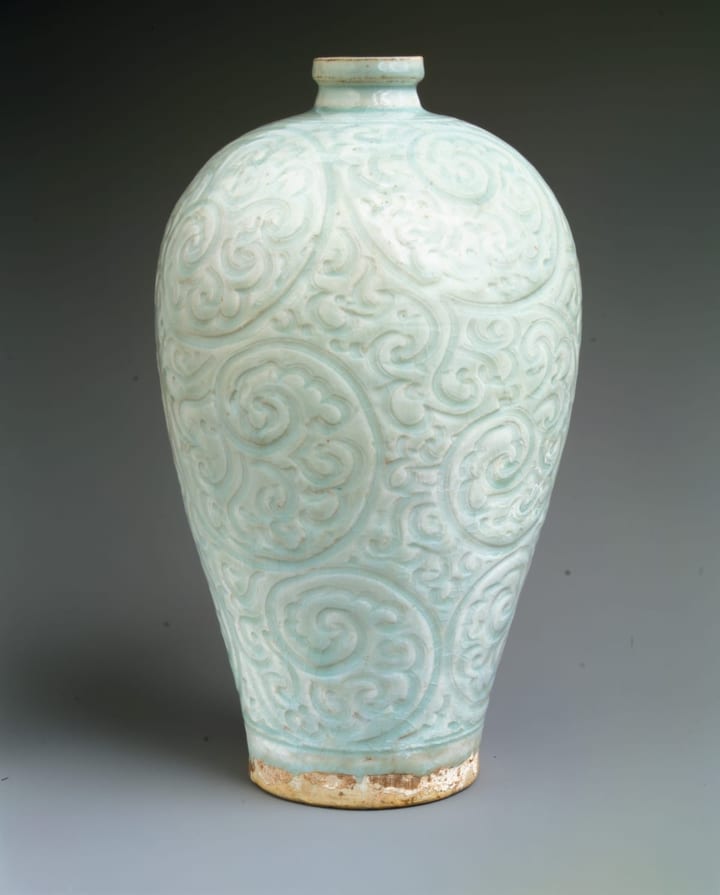
The Met’s Bottle with vegetal scrolls, 23.182.1, is dated to the late thirteenth century, spanning its Southern Song–Yuan attribution. The medium specifies incised and carved design beneath bluish glaze and identifies Jingdezhen Qingbai ware.
A plant scroll has to connect its parts across the bottle’s changing profile. Follow a stem between leaves, then consider how the arrangement occupies the shoulder and body. The Palace Museum’s carved qingbai meiping, 新00083058, offers another example of floral scrolls whose effect remains subtle beneath the pale glaze. Carving establishes the pattern before glazing completes its appearance.
A mould can shape the bowl before further incision
The Smithsonian’s thirteenth-century bowl, F1984.2a–f, was wheel-thrown, then shaped over a drape mould. The mould formed fluting and a central groove; blunt-edged and comb-like tools supplied incised paired fish.
Here forming also established parts of the decoration. The later incisions added another element to that prepared field. This combination offers a useful comparison with directly carved objects and with designs organised chiefly through glaze.
Two bowls reveal different treatments of the surface
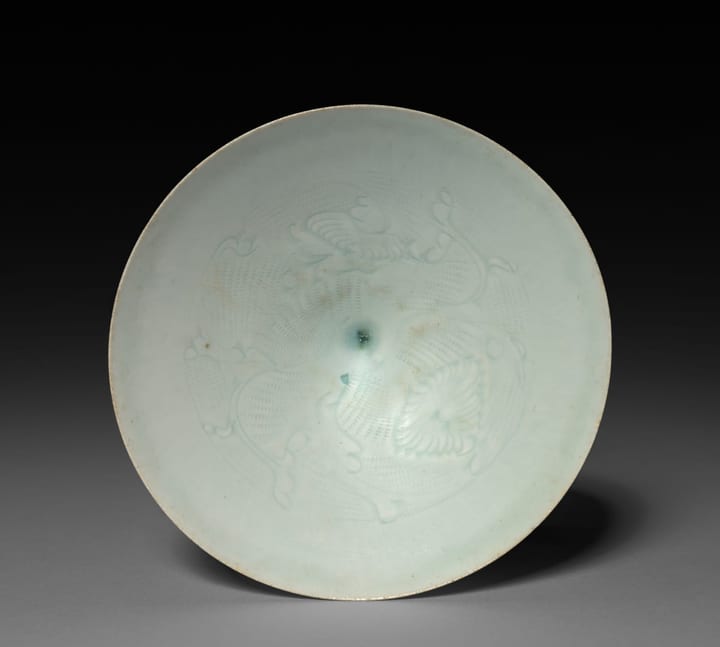
Cleveland’s Conical Bowl with Floral Scroll, 1964.210, is dated to the 1100s, Southern Song, and attributed to the Jingdezhen kilns in Jiangxi. Its medium explicitly identifies incised decoration on glazed qingbai porcelain. The conical form gives a sloping field for its floral subject.
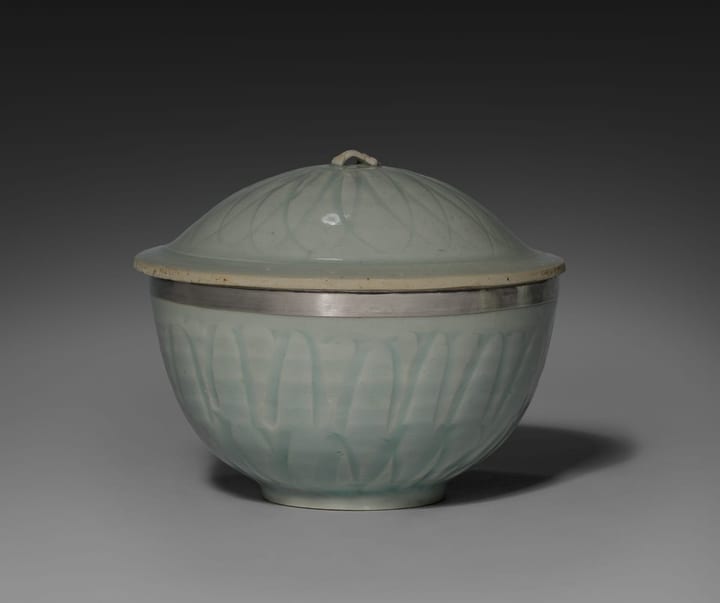
The museum’s Qingbai Ware Bowl with Cover, 2020.173.1, is instead catalogued as an 1100s–1200s South China work with a silver mount. Its lotus-inspired petal treatment and metal rim bring different materials into the comparison. Keep the porcelain decoration and the metal component distinct when describing the object; the record does not provide a date for the silverwork.
A warming set connects decoration with use
Cornell’s wine ewer sits within a warming bowl shaped like a lotus. Rather than treating the two as unrelated containers, consider how the enclosing bowl and pouring vessel work as an ensemble. Their coordinated floral decoration carries the same pale-glaze effect across separate components.
This set gives function a visible structure: one form surrounds another, while the ewer still needs an accessible handle, opening and spout. Comparing it with a single bottle or conical bowl shows why vessel category matters as much as glaze colour when interpreting a ceramic object.
Compare Qingbai with other pale and green wares
Our Yue ware companion follows a separate Zhejiang tradition through green-glazed stoneware and changing vessel forms. Longquan celadon and Yaozhou ware also have their own regional histories. A similar pale or green cast does not establish that any two objects came from the same kiln.
For the broader local context, continue to the Jingdezhen porcelain guide. When comparing examples, retain three things together: the named ware, the catalogue’s material description and the particular forming or decorating method. This makes the comparison more informative than sorting every object by colour alone.
Museum photographs and credits
Bottle with vegetal scrolls, Jingdezhen, China, late 13th century, Southern Song–Yuan dynasties; porcelain with incised and carved design under bluish glaze (Jingdezhen Qingbai ware). The Metropolitan Museum of Art, 23.182.1. CC0.
Conical Bowl with Floral Scroll, Jingdezhen kilns, Jiangxi, China, 1100s, Southern Song dynasty; glazed porcelain with incised decoration, qingbai ware. Official alternate photograph showing the interior. The Cleveland Museum of Art, 1964.210. CC0.
Qingbai Ware Bowl with Cover, South China, Southern Song dynasty, 1100s–1200s; porcelain with pale bluish-white glaze, Qingbai ware, with a silver mount. The Cleveland Museum of Art, 2020.173.1. CC0.