Chinese Dehua porcelain: what blanc de Chine names
The term refers here to white porcelain associated with the Dehua kilns. Dehua is a place of production, while white describes an appearance: a white Chinese ceramic from another centre does not become Dehua ware. The museum attributions below give a firmer starting point than colour alone.
The same regional tradition includes sculpture and vessels. Looking across both is useful because the materials face different demands: a figure needs readable contours and details, while a bottle needs a convincing profile and opening. The finished surface joins those practical and visual decisions.
Read the body and the glaze together
The Met’s Bodhidharma in meditation, 63.176, dates to the seventeenth century. Its account distinguishes an ivory-white ceramic body from the thick, lustrous clear glaze above it. The pale appearance therefore involves two layers, rather than simply a white coating hiding an unrelated material.
In photographs, follow a highlight along a broad fold, then into a recess. That comparison makes the modelled volume easier to see. A bright reflection can obscure a small detail, so use the whole silhouette as well as a close view. The object’s medium statement supplies information that illumination alone cannot.
How moulds and hand modelling work together
The V&A documents clay pressed into removable piece-moulds made from a prototype. Separately modelled or moulded details are then attached. The sequence combines a repeatable main form with further handwork, so mould use alone does not explain every finished detail.
Compare a broad robe with a necklace, fingertip or flower. These parts ask for different scales of attention. Instead of counting details as a measure of quality, consider how each one supports the gesture and how clearly the figure reads from a normal viewing distance.
A lotus pedestal helps identify a devotional image
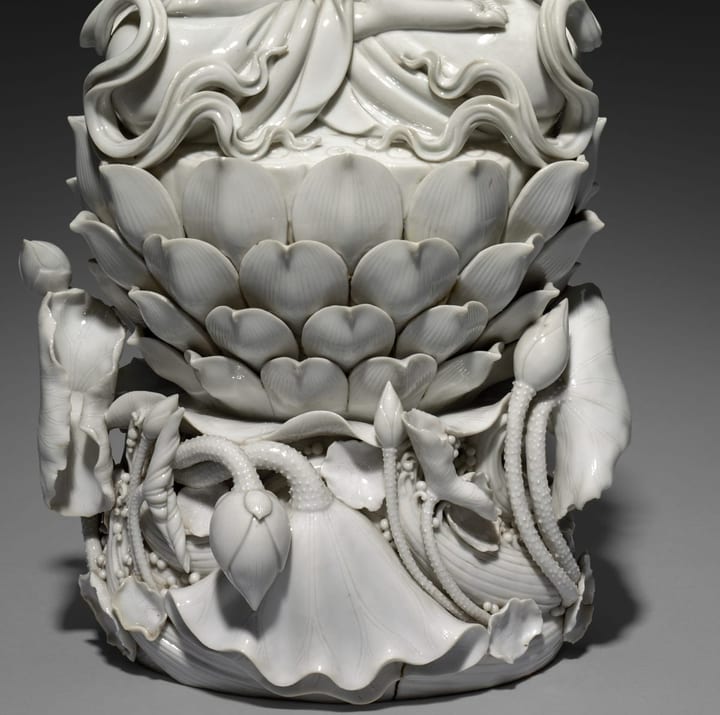
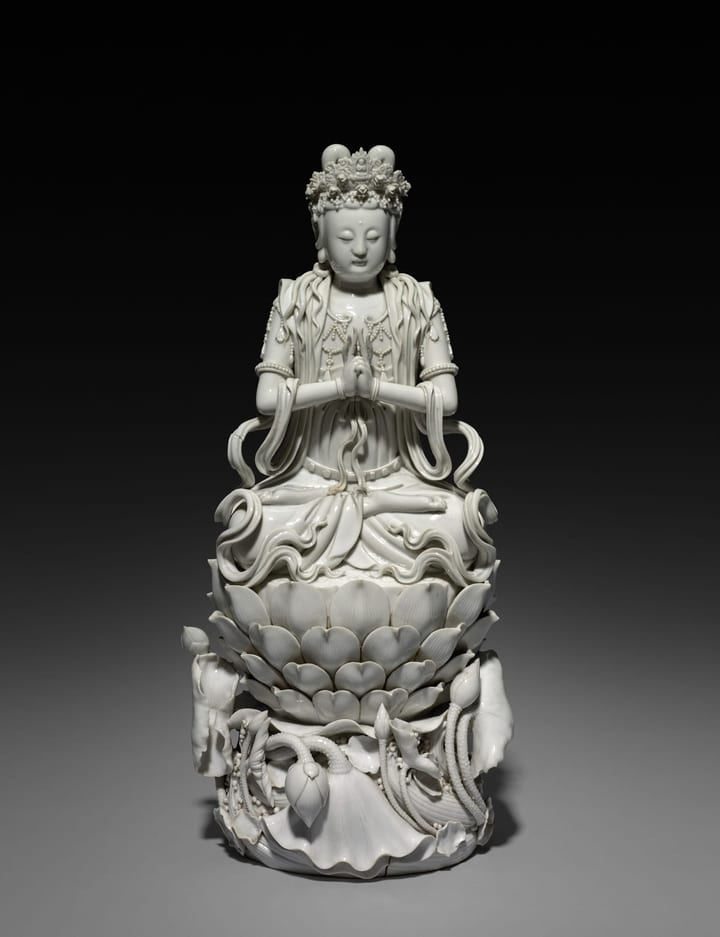
Cleveland’s Bodhisattva Guanyin of the South Sea, 1950.579, is dated to the 1600s and attributed to Fujian across the Ming–Qing period. Its white-glazed figure sits above an elaborate lotus pedestal and waves. The museum uses that watery setting to explain the South Sea identity.
Here the base participates in the meaning rather than merely holding the figure upright. Look from the seated posture down through the lotus and supporting forms: the image is organised as a complete sculptural group. Cleveland connects Guanyin with compassion and allows a possible altar or temple setting, without identifying one original location.
Another Guanyin gives a different comparison
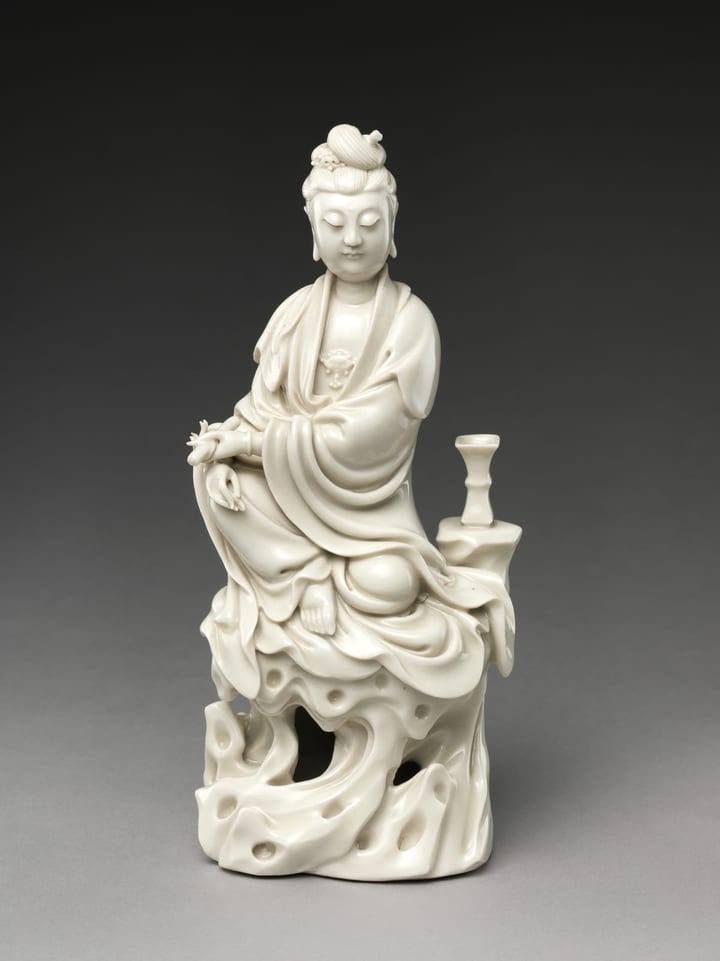
The Met’s Bodhisattva Guanyin seated on a rock, 55.111.84, belongs to the eighteenth-century Qing dynasty and is catalogued as porcelain with ivory glaze, Dehua ware. Its rock seat provides a different framework from Cleveland’s elaborate lotus-and-wave pedestal.
Compare the relation between figure and support before isolating facial details. How much space does the seat occupy? Where does the robe meet it? Those questions make the images easier to discuss precisely while keeping their different dates and arrangements visible. Neither record assigns the selected work to a named maker.
Vessels expand the story beyond figures
The Met’s late-sixteenth-century Bottle with Coiling Dragon, 18.56.60, is attributed to the Wanli period and described as Dehua porcelain with transparent glaze. Its title directs attention to an animal form in relation to a container, offering another way to study sculptural decoration.
The Florida Museum’s archaeological type entry also records small cups and figurines, including applied moulded floral and animal elements. Its stated 1640–1750 range belongs to that classification entry, not to the entire history of the Dehua kilns. Together, the records show why a guide focused only on figures would miss useful vessel forms.
A living ceramic practice and useful comparisons
The V&A describes continuing production in Dehua using traditional handwork alongside modern methods. Historic figures remain useful references for understanding modelling, but they do not prescribe everything contemporary makers must create.
For another Chinese white-ware tradition, continue to our Ding ware guide and compare its own documented bodies, glazes and decoration. Our Jingdezhen porcelain guide gives a separate regional context. The underglaze copper-red guide follows a different decorating decision: placing a copper-bearing painted design beneath the glaze.
Museum photographs and credits
Bodhisattva Guanyin of the South Sea, Fujian, China, 1600s, Ming–Qing dynasties; porcelain with white glaze, Dehua ware. The Cleveland Museum of Art, 1950.579. CC0.
Bodhisattva Guanyin seated on a rock, China, Qing dynasty, 18th century; porcelain with ivory glaze (Dehua ware). The Metropolitan Museum of Art, 55.111.84. CC0.
Detail cropped from the same photograph of Bodhisattva Guanyin of the South Sea shown above, Fujian, China, 1600s, Ming–Qing dynasties. The Cleveland Museum of Art, 1950.579. CC0.