Chinese kingfisher feather work begins with its support
The Palace Museum defines diancui through a metal framework, wire outlines and kingfisher feathers fixed within the recessed areas between the lines. That definition distinguishes the support, the boundary and the coloured decoration. The visible blue is part of a constructed object with several material layers.
The comparison with cloisonné concerns the organisation of separate fields, not the use of fired enamel as the infill. Begin with one bounded area, then follow its edge into the surrounding framework. This helps explain what the feather decoration contributes without turning every metal wire in an ornament into the same technique.
A swallow ornament joins material and imagery
The Walters Art Museum’s Hair Ornament in Form of Swallow, 86.1, is a nineteenth-century Chinese object. Its record explicitly identifies kingfisher feathers and gilded silver among its materials, and explains that feathers provide the blue colour. It also connects the swallow with spring, peace and happy marriage, making the form appropriate to a bridal trousseau.
The bird depicted and the bird supplying the material are different facts. Here the ornament represents a swallow, while the catalogue identifies kingfisher feathers in its decoration. Reading the title beside the medium prevents an easy confusion between subject matter and physical substance.
Headdress ornaments combine several materials
The Met’s Ornaments for a Headdress, 15.95.182a–d, are dated to the eighteenth–nineteenth century, Qing dynasty. The recorded materials are gold, gilded metal, kingfisher feathers, glass and semiprecious stones. The title identifies ornaments for a headdress, not an intact headdress. Gold and gilded metal appear separately in the record and should remain distinct.
Blue feathers and blue gemstones remain different materials
The Palace Museum’s Qing pin, 故00010037, has a silver body and three tiers of gilded-silver lotus supports decorated with diancui. Its description separately identifies a pearl and a sapphire in the upper lotus forms. The feather-covered setting and the inserted stone are related parts of the ornament, not interchangeable names for blue colour.
Locate the supports before concentrating on the central stone. This reverses the habit of treating an ornament as a single gem with an incidental frame. The surrounding worked material can carry colour, pattern and shaped volume of its own.
Chains and pendants add movement
The National Museum of China’s gilded-silver bird-frame pin combines a phoenix-shaped head, a bird framework and suspended chains. Its account identifies feather decoration on several components, including the bird’s wings and pendants, and describes the visual effect of the hanging elements moving.
This example separates three craft questions: how the pin is supported, how individual areas are decorated, and how the suspended parts can move. A still photograph records one arrangement. Understanding the connected components helps explain the object beyond the colour of a single surface.
A fan expands the range beyond metal hair ornaments
In a 2018 conservation account, the V&A describes its Chinese fan FE.29-1980, dated about 1730. Mica leaves combine painted decoration with small kingfisher-feather and mother-of-pearl diamonds. The feather additions appear on one side, with corresponding mother-of-pearl decoration on the other.
This is a documented use of kingfisher feathers on a different support, not proof that every feather-decorated object follows the Palace Museum’s metal-framework definition in identical detail. The conservator also explains that missing painted decoration was not recreated where evidence was insufficient. Studying the surviving materials preserves distinctions that an imagined complete surface could obscure.
Read the layers before assigning a technique
Start with the catalogue’s medium, then distinguish the base, outlined or covered areas, gem settings and any moving attachments. A blue passage might be feather inlay, enamel, a stone or another documented material. The Palace Museum pin demonstrates that more than one can occur within the same object.
Our gold-filigree guide follows fine-wire construction; the cloisonné comparison follows enamel within metal boundaries. Brocade and embroidery instead concern woven patterning and needlework. A design representing feathers is not evidence that actual feathers were used. These comparisons make historical feather work easier to discuss without assuming that a modern blue ornament has the same materials or production history.
The documented ornament shown here
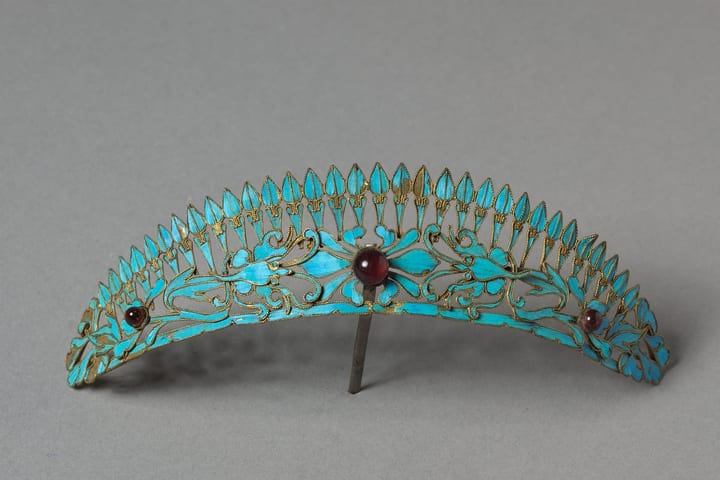
The photograph shows Cleveland Museum of Art’s Headdress Ornament, accession 2001.179.2. The catalogue dates it to the 1800s–1900s and identifies China, Qing dynasty (1644–1911). Its medium is copper-silver alloy, gilding, kingfisher feathers and glass beads. This is a separate object from the Walters swallow and The Met group discussed above; their distinct forms and materials should not be assigned to the photographed ornament.
Images and credits
Headdress Ornament, China, catalogued Qing dynasty (1644–1911), dated 1800s–1900s. Copper-silver alloy, gilding, kingfisher feathers and glass beads. The Cleveland Museum of Art, 2001.179.2, Gift of Mr. and Mrs. Howard L. Ginaven. CC0; complete photograph resized for display. This is a separate object from the Walters swallow and The Met group discussed in the text.