Cloisonné vs painted enamel: cells or a painted ground
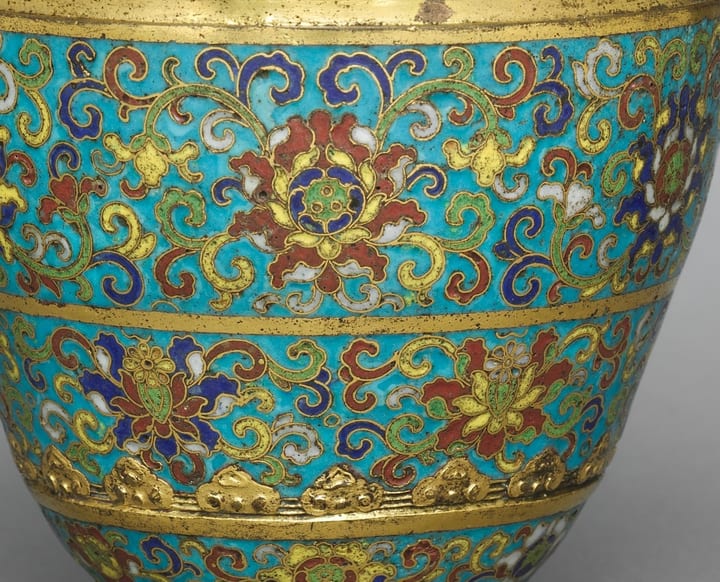
A cloisonné outline is part of the object’s construction. Thin metal wires are bent into a pattern and attached to the metal body. They form small compartments, called cloisons, into which enamel is placed. A painted line on an enamelled surface does not perform that dividing function.
The Palace Museum describes copper painted enamel as a different sequence: coat the copper with white enamel, fire it, then paint designs with coloured enamel materials on the smooth ground and fire again. Here the ground supports the painting; each colour area does not need its own wire enclosure.
Why the firing and finishing sequences differ
Enamel is a glass-based material transformed by heat. In the cloisonné method described by The Met, firing causes the enamel filling to shrink, so filling and firing are repeated. Grinding and polishing then bring the surface level with the metal partitions. Exposed metal is often gilded.
Painted enamel also requires firing. The word painted describes how the design is applied, rather than an ordinary paint coating left to dry. The two methods demand different kinds of control: arranging and filling a network of cells, or managing brushwork over an enamel ground. Neither name supplies one universal recipe or firing schedule.
Copper painted enamel is not porcelain
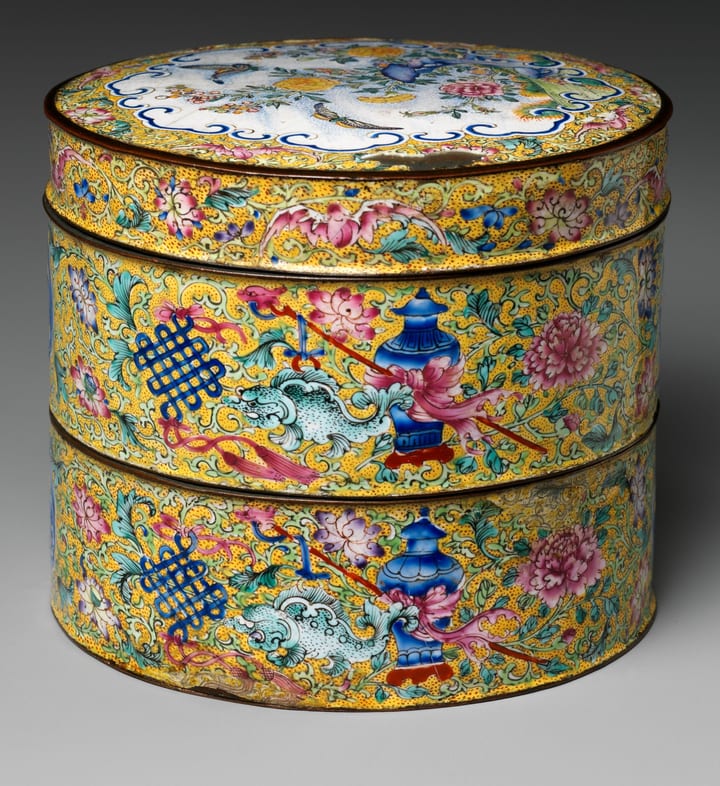
The body beneath the decoration matters. The Met identifies its eighteenth-century Covered Box, accession 24.80.467a–c, as painted enamel on copper. Its Qing court exhibition separately labels a vase porcelain with overglaze enamels. Both involve enamel colour, but the supporting bodies are metal and ceramic respectively.
Flower painting, a pale ground, or a glossy finish cannot settle this distinction alone. Read the material description alongside the technique. The related Jingdezhen porcelain and Chinese lacquerware versus ceramics guides explain other relationships between a vessel’s body and its surface.
Jingtai blue, Guangzhou, and combined techniques
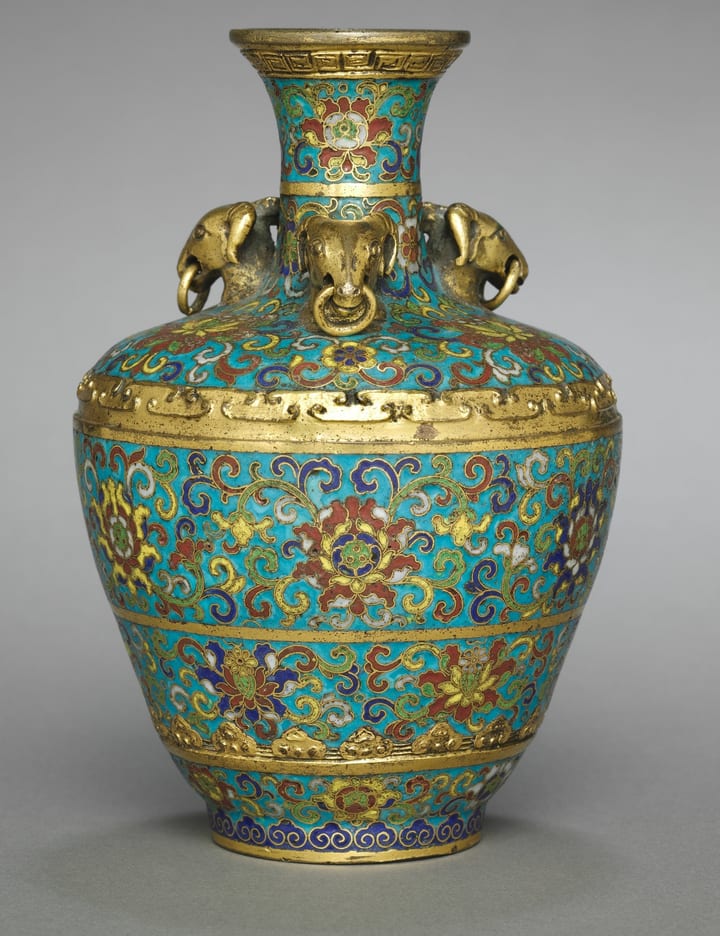
Jingtailan, often translated as Jingtai blue, is a familiar Chinese name for cloisonné. It does not name every Chinese enamel technique or restrict the palette to blue. Cleveland’s Vase with Three Rams’ Heads, accession 1989.321, combines a turquoise ground with varied floral colours and metal outlines.
Guangzhou was an important centre for copper painted enamel, supplying court commissions and overseas markets. The term Canton enamels is associated with this production. The Met also documents an enamelling workshop in the Forbidden City and exchanges involving European enamellers. These histories connect workshops and patrons rather than assigning every object one place of manufacture.
A single object can combine techniques. A Qianlong-period gold-bodied ewer in the Palace Museum has cloisonné decoration together with inset painted-enamel panels. That example also shows why copper, though central to the methods discussed here, should not be declared the only possible metal body.
Living skills and the museum illustrations
China’s official heritage platform describes the safeguarding of Beijing cloisonné through training, preservation of makers’ drawings, and workshop archives. Understanding the craft therefore includes the transmission of design and firing judgment, alongside admiration for historical objects.
The photographs here show two finished museum objects: Cleveland’s cloisonné vase and The Met’s painted-enamel copper box. The close view is a crop of the same vase. They illustrate surfaces and materials; they do not document a contemporary workshop or a complete making sequence. The separate cloisonné guide expands the wirework process.
Photographs, credits and reading boundaries
Vase with Three Rams’ Heads, China, 1736–1795. Cleveland Museum of Art 1989.321, Bequest of Mrs. Severance A. Millikin. CC0; background cropped and image resized. A finished museum object, not a workshop sequence. Cropped as recorded, resized without upscaling, metadata stripped and JPEG-compressed. Source and license links are below. No photographer or museum endorsement is implied.
Covered Box, China, 18th century, painted enamel on copper. The Metropolitan Museum of Art 24.80.467a–c, Bequest of Mary Clark Thompson, 1923. Public domain/CC0; background cropped and image resized. This is metalwork, not porcelain. Cropped as recorded, resized without upscaling, metadata stripped and JPEG-compressed. Source and license links are below. No photographer or museum endorsement is implied.
Detail crop of the same Vase with Three Rams’ Heads, Cleveland Museum of Art 1989.321, CC0; cropped and resized. The metal-outlined enamel areas illustrate the cell pattern; this is not a separate object or process photograph. Cropped as recorded, resized without upscaling, metadata stripped and JPEG-compressed. Source and license links are below. No photographer or museum endorsement is implied.