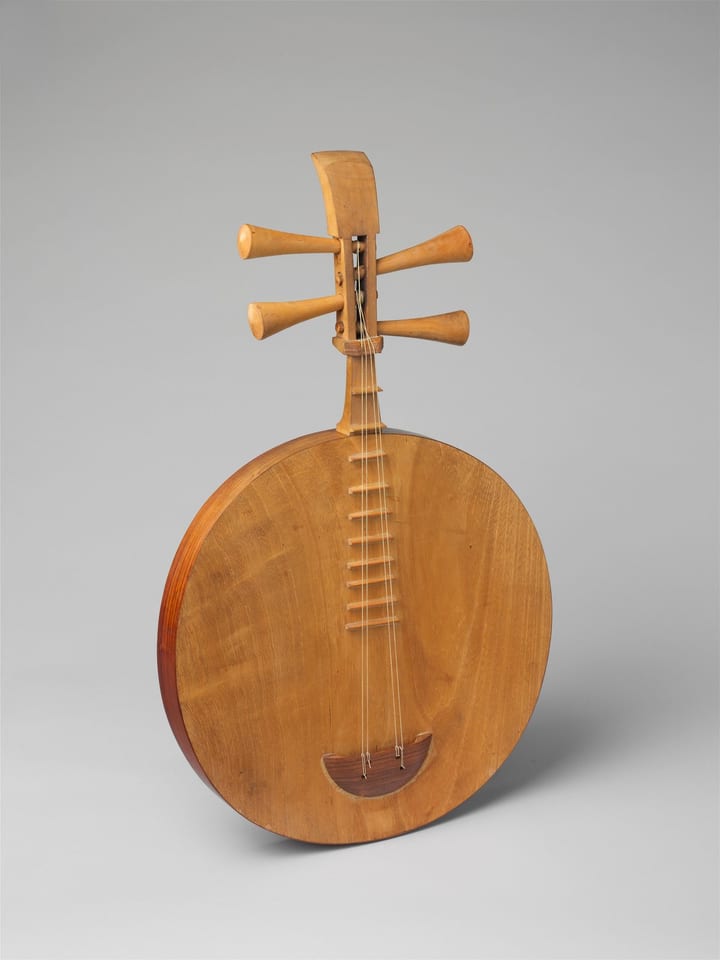
Read the photograph as one complete historical object
The Met’s Chinese yueqin, accession 89.4.53, dates to the nineteenth century. The catalogue records a height of 57.5 centimetres and a body diameter of 34.5 centimetres. Its short neck, broad circular soundboard and projecting tuning pegs remain visible in the complete photograph.
This is an identified museum instrument. Its appearance alone does not establish a named performer or production.
High frets and coordinated hands shape the phrase
The Palace Museum describes a Qing yueqin with thin paulownia front and back boards, a hardwood rim and neck, four strings and nine fret positions. Its account places two strings in each unison pair, with a fifth between the pairs. These details describe the documented form rather than a compulsory specification.
Plucking, rolling, sweeping and left-hand ornaments are among its named techniques. Listen for repeated attacks carrying a phrase and how hands coordinate.
Surviving instruments do not preserve every working part
A second example, Grainger Museum 00.0212, has a circular wooden body, short neck and four hexagonal pegs. Its record describes ten raised frets on the neck and body, with two missing, and notes that the strings are absent. The date is given as before 1950, without a precise year.
The missing parts matter when comparing photographs. Count only what the record or image actually preserves. This museum object cannot supply a present-day tuning demonstration, and its ten-fret description should not be silently substituted for the Palace Museum’s nine-position account.
Longlin yueqin participates in a local festival
A January 2021 report on China’s ICH website describes yueqin teaching in Kesha village, Longlin, Guangxi. Ao Dejin taught playing techniques during a four-day community course. The report places yueqin within the Miao Tiaopo festival and young people’s social encounters.
This is a specific local teaching example. It does not make every regional yueqin identical or turn the separate Met photograph into evidence of that village’s instruments.
A maker and a player can develop an instrument together
For its 2020 exhibition commemorating maker Han Changshu, the Oriental Musical Instrument Museum described his work on the Xuemei series. Its account emphasizes adapting instrument form to performers’ habits. At the opening, musicians used these yueqin for Peking-opera excerpts and other instrumental works.
The report also records comparison performances on different Xuemei models, and Chen Xi playing Spring Comes to the Yi River on a Xuemei No. 4. This is a dated example of maker–performer collaboration, not evidence that every modern yueqin uses the same model, strings or fret layout.
Read an orchestral credit before assuming a fixed place
Hong Kong Chinese Orchestra’s 2025 instrumentation table specifies one zhongruan player doubling yueqin. Doubling means that the listed player may change instruments for the required music; it does not turn the two instruments into synonyms. An orchestral list can therefore include yueqin without giving it an independent permanent section.
Check the instrument credit.
Images and credits
Yueqin, China, nineteenth century; rosewood, paulownia wood and gut. The Met, 89.4.53, The Crosby Brown Collection of Musical Instruments, 1889. Public domain/CC0. Complete museum photograph, uncropped and resized.