Chinese rock crystal carving begins with quartz
The Corning Museum of Glass identifies rock crystal as quartz, or silicon dioxide, usually without color. Its glassmaking FAQ explains that glass has a disordered atomic arrangement and that crystal also became a name for fine clear glass. These overlapping words describe different materials. Carving a quartz block and shaping molten glass are different operations.
Transparency alone cannot settle an identification. Glass may be cut and polished too, and clear quartz may contain cloudy areas. For the objects discussed below, the material names come from their museum records. The Chinese overlay glass guide follows a separate craft in which differently colored glass layers are carved to reveal a design.
Cutting and polishing a transparent form
A 2026 Chinese Arts and Crafts Society account reports a crystal-carving demonstration led by Chen Xuhui in Jiangsu. It names selection, cutting the rough, openwork carving, and polishing as successive operations. This is direct evidence of current teaching practice, rather than a reconstruction of how every old vessel was made.
GIA’s 1986 study of Chinese gemstone carving describes abrasive-assisted cutting, rotating tools, and final polishing. Its illustrated rock crystal bottle has deeply undercut ornament. A later GIA report on a China-based studio working rock crystal and other stones describes diamond tools and designs revised on the stone. Together these records show both material removal and decisions made as the work develops.
An early cup with unresolved workmanship
The late Warring States crystal cup in Hangzhou Museum was excavated in 1990 at Shitang village, Hangzhou. Excavator Du Zhengxian describes its transparent body, undecorated polished surface, and natural cloudy features toward the middle and bottom. At 15.4 centimetres high, it gives a concrete example of an early hollow crystal vessel.
Du also identifies unresolved questions: where the crystal came from, how the core was removed, and how the narrow interior was polished. A general lapidary sequence cannot supply those missing answers. The cup is useful precisely because its surviving finish and the uncertainty about its manufacture can be considered together.
A paperweight and three goats at The Met
The Met catalogues Paperweight, accession 02.18.845, as Chinese rock crystal of the eighteenth century. The title establishes a desk-related use, while the material field identifies the stone. It does not name the carver, quarry, or workshop. Those details should remain open rather than being supplied from the object’s appearance.
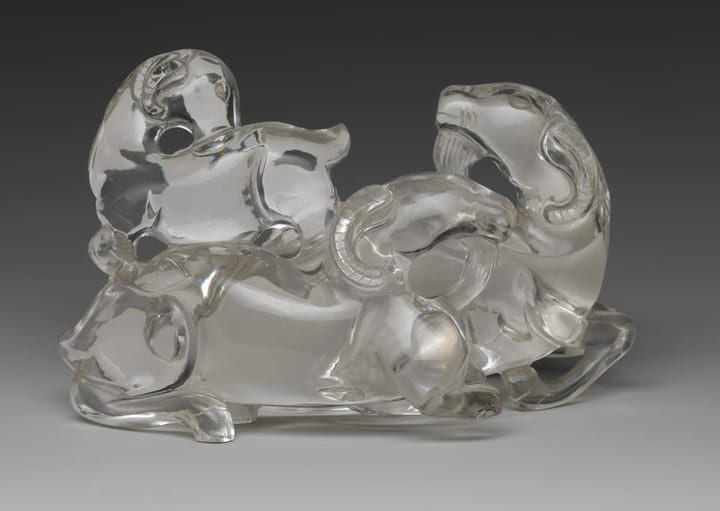
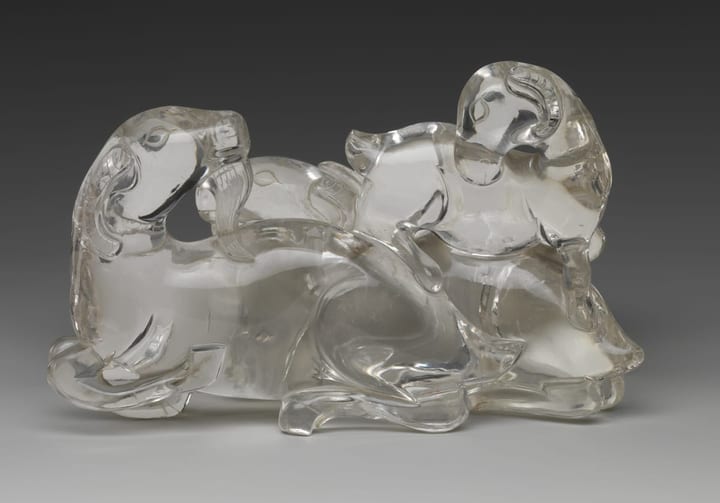
Three goats, accession 24.80.144, is catalogued as a nineteenth-century Chinese rock crystal sculpture. Its Chinese title includes sanyang kaitai. In its discussion of a separate embroidered work, The Met explains the association between three goats, the sound yang, and an auspicious welcome to spring. This provides a motif context without implying that the sculpture and embroidery shared a maker or function.
Looking at light, depth, and remaining stone
For a transparent carving, study the outer contour first, then the spaces removed from it. An actual opening and a dark-looking area within the quartz are different things. Moving around an object, where viewing conditions permit, helps distinguish its silhouette from overlapping forms seen through the material. A single photograph can compress these layers.
Notice the contrast between broadly polished areas and recessed detail, and whether the subject is a vessel, a solid figure, or an undercut composition. The related jade carving guide explores another family of lapidary materials. The soapstone carving guide instead follows softer carving stones and regional approaches to shaping them.
Museum photographs and credits
Three goats, China, 19th century. Rock crystal. The Met, 24.80.144; Bequest of Mary Clark Thompson, 1923. First view of the same sculpture shown in the alternate museum photograph below. Public domain/CC0; cropped and resized.
Alternate museum photograph of the same Three goats sculpture, The Met, 24.80.144. The different viewpoint reveals its overlapping carved forms; it is not a second object or a making stage. Public domain/CC0; cropped and resized.