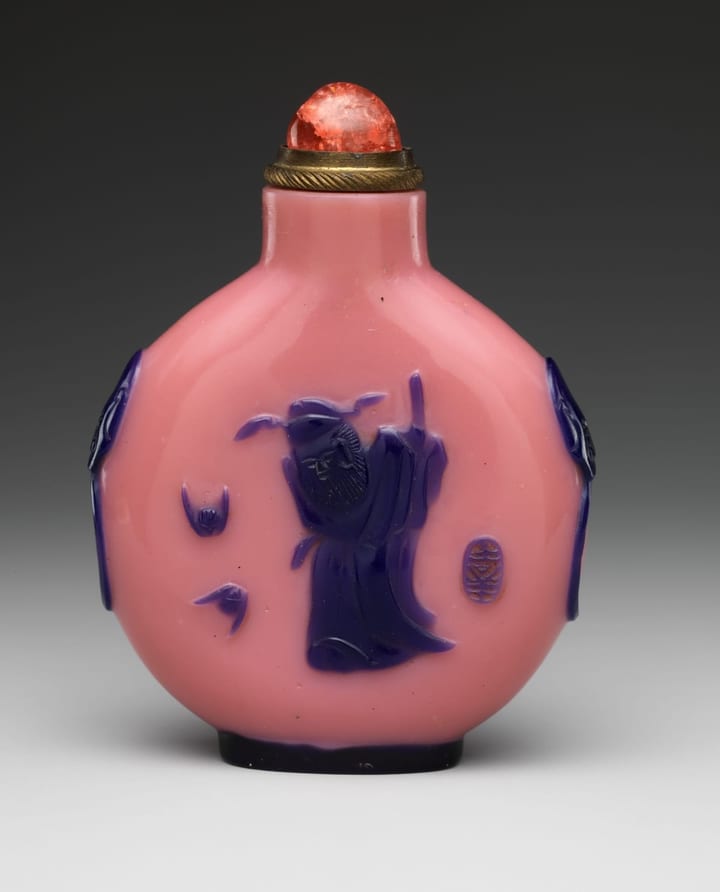
Chinese pink glass snuff bottle with a dark blue raised Zhong Kui figure and a coral stopper

Traditional craft | 套色玻璃/套料(tàosè bōli / tàoliào)

Chinese Overlay Glass

Chinese overlay glass creates contrasting decoration by combining differently coloured glass and removing selected areas of the outer material. In carved examples, the remaining glass stands above the exposed ground as relief. Known in Chinese as taoliao or taose boli, this technique can transform a small bottle into a scene that continues around its sides. It also appears on larger vessels.

How Chinese overlay glass creates relief

The Palace Museum explains taoliao as glass combined in contrasting colours, with different choices for the base material. Its account notes that exterior patterns are commonly ground and worked into shape. A Hong Kong Museum of Art example makes the removal especially clear: unwanted portions of the applied colours are taken away, leaving a raised design.

The Corning Museum of Glass places this approach within cameo glass, a broader category involving contrasting glass layers. Cameo therefore does not automatically mean a carving in a naturally layered stone. Here the substance being shaped is glass. The focus of this guide is carved overlay; the broader cameo-glass category also includes other methods of removing outer material.

Making the blank and working its surface

The coloured blank must exist before its relief can be developed. Corning’s general cameo-glass account separates preparation of the layered blank from decoration after controlled cooling. This distinction helps explain two kinds of work: forming the glass and subsequently removing glass from its solid surface. It does not prescribe one documented manufacturing sequence for every Chinese bottle.

Wheel engraving is one method of working solid glass. Corning describes a rotating disk carrying abrasive, with the object held against it. This explains the grinding principle without establishing the pictured bottle’s exact tools.

Small bottles with different material combinations

The Met’s Snuff bottle with demon queller Zhong Kui, accession 14.40.447a, b, is catalogued as Chinese, mid-nineteenth century, and overlay glass with a coral stopper. The title identifies its figure; the material record also reminds us that the stopper is a distinct component. Its coral should not be described as another colour of the glass body.

Princeton University Art Museum’s bottle, accession y1936-771, is explicitly titled Glass snuff bottle with blue overlay carved with fish among fronds. The record identifies China, dates it to 1780–1850, and lists glass with blue overlay. It supplies a useful blue example without making colour alone the test of a technique or a date. The title itself documents both the overlay and the carved subject.

Qing history beyond the bottle

The Palace Museum dates the establishment of the imperial glass workshop to 1696, during the Kangxi reign. That date concerns an institution within Qing court production, not the beginning of glass in China or proof that every later overlay object was made for an emperor.

Corning’s Snowflake Warrior Vase, accession 57.6.10, demonstrates a larger narrative format. Its thick red overlay covers a snowflake-glass base, and the carving relates to scenes associated with Beijing opera. The museum places it around 1825–1875 and only possibly in Beijing. Its study explicitly questions older Qianlong-period attributions lacking firm evidence: vivid carving cannot supply a secure date by itself.

Compare the decoration, not just the silhouette

Compare Chinese inside-painted snuff bottles for images brushed onto an inner wall, and Chinese jade carving for a different material worked with abrasives. Museum photographs show finished objects; alternate views and labelled details remain views of the same named artifact.

Museum photographs and credits

Snuff bottle with demon queller Zhong Kui, China, mid-19th century; overlay glass with coral stopper. The Met, 14.40.447a, b; public domain/CC0, cropped and resized.

Glass snuff bottle with blue overlay carved with fish amongs fronds, China, 1780–1850. Princeton University Art Museum, y1936-771; Bequest of Col. James A. Blair, Class of 1903. Public domain image; resized. Image courtesy of the Princeton University Art Museum.

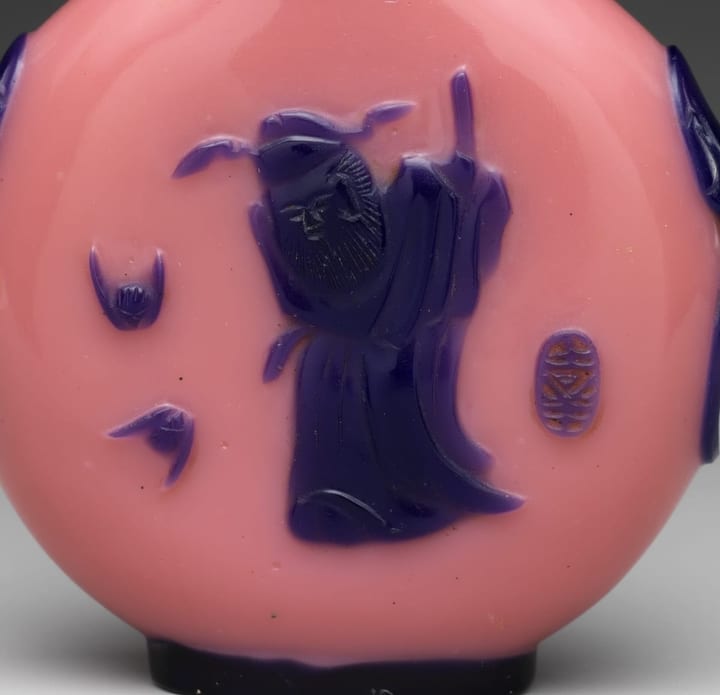
Detail crop from the same photograph of The Met’s 14.40.447a, b bottle shown above. The raised blue decoration contrasts with the pink glass body. Public domain/CC0; cropped and resized.
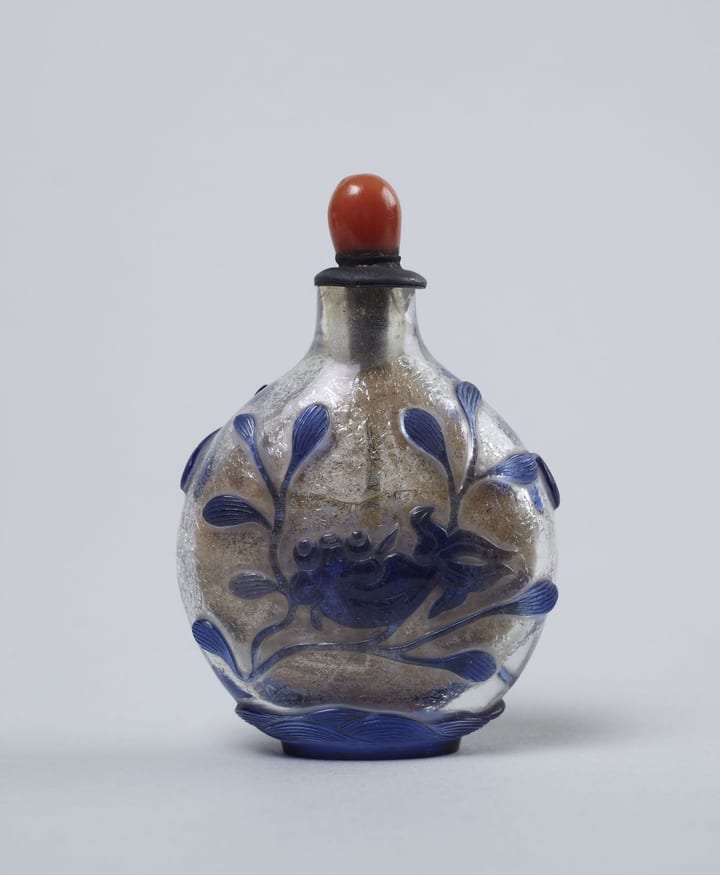
Chinese clear glass snuff bottle with dark blue fish, fronds and waves carved in overlay relief

Chinese Overlay Glass in practice

Designs could refer to familiar figures, auspicious subjects, antiques, or narrative scenes. Their meaning belongs to a particular motif and setting, rather than to every object made with overlay glass.

Detail crop of the same pink glass bottle showing the dark blue Zhong Kui relief, nearby motifs and contrasting ground

Chinese Overlay Glass in practice

Designs could refer to familiar figures, auspicious subjects, antiques, or narrative scenes. Their meaning belongs to a particular motif and setting, rather than to every object made with overlay glass.

How Chinese Overlay Glass is practiced

  1. Prepare contrasting glassForm a blank that combines a ground with one or more contrasting colours. Choose the colour relationship and the material available for the planned relief. The precise forming method must be established separately for an individual object.
  2. Cool before coldworkingIn the general cameo-glass workflow described by Corning, the blank is gradually cooled to reduce stresses before decoration. A finished object photograph does not reveal its original cooling schedule.
  3. Plan the areas to retainEstablish which portions of the outer colour will remain as motifs and where the ground will be exposed. Consider the design around the neck, body, and sides rather than only the principal face.
  4. Remove and refineGrind or cut away the unwanted outer glass, then work the edges, contours, and smaller details. This sequence explains carved overlay; it should not be transferred automatically to every type of layered glass.
  5. Finish the worked surfaceRefine and polish as the intended effect requires. Preserve the difference between raised design and ground. The maker’s exact abrasives and finish cannot be recovered from colour contrast alone.

Place, craft, and cultural meaning

Designs could refer to familiar figures, auspicious subjects, antiques, or narrative scenes. Their meaning belongs to a particular motif and setting, rather than to every object made with overlay glass.

Chinese Name套色玻璃/套料(tàosè bōli / tàoliào)
Region or OriginChina; Qing-period glassworking associated with Beijing, with workshop attribution varying by object
CategoryTraditional craft
MaterialsA glass ground with contrasting glass over it. Grounds may be colourless, milky white, or coloured; the overlay need not be red. Stoppers and other fittings can be separate materials.
ToolsGlass-forming equipment for the blank, followed by tools for grinding, cutting, engraving, and polishing. Abrasive wheels are part of glass coldworking, although a museum’s medium alone does not establish an individual object’s exact tool sequence.
UsesSnuff bottles and larger decorative vessels, including vases. The historical bottle form carried a practical function while providing a small surface for carved imagery.

Common questions

Is Chinese overlay glass painted on the outside?
In carved overlay, the raised contrasting design is glass left after surrounding material is removed. That differs from applying a painted image. A bottle can combine techniques, so follow its specific museum description.

Does cameo glass mean agate or another hardstone?
No. Cameo can describe a relief arrangement, but cameo glass is made of glass. The material and the decorative method must both be identified; a similar colour contrast does not make two objects the same substance.

Is every overlay bottle red on white and made at court?
No. Different ground and overlay colours occur, and the technique does not establish court ownership or manufacture. Use the date, material, and attribution attached to the particular museum object.

Sources and further reading