A landscape at the scale of a desk
Princeton University Art Museum describes gongshi, or rare stones, and guaishi, or fantastic stones, as objects admired by China’s scholar-officials. Their forms could recall mountains and the mythical homes of Daoist immortals. Small stones belonged on desks; larger examples could stand in gardens and courtyards.
The museum’s Taihu Rock, accession 2008-65, is a Qing-dynasty limestone example on a hongmu wood base, 134.6 centimetres high. Its measurements distinguish it from a small desktop ornament. Read the dimensions before imagining the setting: a photograph alone does not establish an object’s scale. Princeton’s account describes carved limestone being submerged in the lake for further shaping by water and sand. That explanation should not become a manufacturing history for every collected stone.
White Taihu and black Lingbi examples
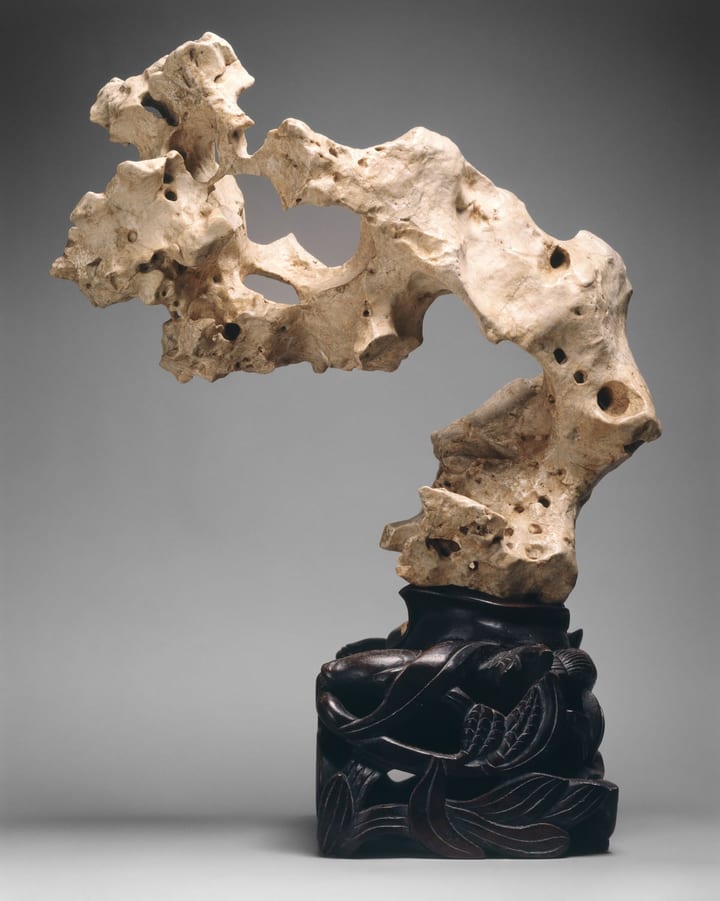
The pale rock pictured here is The Met’s Scholar’s rock, accession 2011.575.9a, b. Its record identifies white Taihu limestone and a wood stand, and dates the object to probably the seventeenth century. The word probably matters. This is an attribution to a historical period, not a known date of quarrying or the name of a documented maker.
A separate Met example, accession 2009.512.1a, b, is catalogued as black Lingbi limestone on a wood stand, from the Qing dynasty’s Kangxi period, 1662–1722. It measures 46.7 centimetres high overall, including its base. The two material names should not be treated as interchangeable labels for every unusual rock; they identify particular catalogued examples.
Looking at openings, edges and the stand
Start with the outer silhouette, then follow the spaces within it. A hole seen against the background reads differently from a dark recess facing the viewer. Look again from another position when the display allows it. Overlapping contours can join into a single dark patch in a photograph and separate when the viewpoint changes.
The stand is part of the encounter. Compare where it meets the stone, which projections it leaves exposed and how high it raises the whole composition. In the pictured example the pale stone contrasts with a darker support. That visible contrast can guide looking, but it cannot by itself prove the stand’s age, wood species or original association.
Natural stone and deliberately stone-like art
Shanghai Museum’s 2020 exhibition presented Hu Kemin’s gift of scholars’ rocks. Its account lists Lingbi, Taihu, Kun and Ying stones alongside works in porcelain, copper, jade and wood. The latter can evoke stone without being geological specimens. A rocky appearance alone cannot establish material.
The museum also notes former collectors’ inscriptions and original wood stands. Those records connect stones to histories of appreciation and ownership. The exhibition placed stone displays alongside paintings of rocks, showing how a collected object and a painted image could share a field of attention.
Emptiness and solidity as ways of seeing
Middlebury College Museum of Art relates rock appreciation to ideas including yin and yang, and xu and shi, or emptiness and solidity. These are contexts for interpretation, not a fixed symbolic code for each hole and ridge. Its account also notes that Lingbi rocks were admired for resonance when tapped. That historical practice is not an invitation to strike a museum object.
Use those ideas as questions. Does a narrow gap divide the mass, or make its weight more noticeable? Does the outline suggest a peak from one position and a cloud from another? The value of looking closely is that an association can change. A reader need not identify one correct animal, mountain or story before appreciating the form.
Scholar’s rocks and carved mineral objects
This guide concerns the presentation and appreciation of rock forms. The related rock crystal carving guide follows another problem: shaping quartz into named vessels or figures. Keep those questions distinct when reading a collection label. An accession number, material identification and stated uncertainty provide firmer information than a loose resemblance between two surfaces.
When comparing examples, write down the stone name, measurements, stand material and the museum’s own dating language. Then separate those recorded facts from what you notice in the photograph. A useful description can acknowledge both: the documented object and the landscape that its shape invites you to imagine.
Images and credits
Scholar’s rock, China, probably 17th century; white Taihu limestone and wood stand. The Met, 2011.575.9a, b. Rosenblum Family Collection, Gift of Anna Rosenblum Palmer, 2011. Public domain/CC0. Complete museum photograph, uncropped and resized for display.