Chinese soapstone miniature landscape with carved mountains, trees, pavilions and a river scene

Traditional craft | 软石雕刻(青田石雕、寿山石雕等)

Chinese Soapstone Carving

Chinese soapstone carving includes small sculptures and carved objects catalogued under an English material name that needs careful reading. Qingtian and Shoushan introduce two important regional traditions of softer carving stone. They offer a useful way to understand stone selection, relief, openwork, and finishing, while their materials should not be reduced to one uniform talc recipe.

Reading Chinese soapstone carving as a material category

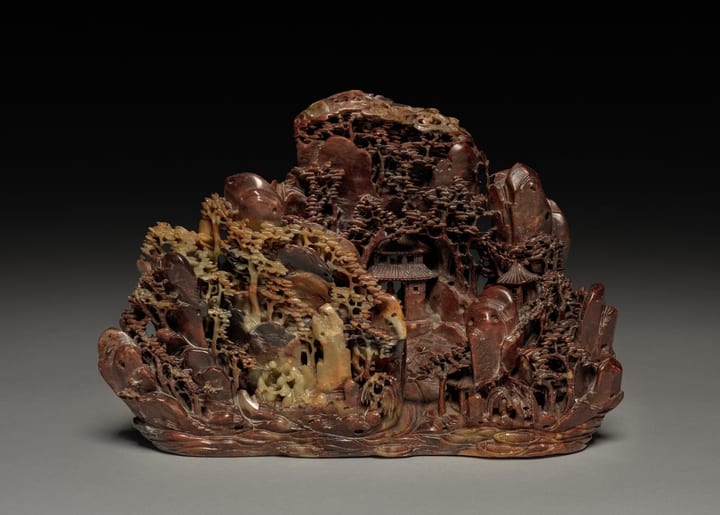
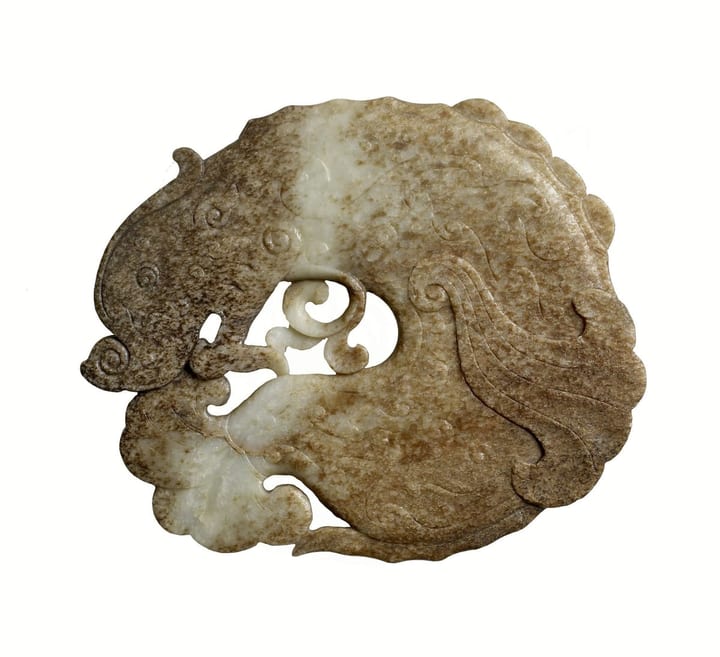
The Cleveland Museum of Art describes its Qing-dynasty Landscape, accession 1917.25, as soapstone. The Walters Art Museum uses the same English material label for its Disk in the Shape of a Dragon, accession 42.268. These are collection identifications; neither record specifies a Qingtian or Shoushan quarry.

A regional stone name and a mineral name answer different questions. Qingtian identifies a place and a carving material tradition in Zhejiang; Shoushan refers to material and craft associated with the Fuzhou area of Fujian. Neither is a synonym for every Chinese object that an English catalogue calls soapstone.

Why one mineral formula is insufficient

Zhu Xuanmin’s published study uses X-ray diffraction and chemical analysis to distinguish pyrophyllite, dickite, illite, and sericite types among Qingtian stones. The finding matters to craft description: varieties grouped under one regional name do not necessarily have the same mineral composition.

A separate research report published by GIA identifies dickitic, nacritic, and illitic types among the Tianhuang stones examined. Tianhuang is associated with the Shoushan area, but this study does not make every Shoushan stone Tianhuang. Nor does a yellow or reddish photograph establish either name. In this guide, museum material labels remain attached to their own objects.

Qingtian and Shoushan: design from the stone

China’s national heritage inventory describes Qingtian stone carving through studying the material, roughing out, carving, waxing, and finishing. It emphasizes adapting the subject to the stone and using its natural colour distribution. Openwork is especially prominent, alongside carving in the round, relief at different depths, and incised lines.

The Shoushan entry likewise places xiangshi, or studying the stone, at the centre of design. Its techniques include sculptural figures, seal knobs, openwork, high and low relief, and boyi, a subtle low-relief approach linked to pictorial expression. A carver chooses among these possibilities; they are not compulsory stages in one elaborate object.

How a small landscape creates depth

Cleveland’s Landscape is catalogued as Chinese, Qing dynasty, 1644–1911. The museum describes a pond, bridge, waterfall, and temple front, with a Buddha visible from the back. The scene therefore rewards attention to both the overall mountain shape and the smaller spaces within it.

The museum also interprets indentations as evidence that stones and metal once embellished the work, and suggests an imagined earthly paradise. That proposed earlier appearance differs from the surviving object. It should not be reconstructed as a certainty, or used to claim that every soapstone landscape was originally inlaid.

A dragon-shaped disk and a wider range of uses

The Walters dragon-shaped disk is dated to the tenth–thirteenth century and attributed to China. Its catalogue supplies a concrete example beyond the later miniature landscape. The record does not establish its original owner or use, so a dragon shape alone is insufficient reason to call it an imperial emblem or a ritual implement.

These objects also broaden the subject beyond seal cutting. The regional traditions include seals, but their sculpture, relief, and openwork deserve attention in their own right. The related seal engraving guide follows inscriptions; the rock crystal guide explains a different material and abrasive working; the Duan inkstone guide follows another stone with a particular desk function.

Museum photographs and credits

Landscape, China, Qing dynasty, 1644–1911. Catalogued as soapstone. The Cleveland Museum of Art, 1917.25; Worcester R. Warner Collection. CC0; resized from the museum’s print JPEG.

Disk in the Shape of a Dragon, China, 10th–13th century. Catalogued as soapstone. The Walters Art Museum, 42.268; Acquired by Henry Walters. CC0; resized.

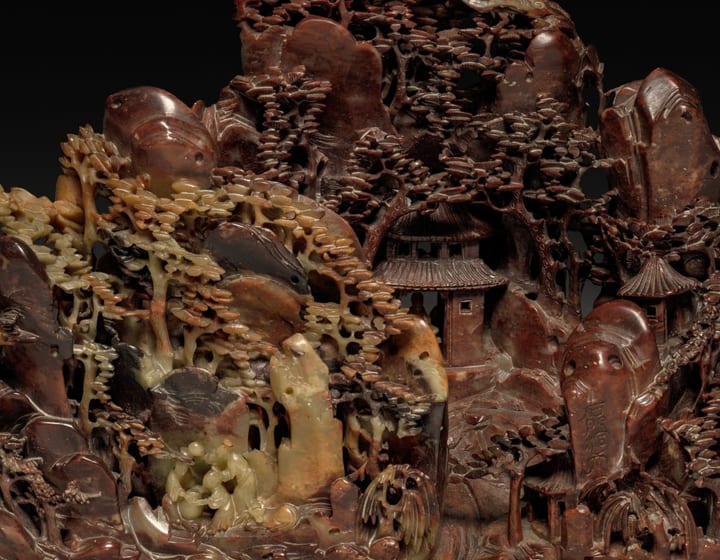
Detail crop from the same photograph of The Cleveland Museum of Art’s Landscape, 1917.25, shown above. The pavilions and layered carving belong to this same object. CC0; cropped and resized.
Chinese dragon-shaped stone disk with pierced openings, incised curls and a mottled pale-and-brown surface

Chinese Soapstone Carving in practice

The relationship between a stone’s natural shape and a chosen subject is central to the regional craft accounts. A sculpture can offer an imagined landscape or a familiar figure, without every motif carrying the same meaning.

Detail crop from the same soapstone landscape photograph showing pavilions, tree forms and densely carved rocky layers

Chinese Soapstone Carving in practice

The relationship between a stone’s natural shape and a chosen subject is central to the regional craft accounts. A sculpture can offer an imagined landscape or a familiar figure, without every motif carrying the same meaning.

How Chinese Soapstone Carving is practiced

  1. Study the stone and choose a subjectIn the documented regional workflow, examine shape, colour, and texture before cutting. Arrange the composition around the usable material rather than imposing the same design on every block.
  2. Establish the main massesPrepare a design and rough out the major forms. The Fujian account distinguishes initial blocking from the further carving that makes the structure and subject clear.
  3. Carve the chosen detailsDevelop figures, relief, incised lines, or openings with suitable tools. These are alternatives or combinations selected for a particular work, rather than requirements for every carving.
  4. Refine and smoothRefine the tool-cut surfaces, then carry out the appropriate polishing. The Shoushan account treats refining and polishing as distinct operations within a connected sequence.
  5. Complete the finishQingtian and Shoushan accounts include wax-related finishing as part of their documented workshop practice.

Place, craft, and cultural meaning

The relationship between a stone’s natural shape and a chosen subject is central to the regional craft accounts. A sculpture can offer an imagined landscape or a familiar figure, without every motif carrying the same meaning.

Chinese Name软石雕刻(青田石雕、寿山石雕等)
Region or OriginChina; Qingtian in Zhejiang and the Shoushan area of Fuzhou in Fujian are distinct named carving traditions
CategoryTraditional craft
MaterialsFollow each collection’s material label. Qingtian stones include several mineralogical types; Shoushan materials are also diverse. A museum object described simply as soapstone is not thereby proven to come from either region.
ToolsFujian’s industrial gazetteer records chisels, carving knives, files, hammers, and drills for Shoushan work, alongside later mechanized equipment. Tool choice follows the stone and the form; a knife-cutting description is not transferable to hard quartz.
UsesCarved landscapes, figures, animals, seals, and ornamental objects belong to this field. A small landscape can invite close viewing from several sides, while a seal combines a shaped body with a working inscription face.

Common questions

Is all Chinese soapstone carving made from pure talc?
No. Do not treat the broad catalogue term as a complete chemical identification. Published studies of Qingtian and Tianhuang materials document several mineralogical types. Individual works require their own material evidence.

Can colour identify a carving as Qingtian or Shoushan stone?
Colour alone does not establish a quarry or regional stone type. Use a specific object identification or material study. The Cleveland and Walters works here are described as soapstone without assigning them to either named source.

Is soapstone carving mainly about making seals?
Seals are one use, alongside figures, miniature landscapes, and other objects. Regional accounts describe carving in the round, relief, and openwork as well as seal-related work, so the subject is wider than inscription cutting.

Sources and further reading