Chinese double-gourd vases vary beyond two round lobes
The Palace Museum names huluping through resemblance to a gourd. Its terminology includes octagonal forms, round upper sections above square lower bodies, flattened versions and elongated examples. The label therefore covers more than one strictly rounded outline.
Start by tracing the lower body, waist and upper section as connected volumes. Compare how quickly the sides contract and expand. A narrow waist separates the lobes visually, while their proportions determine whether the vase appears compact, tall or strongly divided.
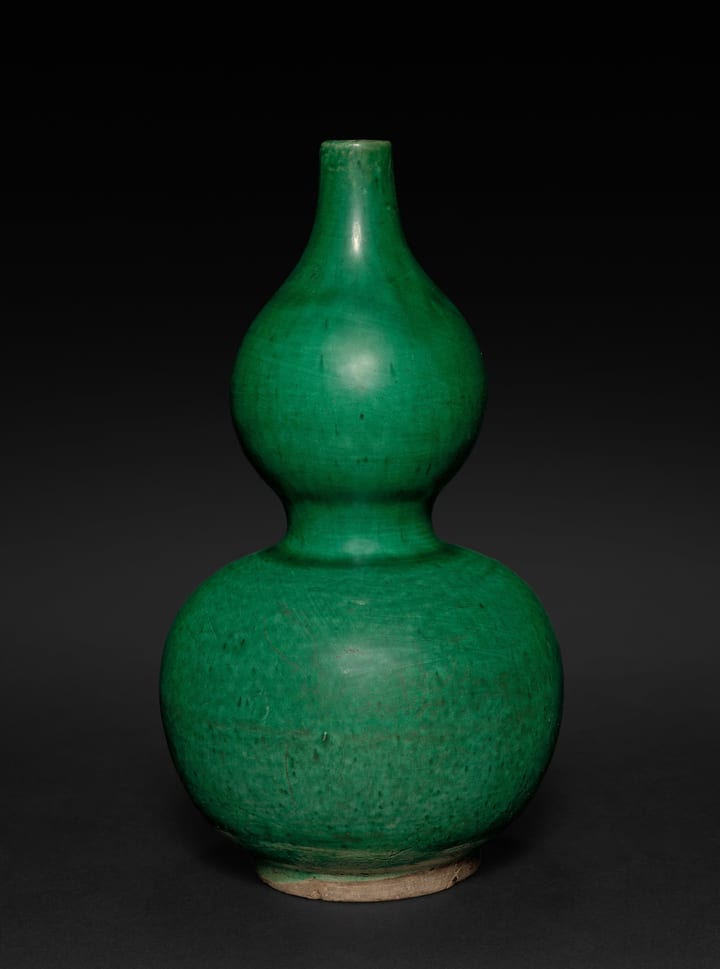
The illustrated Ming vase emphasizes a continuous green surface
Cleveland’s Double Gourd-shaped Green Vase, 1956.711, is dated broadly to the Ming dynasty, 1368–1644. It is 20.2 centimeters high. The catalogue’s medium is stoneware; it does not assign the object to a named kiln.
The complete photograph shows a larger rounded base, a constricted middle and an upper lobe tapering toward the opening. With no large painted narrative, the profile and surface receive attention together. The photograph shows a finished vessel, not its hidden internal joints.
Technical notes document construction from several sections
For yellow-glazed porcelain vase 1942.9.552, the National Gallery of Art records two globular sections joined at the waist. The lower section was itself made in two parts. The upper section continues into a tapering neck.
The description also notes two grooves around the waist and yellow transparent glaze covering the vessel except its rounded foot ring. These are observations of this eighteenth-century vase, rather than a universal recipe for every gourd-shaped ceramic.
A square lower body can carry a specific interpretation
The National Museum’s blue-and-white vase with the Eight Immortals combines a round upper section, a square lower one and a long waist. Clouds, cranes and trigrams occupy the upper portion; figures spread around the lower body.
Its discussion connects the form with Jiajing-period Daoist interests and interprets the round-and-square pairing through a cosmological idea. That reading belongs to the described design and historical context. It need not be assigned to every two-lobed vase or every plain green surface.
A small Qing vase divides its painted subjects by lobe
The Palace Museum’s Qianlong vase 故00152671 is ten centimeters high, with ribbon-shaped handles and a rectangular foot. Enamel flowers cover a yellow ground. Its upper oval panels show landscapes and buildings; lower shaped panels contain European mother-and-child scenes.
The museum discusses shading and perspective in those figures alongside the Chinese gourd form and landscape subjects. Here the two-part body also organizes different pictures. The interpretation comes from the record’s specific imagery, not the silhouette alone.
Separate fired ceramic form from a mold-grown fruit
Our molded gourd vessels guide concerns a living fruit expanding inside a patterned mold. Its grown shell is the material. A ceramic double-gourd vase instead gives a fired body a fruit-related shape; the National Gallery’s documented joins show one way that body was assembled.
Read the material before interpreting the outline. Then compare construction, the distribution of decoration and the museum’s stated use. A shared fruit reference can connect objects without making their materials or making methods interchangeable.
Images and credits
Double Gourd-shaped Green Vase, China, Ming dynasty, 1368–1644. Stoneware. Cleveland Museum of Art, 1956.711; The Fanny Tewksbury King Collection. CC0. Complete photograph, resized.