Chinese millefleurs porcelain: a layout rather than a palette
Guimet explains mille fleurs as a European expression also used for densely flowered textiles. In its Chinese porcelain discussion, the museum refers to a hundred flowers represented without empty space. Cleveland uses the Chinese title 萬花錦紋 for its bottle-shaped vase, alongside the English term millefleurs.
These names direct attention to a composition built from many blossoms. They do not require every example to have identical flowers, an identical palette or one production date. A useful first description separates the dense floral arrangement from the enamel colours used to create it.
A Jiaqing vase makes a crowded surface readable
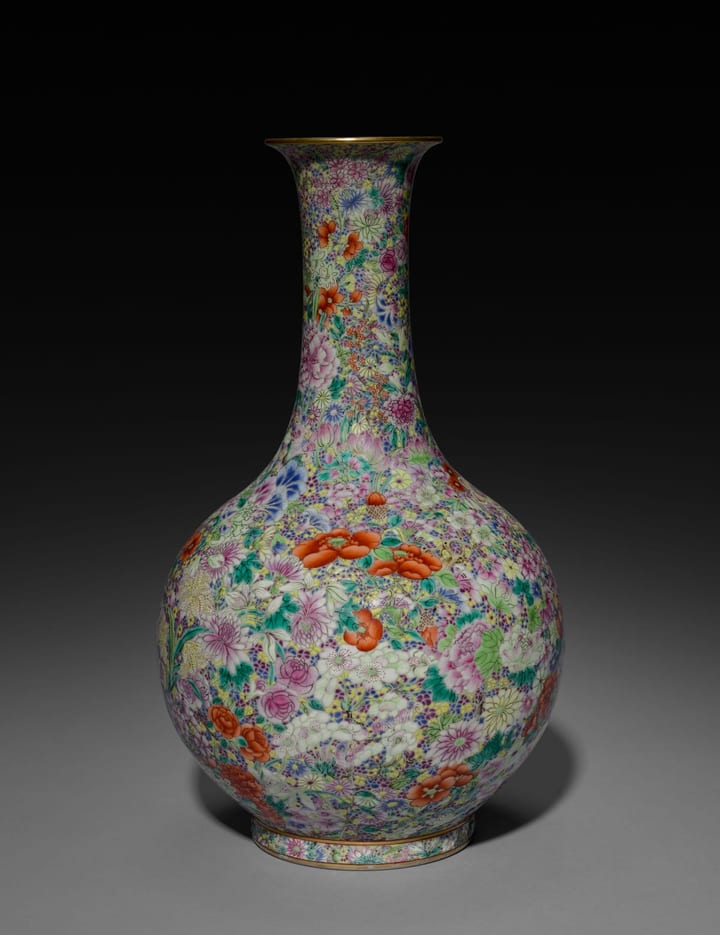
Cleveland’s Bottle-Shaped Vase, 1944.151, is dated 1796–1820, the Jiaqing reign. Its medium is porcelain with overglaze colours and gold. The museum identifies peonies, morning glories, lilies and lotuses and explains that shaded petals suggest volume and depth.
The effect depends on more than filling every gap. Flower heads vary in size and orientation, and a recognisable petal can emerge from the surrounding foliage. Consider how the smaller forms connect larger blooms, then how that continuous field fits the rounded body and narrowing neck. The gold-painted mouth supplies a different edge treatment from the floral surface.
Guimet’s Qianlong jar joins variety with enamel control
Guimet’s G3344 is a Qianlong-period jar, 1736–1795, attributed in its Grandidier catalogue to Jingdezhen, Jiangxi. The catalogue records a high rounded shoulder, wide opening, gold at the mouth and pale-blue surfaces inside and beneath the vessel.
The museum’s collection essay identifies a famille rose palette and notes that this particular work underwent multiple firings to accommodate its enamels. It also discusses lightly shaded colours that give the flowers volume. This connects the final density of the design with controlled painting and firing; it does not supply a universal temperature or firing count for all millefleurs.
Similar decoration can belong to different dates
The museum network in Centre-Val de Loire describes a mille-fleurs vase at the Château royal de Blois, 39.5.313, as nineteenth-century, with an apocryphal Qianlong mark. The record distinguishes the later object from the prestigious earlier model it recalls. The mark is not accepted as its production date.
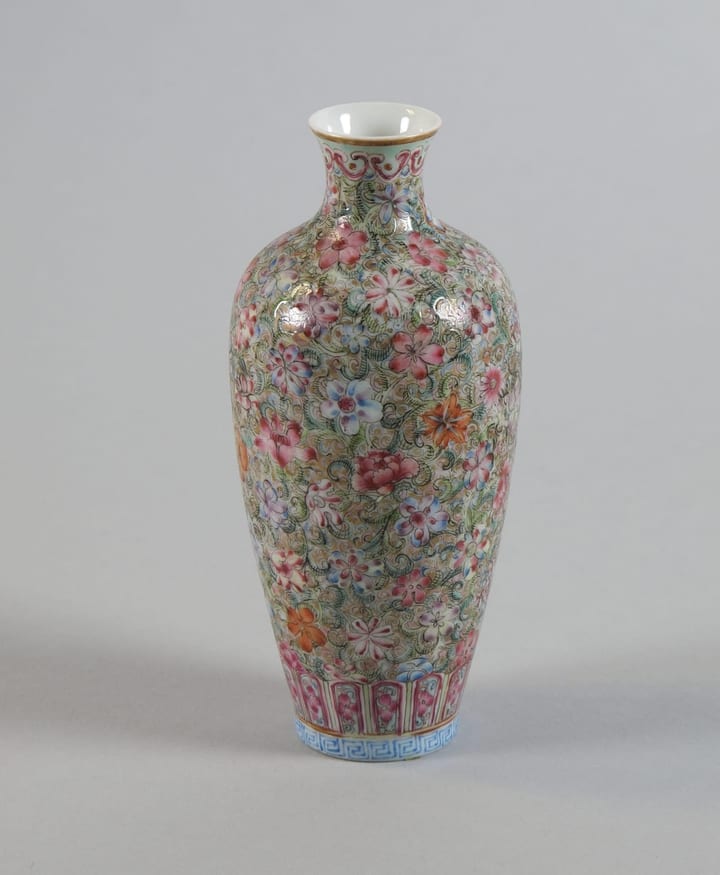
The Met’s Vase with millefleurs decoration, 50.145.322, is later again: its current catalogue date is the 1920s to 40s. The medium specifies Jingdezhen porcelain painted in overglaze polychrome enamels. Keeping that date visible gives a more informative comparison than describing every dense floral vase as Qing or Qianlong.
Whole-vessel coverage still needs a clear structure
A painter planning a many-flower design faces a changing surface: a broad body, narrow neck, curving shoulder and distinct rim. The Guimet jar’s large shoulder and the Cleveland bottle’s slender neck provide different spaces in which to arrange the floral field.
Try following one cluster until it meets the next. Does a leaf separate two similarly coloured flowers? Does a smaller blossom connect larger shapes? These are questions about how an image remains coherent on a vessel. They also explain why a close detail and a complete view show different kinds of work.
Abundance and individual flowers should be read together
Guimet links particular flowers with associations that can vary by context, including peony with wealth and spring, and lotus with purity and summer. The assembled field can therefore combine plants associated with different seasons rather than depict a single garden at one moment.
A vessel’s painted flowers remain even when it is displayed empty. Real flowers, if placed in it, introduce another group of shapes and colours. The relationship between those stems and the permanent floral field offers a different way to consider a vase in use.
Place the pattern beside other decorating approaches
Our famille rose guide explains the palette and its tonal possibilities. Millefleurs asks another question: how are many flower forms organised across the available surface? A flower painted in famille rose is not automatically part of a millefleurs composition.
Our grisaille companion follows restricted-tone enamel images, while wucai and doucai examine other colour and layer relationships. Continue to Jingdezhen porcelain for the broader production context. Keeping palette, composition and making sequence distinct makes these related guides useful together.
Images and credits
Bottle-Shaped Vase with millefleurs decoration, China, Qing dynasty, Jiaqing reign, 1796–1820; porcelain with overglaze colors and gold. The Cleveland Museum of Art, 1944.151. CC0.
Vase with millefleurs decoration, China, 1920s–40s; porcelain painted in overglaze polychrome enamels (Jingdezhen ware). The Metropolitan Museum of Art, 50.145.322. CC0.