Chinese grisaille porcelain: keep the term beside its medium
Historic Deerfield calls its circa 1745 export teacup, HD 67.142, en grisaille and also gives the terms encre de chine and ink color. Its material record specifies hard-paste porcelain, overglaze black enamel and gilding. Those fields identify a fired ceramic decoration with an ink-like appearance.
Chinese mocai provides a related comparison rather than a label to apply indiscriminately. Beijing Art Museum explicitly places its painting above the fired glaze and allows small additions of other colours. A catalogue’s chosen term and technical description are more useful than demanding that every passage be exactly gray.
A Washington portrait gives a precise source-image link
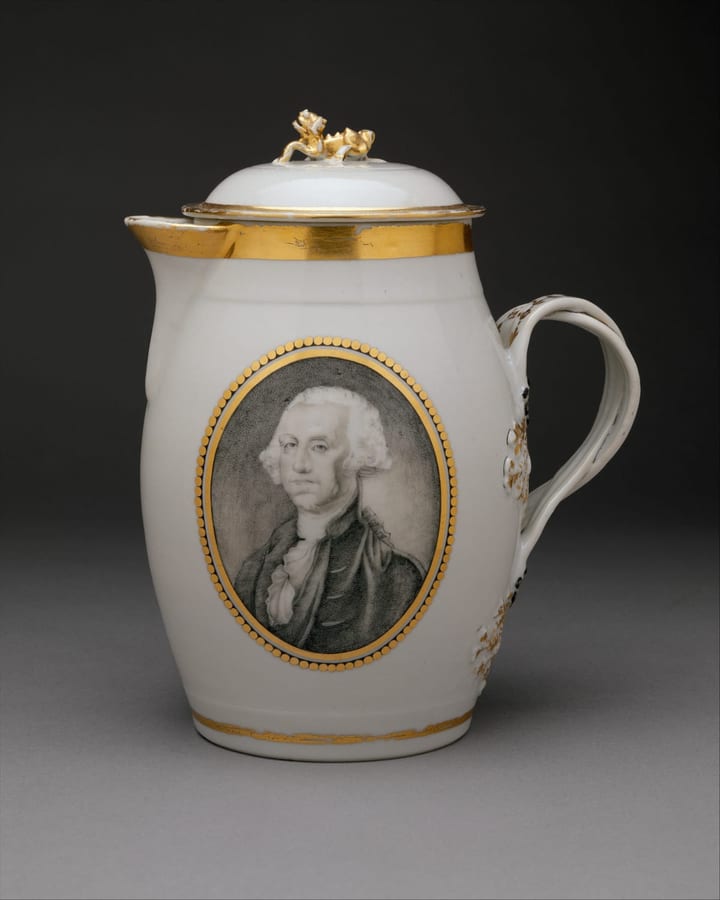
The Met’s Toddy Jug, 34.74a, b, is dated 1800–1820, made in China for the American market. The museum describes George Washington’s portrait in grisaille and identifies its source as an engraving by David Edwin after Gilbert Stuart, faithfully copied by a Chinese artist.
Gold initials beneath the spout identify Edward Tilghman, the recipient of one of four jugs ordered by Benjamin Chew Wilcocks. The portrait and personal lettering bring different kinds of identification onto a serving vessel.
Flowers and landscapes offer other uses of restricted colour
The Nelson-Atkins Museum’s mid-eighteenth-century Chinese export Teapot, 2003.16.9A, B, has grisaille bouquets arranged in large vases. Its record also notes black enamel and gilding around the rim and related decoration on the cover. This offers a floral comparison with the portrait jug.
The Met’s early-eighteenth-century Vase with landscape, 79.2.1026, is instead identified in its Chinese title as a Yongzheng mocai landscape vase from Jingdezhen. Its medium specifies black and red overglaze enamels. Keep that description intact: it provides a useful related ink-colour example without requiring the English catalogue to call it grisaille.
Ink-like painting can coexist with another surface illusion
The Palace Museum’s Yongzheng brush pot, 故00151913, combines an ink-colour landscape with woodgrain glaze at its upper and lower edges and inside. The museum describes painting black material on white porcelain and subsequently firing it to obtain an effect resembling ink painting on paper.
The object therefore imitates different materials in different areas: woodgrain frames a pictorial field, and ceramic paint supplies an ink-like image. Compare the boundary between the treatments as well as the landscape itself. The brush pot’s function also places that image among the equipment of writing.
Chinese porcelain body and painting location are separate facts
The Fitzwilliam Museum’s Anatomy saucer, C.1-2021, provides an instructive boundary. It is Chinese porcelain decorated in overglaze grisaille by a Dutch painter. The museum discusses porcelain blanks shipped from China to the Netherlands for decoration.
That saucer is a comparison rather than an example of Chinese-painted grisaille. In the Washington jug’s case, the Met explicitly identifies a Chinese artist; in other cases, a Chinese body alone cannot establish where the enamel painting happened. Distinguish production, decoration and later ownership when reading a museum record.
Compare tone, composition and painting stages
Begin with one tonal motif: which marks define its contour, and which passages suggest volume or distance? Then consider how much unpainted porcelain surrounds it and how borders or inscriptions organise the rest of the vessel. These questions make a small palette visually informative.
Our famille rose guide concentrates on a named enamel palette; wucai and doucai explain other relationships between colours and decorating layers. The millefleurs companion follows a densely covered floral layout. These terms answer different questions, so a comparison works best when it keeps both the image and its making sequence in view.
Images and credits
Toddy Jug, made in China for the American market, 1800–1820; porcelain with a grisaille portrait of George Washington and gilt decoration. The Metropolitan Museum of Art, 34.74a, b. CC0.