An arc is a form, not a complete explanation
The Met’s Arc-shaped pendant, 2001.665, is Chinese nephrite dated to the fifth–fourth century BCE. Its length is fourteen centimetres; the catalogue distinguishes form, material and date.
Compare the companion guides to bi discs and cong tubes. A huang does not present a complete circular ring or a squared hollow body. Calling it an arc does not prove that it was physically cut from a finished bi, or that every example had an identical suspension arrangement.
Excavated examples anchor the comparison
Shanghai Museum’s Huang comes from the Songze Site in Qingpu District, Shanghai. It is attributed to Songze culture, which the museum places about 6,000–5,400 years ago. The piece measures 6.6 centimetres long, 2.4 wide and 0.3 thick. This is a particular excavated example, rather than a date for the entire form.
Academia Sinica records another Jade Huang Pendant, R020628, from Liu-li-ko in Huixian, Henan. Its collection entry places it between the middle seventh and middle sixth centuries BCE and records a length of 8.1 centimetres. The site and dated object offer a different kind of evidence from a general resemblance between two arcs.
Read holes and surviving marks on their own object
The Smithsonian’s F1917.383 is a small, flat nephrite plaque from the Lake Tai region, dated about 3500–2700 BCE. The record describes an oval upper edge and a straighter lower edge interrupted by a curved notch. It also notes two functional holes, conically bored from both sides, and two saw marks.
Drill and saw marks provide evidence of shaping, but the recorded details belong to this particular Neolithic plaque. They do not demonstrate the tools used for the later photographed pendant.
A patterned arc can terminate in animal heads
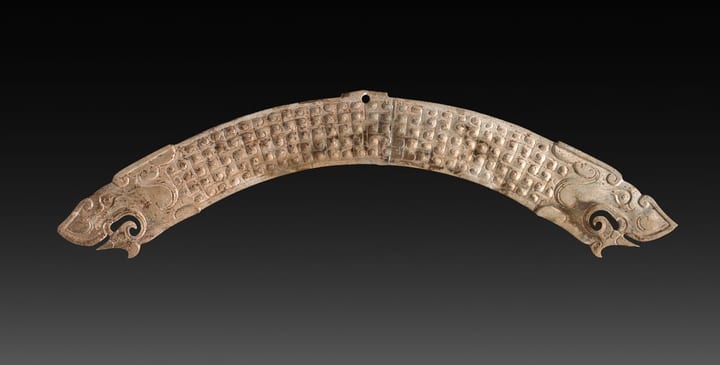
The photograph shows Cleveland’s Arc-Shaped Pendant (Huangpei), 1952.578, dated about 400–300 BCE in the Warring States period. Its nephrite body measures 14.1 centimetres. The ends form stylized animal heads, while raised curls cover the intervening arc and a small opening pierces the upper centre.
Notice how repeating curls fill the body while larger heads finish the ends. The photograph shows a finished object, rather than a workshop sequence.
A pair and an assemblage are different claims
Princeton catalogues 2005-54 a-b as a pair of carved jade huang, dated to the late tenth century BCE in the Western Zhou period. The recorded widths differ: 10.9 and 10.1 centimetres. A shared catalogue grouping need not mean that two surviving pieces have exactly matching dimensions.
A later comparison at The Met makes reconstruction explicit. Its early eighth-century Assemblage of pendants, 1994.605.111a–e, combines nephrite with bronze and turquoise and includes arc-shaped and cloud-shaped components. The museum identifies the display as a reconstruction of a type suspended from a woman’s belt, supported by Tang murals and stone engravings. That evidence concerns a later arrangement; it should not be transferred unchanged to a Neolithic arc.
Working the outline and refining the surface
GIA’s research describes jade shaping through abrasives and discusses cutting, grinding, drilling and polishing among early operations. Removing material establishes the body, while finer work develops openings, decoration and finish. A smooth surface may conceal earlier working marks, so the visible finish is not the whole manufacturing history.
The name alone does not establish antiquity
Birmingham Museum of Art calls its object 1991.1067 Huang but dates it to about 1850, in the Qing dynasty. The catalogue lists jade and records an inscription referring to the Great Song Court. The wording and the museum’s object date are different pieces of information; the inscription should not silently replace the catalogue date.
Images and credits
Arc-Shaped Pendant (Huangpei), China, c. 400–300 BCE. Nephrite. Cleveland Museum of Art, 1952.578, Anonymous Gift. CC0. Complete photograph, uncropped and resized for display.