Recognising a tablet without reducing every example to one outline
Taiwan’s National Museum of Natural Science describes the gui as a pointed tablet. It distinguishes the related zhang by an oblique blade. These form names help orient a comparison with the round bi, squared cong tube and curved huang.
The National Museum of China gives a broader classification: flat-ended, pointed and rounded-projecting forms. Its account links gui with rulers and nobles in Zhou settings, including tokens of status and ceremonial activities. A single familiar outline is therefore an introduction to the category rather than its complete historical range.
A long history appears in particular catalogue records
The National Palace Museum’s exhibition identifies a gui from late Shandong Longshan culture, about 2200–1900 BCE. Its recorded length is 24.6 centimetres, width seven and thickness 1.2. It is presented within the exhibition’s discussion of the shift from tools toward ritual objects.
The National Gallery of Victoria records a different Gui tablet, 651-D4, as Chinese and Han dynasty, 206 BCE–220 CE. Its description notes a blade-like form with rock and wave imagery below and a star design above. The medium is listed simply as jade. That individual catalogue attribution should remain attached to this object.
An oath gives a tablet a specific political voice
Henan Museum’s Jade Gui Tablet with Oath of Loyalty was unearthed at Xizhangji village, Wenxian county, in 1980. The museum assigns it to the Spring and Autumn period. At 11.7 centimetres high and only two millimetres thick, the tablet carries brush-written text in three lines.
The text concerns loyalty and the consequences of disobedience. Henan’s discussion proposes a connection with Jin politics around 497 BCE, presenting that historical setting as an interpretation. Here the written surface adds evidence beyond the form: the object records a commitment rather than remaining an anonymous emblem of rank.
Qing examples bring old forms into new visual settings
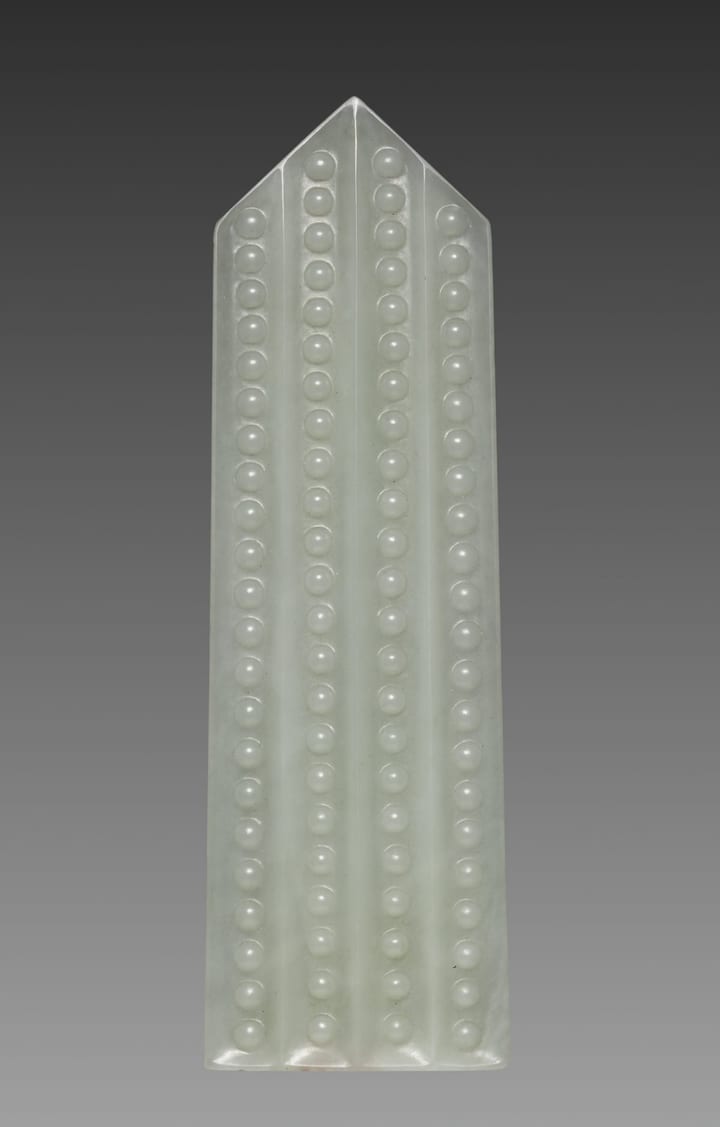
The photographed Cleveland gui, 1952.476, is dated 1793 and measures 22.1 by seven centimetres. Rows of raised rounded elements cover its front. The museum identifies a Qianlong essay on the reverse; the front photograph does not show that inscription.
Another Qing gui in the National Palace Museum, 故玉001353N000000000, is dark green, with two dragons extending toward the pointed end. Gold fills the engraved lines, contrasting with the stone. Its recorded length is 29.2 centimetres. This decoration differs from Cleveland’s pale relief surface while retaining a tablet format.
An inscription date can remain open to reassessment
Cleveland’s separate Scepter with poems by Tao Qian, 1960.278, refers in its inscription to production in the Xiuneisi jade workshop in 1122. The museum explicitly questions that Northern Song attribution. Its date field reads 1122 or later, and its cultural attribution allows a possible Qing, Qianlong-period origin.
The poet’s lifetime, the date mentioned by the inscription and the museum’s assessment of manufacture are distinct. Keeping them visible allows the object to retain its literary interest without turning a historical reference into a securely established production date.
Working marks and material labels answer different questions
The Smithsonian’s Straight chisel, identified as gui, F1917.57, offers another shape. Its archive describes a Qing object in the style of a Neolithic model, with two conical perforations at one end bored from opposite sides. The slightly tapering body has rounded edges and a bevelled end. These details belong to this particular later object.
GIA’s research describes jade shaping through abrasive removal, including cutting, grinding, drilling and polishing. Raised decoration, holes and smooth fields involve different working demands. Their presence does not supply a complete workshop reconstruction, and the broad name jade does not by itself settle a specimen’s mineral identity. The companion jade-carving guide follows that wider craft background.
Images and credits
Tablet (gui) with Grain Pattern and Imperial Inscription, China, 1793, Qing dynasty. Translucent white jade. Cleveland Museum of Art, 1952.476, Anonymous Gift. CC0. Complete front photograph, uncropped and resized for display.