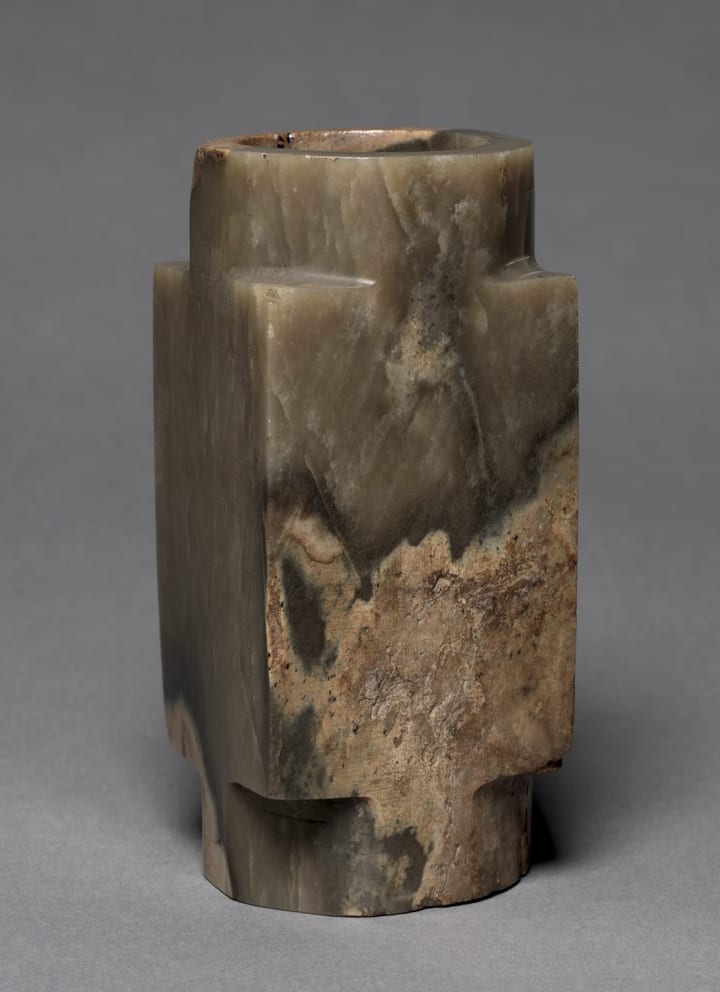
Read the circular opening and squared body together
The Met’s Liangzhu cong, 2004.52, is dated about 2400 BCE. This 25.4-centimetre nephrite tube has a gently tapering square exterior.
Compare the outer corners with the projecting ends and through-hole. The companion guide to jade bi discs examines a flattened ring; a cong gives the opening a vertical body.
Corner faces need to be read across an edge
The Met describes round eyes and bar-shaped mouths on corner masks. Read adjoining faces together: the decoration crosses the edge between them.
Seattle Art Museum’s compact nephrite cong, accession 88.112, is only about six centimetres high. Its label identifies eight pairs of projecting eyes across stylized corner faces. The museum attributes its pale surface to changes during long burial, noting that it was originally translucent green. That account belongs to this particular object.
A Fitzwilliam Museum example, O.2-1946, supplies another comparison: dark green nephrite with pale flecking, a round opening and four bands of animal-like masks across the prism surfaces. Its recorded height is eleven centimetres. Count the tiers and compare proportions before assuming that all tubes share one size or arrangement.
The archaeological setting extends beyond a single jade
UNESCO places the Archaeological Ruins of Liangzhu City in the lower Yangtze region and dates the principal site to about 3300–2300 BCE. Its account brings together urban planning, water management, rice cultivation and cemeteries whose differences express social hierarchy. Jade artefacts are part of that larger evidence.
A museum object separated from its surroundings cannot reveal that entire system by itself. UNESCO’s inscription concerns the archaeological site, rather than a separate intangible-heritage listing for the cong form.
A bore and an outer surface preserve different work
GIA describes early jade working as abrasive shaping, with operations including cutting, grinding, drilling and polishing. Abrasive particles remove the stone while a tool directs the action. This differs from slicing a soft material with a knife. A finished tube therefore combines several working problems rather than one act of carving.
Cleveland records a ridge inside its Ceremonial Tube, 1915.630, where bores from opposite ends met. This is object-specific evidence of making; neither the tools of every earlier maker nor the internal ridge are demonstrated by the exterior photograph.
Keep early uncertainty separate from later explanations
The photographed Cleveland nephrite cong is dated about 1600–1056 BCE, in the Shang dynasty. A later period must not be conflated with the earliest Liangzhu examples.
UMMA distinguishes unknown Stone Age meanings from the later Zhou Li explanation linking the square cong with earth and the circular bi with heaven. This association belongs to a textual interpretation; it is not direct testimony from the first makers.
A familiar form can be made again centuries later
The Rijksmuseum’s cong, AK-MAK-512, is catalogued as Chinese and dated to 1600–1699 CE. Its record explicitly identifies it as a later imitation. The square tube is therefore not, by itself, proof of a Neolithic date. A revival can preserve interest in an old form while belonging to a different historical setting.
Images and credits
Ceremonial Tube (Cong), China, Shang dynasty, c. 1600–1056 BCE. Nephrite. Cleveland Museum of Art, 1915.630, Gift of the John Huntington Art and Polytechnic Trust. CC0. Complete photograph, uncropped and resized for display.