Chinese handscroll vs hanging scroll: what changes?
A handscroll is arranged for horizontal viewing. The Met describes an image that may occupy several joined sheets of paper or silk, with a mounting that winds around a wooden dowel at the left end. Its right end typically includes a silk wrapper and a fastening.
A hanging scroll has a paper backing and surrounding silk mounting. A cord at the top suspends it, while a wooden rod at the bottom supplies weight and helps it roll for storage. The support system explains why these formats work differently even when both carry ink painting.
Read a handscroll through successive passages
Dawn Delbanco’s Met essay describes traditional viewing from right to left, opening a section and rolling it again before moving onward. The viewer can pause over one passage and proceed more quickly through another. A continuous landscape or narrative is experienced over time.
A museum case or a digital photograph may reveal much more at once. To recover something of the sequential encounter, begin at the right and examine one passage before moving left. This is an approach to looking at a reproduction, rather than permission to handle a museum object.
Twin Pines: picture size and mounted length
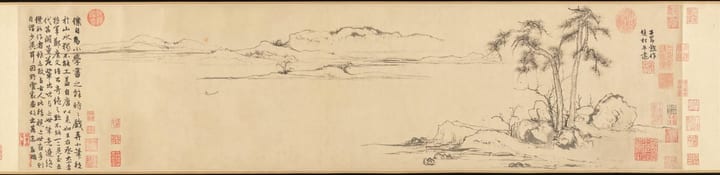
Zhao Mengfu’s Twin Pines, Level Distance, dated about 1310, is The Met’s accession 1973.120.5. It is a Chinese Yuan-dynasty handscroll in ink on paper. The catalogue records an image measuring 26.8 by 107.5 centimeters, but an overall mounted length of 781.5 centimeters.
Those measurements identify different parts of the object. The photograph reproduced here shows the painted image field, including inscriptions and seals, rather than that entire mounting. The museum identifies a title at the right of the pines and a longer inscription above the distant mountains on the left. Reading the work involves text as well as scenery.
A hanging scroll presents the mounted composition
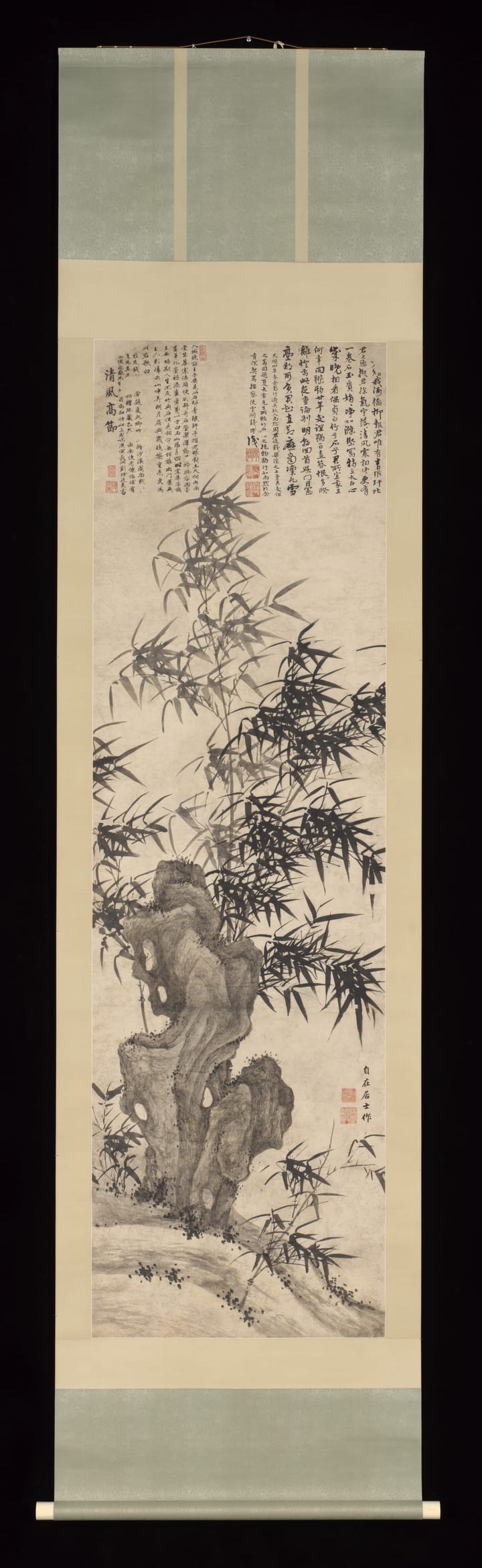
Xia Chang’s Windblown bamboo, about 1460, offers a vertical comparison. The Met records accession 1989.235.1 as a Chinese Ming-dynasty hanging scroll in ink on paper. Its image is 203.4 centimeters high; the overall mounting is 299.7 centimeters high.
The complete mounted photograph shows the painting surrounded by substantial borders, with a suspension cord above and a roller below. These belong to the object encountered on the wall. The Met relates the bamboo subject to integrity and strength, showing that a display format and a cultural meaning can be discussed separately.
Inscriptions extend the life of a handscroll
Delbanco explains that inscriptions may precede or follow a painting. Further sheets can hold colophons: comments written by friends, collectors or later viewers. These texts may discuss the artist, the painting or an earlier response.
The extended object can preserve a history of reception as well as an image. A long mounted scroll need not be filled throughout with scenery. Attend to where the painting ends and commentary begins, while consulting the individual catalogue for the identities and dates of those additions.
Mounting is a skilled practice
In Cleveland Museum of Art’s interview with conservator Yi-Hsia Hsiao, training includes preparing paste, handling very thin wet paper, cutting narrow strips, using paste and smoothing brushes, toning silk and paper, sewing cords and trimming wooden rollers. These are distinct skills within the making of a support.
This helps explain the difference between creating a painted image and assembling its scroll format. The museum’s account presents sustained specialist training; a few visible borders do not reveal all the work underneath them.
A documented remounting, with a specific purpose
Cleveland’s Facing the Ancestors describes a Chinese ancestor group portrait that arrived mounted as a panel. After assessment, conservators replaced its old paper linings and remounted it as a Chinese hanging scroll. New, thin, toned xuan-paper linings and a drying board formed part of that treatment.
The example shows that a present mounting can have a documented conservation history. The museum also explains that portraits of this type were hung over a home altar during New Year worship. Here the chosen format connects preservation, viewing and a particular ritual use; it does not establish the purpose of every hanging scroll.
Display and storage belong together
Harvard Library describes scrolls as layered structures intended to be opened for limited viewing, rolled, wrapped and stored in protective boxes. Their paper, silk, wood and other components work together. A hanging scroll’s ability to hang does not make permanent exposure its intended condition.
For a historical object, its condition determines how it can be opened or displayed. Harvard recommends a conservator’s help when damage is apparent. The comparison is most useful as an explanation of formats; treatment decisions depend on the particular work.
Connect format with brushwork and materials
The gongbi and xieyi comparison follows pictorial decisions within an image; the baimiao guide examines ink outlines. Either discussion benefits from knowing what part of a scroll a photograph presents. Four Treasures of the Study introduces the working materials that precede the mounting stage.
Images and credits
Zhao Mengfu, Twin Pines, Level Distance, about 1310. China, Yuan dynasty. Handscroll; ink on paper. The Metropolitan Museum of Art, 1973.120.5; Ex coll.: C. C. Wang Family, Gift of The Dillon Fund, 1973. Public domain, CC0. The museum photograph shows the painted image field, not the complete 781.5-centimeter mounting; supplied image used uncropped, with responsive resizing for display.
Xia Chang, Windblown bamboo, about 1460. China, Ming dynasty. Hanging scroll; ink on paper. The Metropolitan Museum of Art, 1989.235.1; Edward Elliott Family Collection, Gift of Douglas Dillon, 1989. Public domain, CC0. Complete mounted scroll photograph, including suspension cord, borders and bottom roller; supplied image used uncropped, with responsive resizing for display.