Chinese baimiao painting: an image made through lines
The Palace Museum defines baimiao as outlining subjects in ink without added color. This explains the traditional emphasis: the ink line itself carries the representation. The English term white drawing does not mean that white pigment supplies the outlines.
Liao Anya’s Palace Museum study distinguishes an independent pictorial form from outlining within copying techniques. A line painting can be the intended result, rather than an unfinished stage awaiting color.
A line has character as well as a boundary
The Met’s In the Palace, accession 1978.4, is an early-twelfth-century work by an unidentified artist after Zhou Wenju, dated before 1140. The museum associates its plain-drawing manner with Li Gonglin and describes an iron-wire type of line: the brush tip stays centered within the stroke, producing a taut, flowing mark.
That explanation concerns a particular manner of drawing. It offers a useful way to look at a sleeve or a bending body: follow the line as a brush movement as well as an edge. The museum records ink and touches of color on silk for this object, a reminder to keep its complete material description alongside its stylistic designation.
Narrative without a written text on the painting
Odes of the State of Bin: The Seventh Month, The Met’s accession 1982.459, is catalogued as a thirteenth-century baimiao handscroll by an unidentified artist. Its source poem belongs to the Book of Odes and follows the countryside through agricultural work, silkworm cultivation, seasonal preparation and domestic life.
The museum describes a continuous narrative with no text included in the painting. The surviving scroll lacks illustrations for the poem’s first two stanzas and opens with mulberry leaves being picked for silkworms. A literary subject can therefore be carried by pictured actions and their sequence, without every passage being written beside them.
The format matters to the reading. The museum presents the handscroll from right to left; a photograph of one passage shows only part of a much longer unfolding work. Follow the local grouping of figures while keeping that larger sequence in mind.
Flowers defined by contours, veins and light ink
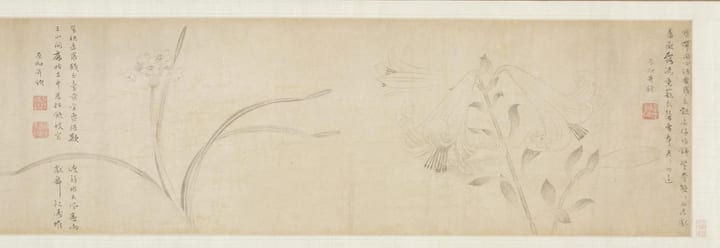
Zhao Zhong’s Ink Flowers, dated 1361, offers a different subject. Cleveland Museum of Art explicitly identifies accession 1967.36 as linear baimiao. Its curatorial description explains how fine lines define plant contours and the veins of petals and leaves, while light ink washes give the forms subtle modeling.
The scroll pairs flowers with poems. Its subjects include lily, narcissus and peony; the museum says that their combination does not correspond to a known seasonal or symbolic system popular in the fourteenth century. This leaves room to appreciate the particular arrangement without assigning a standard message to every blossom.
The museum photograph here is a handscroll detail showing narcissus and lily, not the entire three-flower composition. Compare its sweeping leaves and bounded blossoms; the catalogue supplies the baimiao identification.
Fine drawing can carry an ethical argument
Wang Shanggong’s Paragons of Loyalty and Filial Piety, The Met’s accession 1985.335, is dated 1593. The museum describes an exceptionally delicate baimiao manner inspired by Li Gonglin’s monochrome drawings. Its thin lines provide a different comparison from the iron-wire terminology used for In the Palace.
The subject reaches beyond an exercise in dexterity. The Met interprets Wang’s revival of earlier stories in relation to his own time, including themes of officials admonishing a ruler and an emperor receiving ministers. The painting connects inherited pictorial language with contemporary social commentary. Appreciating line does not require setting aside what the figures are doing.
A documented way to study different kinds of line
In Liao Anya’s copying study of Vimalakirti Preaching Buddhist Doctrine, analysis precedes drawing. Flowing garments, firmly outlined ornaments and fine facial details are copied in separate groups with different ink strengths.
This working choice shows why studying baimiao involves more than applying one thin outline everywhere. Skin, fabric and a held object call attention to different kinds of marks.
Connect the painted line with its working materials
The calligraphy guide follows written characters, while baimiao makes pictured forms. They invite related attention to brush movement without becoming the same practice. Four Treasures of the Study introduces the working materials; the pine-soot and oil-soot comparison follows how ink is made. Those material histories complement the decisions visible in a painting.
Images and credits
Zhao Zhong, Ink Flowers, 1361, detail showing narcissus and lily. Handscroll; ink on paper. Cleveland Museum of Art, 1967.36; John L. Severance Fund. CC0. The museum source photograph shows part of the scroll, not its entire three-flower composition; used uncropped and resized for display.