Gongbi vs xieyi painting: a working distinction
Gongbi (工笔) is commonly introduced as meticulous or careful painting. The Asian Art Museum describes close attention to detail, forms and standards. Its teaching examples associate the approach particularly with works in color. This is a useful emphasis rather than a requirement that every careful picture use the same palette.
Xieyi (写意) is often translated as freehand painting or sketching ideas. The museum emphasizes a free, spontaneous character, usually in ink and sometimes with light color. Compare how a painting describes its subject: through carefully articulated boundaries and modeling, or through marks whose movement remains especially prominent.
What the outline-and-wash sequence explains
ChinaCulture’s account of gongbi describes fine lines followed by washes of ink and color applied in successive layers. This gives a practical distinction between drawing a boundary and developing the area it encloses. An outline can establish the form while later washes contribute to its appearance.
Look at a petal or a bird’s body in a documented example. Ask where the contour is defined and how the interior shifts in tone or color. This is a way of reading the finished result; a museum photograph does not reveal the exact number of layers or the artist’s full working schedule.
Expressive brushwork involves more than fewer details
Santa Barbara Museum of Art’s account of Peter Sturman’s lecture describes xieyi through a quick-moving brush and images that appear spontaneous. It connects the practice with calligraphy and, for scholar-official painters, with literary expression. Brush movement can therefore contribute to a work’s cultural character as well as its visible shape.
Seeming spontaneity is an effect to examine, not a record of how long the whole painting took. Follow a mark’s changing direction or weight, then consider what it contributes to the subject. The term does not require the picture to abandon recognizable birds, flowers or figures.
Zhou Zhimian: outlined flowers and dotted leaves
Henan Museum’s bird-and-flower handscroll by Zhou Zhimian is dated to the Wanli reign, 1573–1620. Its account explicitly combines gongbi and xieyi, describing a method of linking flowers and dotting leaves. Outlined flower contours work alongside leaves developed through ink and color.
This makes the comparison concrete without forcing an entire composition into one category. The museum also relates Zhou’s bird painting to sustained observation of birds and their different poses. Freer handling and attention to a subject’s living character can belong to the same practice.
Lu Ji: careful flowers beside broader trees and rocks
The Palace Museum’s Ming hanging scroll by Lu Ji, accession 新00146440, depicts birds with osmanthus and chrysanthemums. Its catalogue distinguishes the carefully colored flowers and birds from trees and rocks handled in broader ink brushwork, explicitly describing a combination of gongbi and xieyi. The recorded material is colored painting on silk.
The contrast helps organize the picture. More detailed subjects and more broadly handled surroundings support one another within a single work. The museum connects the selected birds and flowers with wishes for prosperity, longevity and moral character, placing that imagery within a courtly setting. Cultural intention is present in the meticulous passages as well as the freer ones.
A museum example of fine line and graded wash
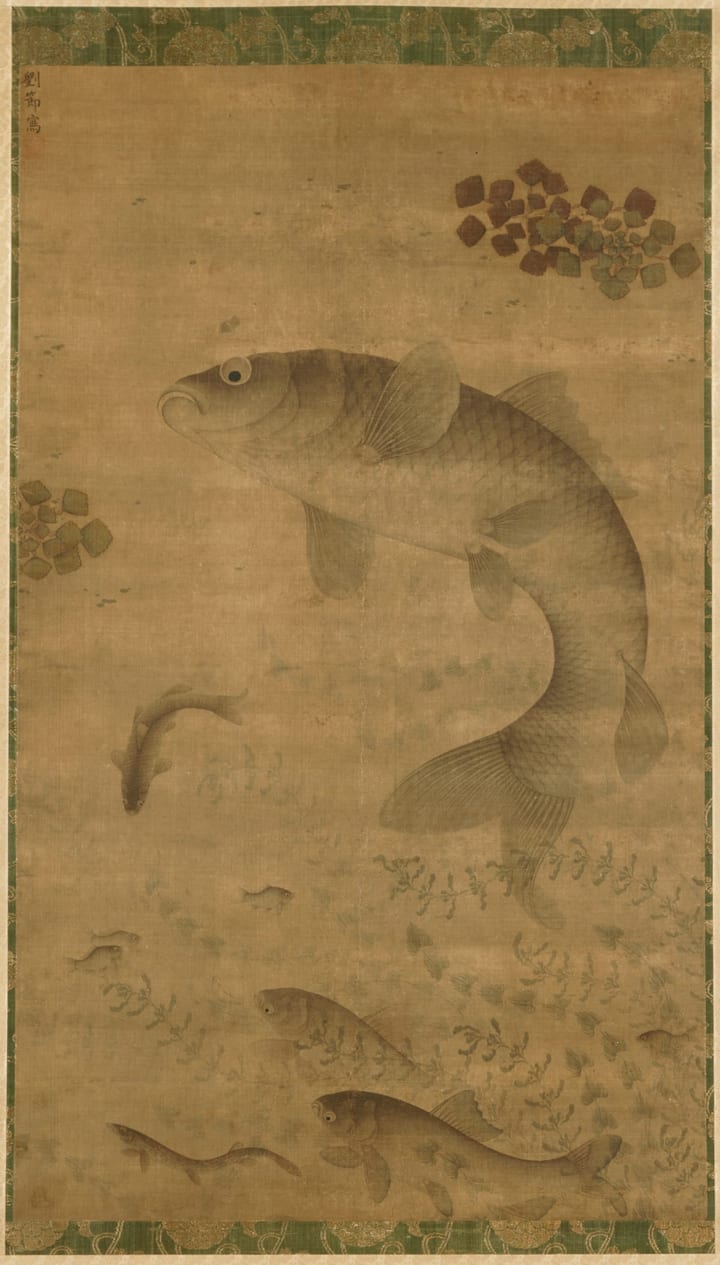
Cleveland Museum of Art’s Leaping Carp by Liu Jie, accession 1977.55, is catalogued as a Ming-dynasty hanging scroll, dated 1368–1644, in ink and color on silk. The museum specifically describes fine ink line and graded wash in the representation of the fish.
The photograph provides a useful comparison point for those recorded features. Follow a fin’s bounded shape and the changing tone across the body. The collection description establishes line and wash; it does not give the work a gongbi label or document each stage of its manufacture. Its detailed representation also carries possible auspicious readings, which the museum discusses separately from technique.
Shared materials, different pictorial decisions
The Asian Art Museum identifies brush size and type, pressure, speed, moisture, ink or color loading, brush angle and the paper or silk as factors affecting a painted mark. A style name alone therefore cannot specify the complete set of working materials or explain every visible effect.
The baimiao guide follows the pictorial work of ink outlines in greater depth. Here the comparison concerns how outlines, washes and direct brush marks are organized together. Four Treasures of the Study introduces the materials, while the pine-soot and oil-soot guide follows ink manufacture before painting begins.
Images and credits
Liu Jie, Leaping Carp, China, Ming dynasty (catalogue date 1368–1644). Hanging scroll; ink and color on silk. Cleveland Museum of Art, 1977.55; John L. Severance Fund. CC0. Complete museum photograph, uncropped and resized for display.