An album is a format, not a subject
A Chinese painting album, or ceye (冊頁), brings relatively small pictures or calligraphy together in a booklike structure. Landscapes, flowers, birds and written responses can all occupy its leaves. The word album therefore tells you how works have been gathered and presented; it does not identify one painting style.
The Met’s account of East Asian painting formats describes individual pages carrying rectangular, square or fan-shaped works. An artist may assemble an album, but a collector can also bring works together by artist, period or subject. When a catalogue calls something an album leaf, ask whether you are seeing one contribution or the whole surviving sequence.
Reading one leaf and then the next
Begin with a single reproduced leaf. Notice the size of its painted field, the surrounding support and any writing or seals. Then move to another leaf and compare the distribution of dark and light, the viewpoint and the relationship between text and image. This is a way to look closely at reproductions, not an instruction to handle a museum album.
A sequence can invite comparison even when its pictures do not form a continuous panorama. The boundary of each leaf gives one composition a pause before the next. An online grid is useful for comparing pages, while an individual enlargement reveals brush marks that the grid can hide.
Huangshan, one vista at a time
Zheng Min’s Eight views of the Yellow Mountains, dated 1681, shows what an album sequence can accomplish. The Met describes seventeenth-century Anhui painters using this format to present Huangshan through successive views. Its catalogue identifies nine leaves of painting and calligraphy in ink on paper.
An accompanying inscription explains that a younger friend requested the album. Zheng painted from memory, hoping to encourage the friend to visit the mountains. The work is consequently more than a small landscape collection: different views, remembered travel and a written exchange belong to the same encounter. The museum also distinguishes the measurements of an image from those of its mounting.
A collective album can connect different artists
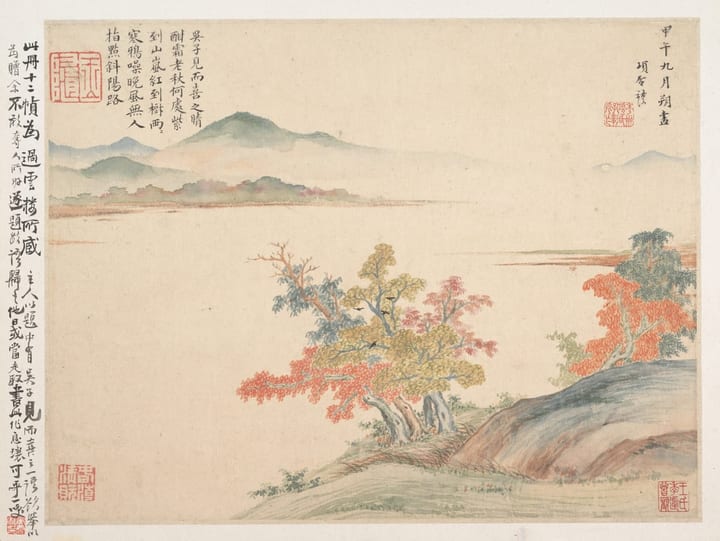
The illustrated Autumn Landscape by Xiang Shengmo is a leaf from an album made for Zhou Lianggong, a seventeenth-century collector and official. Dated 1654, it is ink and colour on paper. The museum describes Zhou’s collaborative albums as a place where artists with different affiliations and approaches could see and assess one another’s work.
Look at the photograph’s broad water, distant hills, autumn trees, inscriptions and red seals as parts of a single leaf. It does not show the entire collective album or its binding. The catalogue gives the picture as 25.1 by 33.3 centimetres, a useful reminder that a large screen reproduction can conceal the intimate scale of the original.
Read the attribution as carefully as the picture
The Met’s Eight Songs of the Xiao and Xiang Rivers is currently catalogued as a sixteenth- or seventeenth-century album by an unidentified artist after Wen Zhengming. Although it bears Wen’s signature, the museum considers the painting and calligraphy to be in his style after his death.
That distinction matters when comparing albums. A historical signature, a modern catalogue attribution and the name of the style being followed are different kinds of information. Retaining “after” in a credit gives readers a more accurate account than presenting the work as an unquestioned original by the named master.
Brushwork and mounting are different kinds of skill
The painted surface may be paper or silk, while mounting supplies the structure through which the work is supported and encountered. Do not assume that every visible border was painted with the picture or that every surviving leaf retains its first arrangement. A specific catalogue or treatment record is needed before drawing those conclusions.
Cleveland’s conversation with conservator Yi-Hsia Hsiao describes specialist training in preparing paste, working with very thin wet paper, using paste and smoothing brushes, and toning mounting materials. It also documents experienced teachers passing on Chinese painting conservation skills. Those accounts explain why the supporting craft deserves attention alongside the artist’s brushwork, without turning an album photograph into a do-it-yourself mounting recipe.
Connect the leaf, sequence and catalogue
For a first comparison, follow a single picture, compare two leaves, and then read the catalogue’s account of the set. Keep image dimensions separate from the complete mounted object. Together these questions reveal how a modest-sized painting can participate in a larger sequence, a friendship or a collection.
Images and credits
Xiang Shengmo, Autumn Landscape, leaf from Album for Zhou Lianggong, dated 1654; ink and colour on paper. The Metropolitan Museum of Art, 64.268.1, Seymour Fund, 1964. Public domain, CC0. Complete museum photograph of one leaf, uncropped and resized; not the whole album or its binding.