What Chinese gold and silver inlay adds to the body
The Palace Museum describes a bronze-working method in which shallow patterns or characters are prepared in the surface, thin gold or silver sheet or wire is fitted into them, and the surface is ground and polished. The host metal remains the body of the object; the precious metal supplies the contrasting design.
Wire suits narrow, continuous lines, while pieces of sheet can occupy broader areas. The relationship is between a prepared receiving space and an inserted material. A finished photograph may show the pattern, but it does not necessarily reveal the depth of a channel or its concealed edges.
Early examples: an iron belt hook and a bronze wine vessel
The Palace Museum places gold and silver decoration on bronzes in the pre-Qin period and describes its flourishing during the Warring States and Western Han. These are broad historical markers, not proof that every later object followed one unchanged workshop recipe.
A fourth- to third-century BCE belt hook at The Met, accession 65.170.2, is catalogued as iron inlaid with gold and silver. It is a useful correction to the assumption that the technique only belongs to bronze vessels. The record identifies a small fitting associated with dress, rather than a freestanding ritual vessel.
The National Museum of China’s Western Han rhinoceros-shaped zun gives a different context. Its hollow body held wine, with a covered opening on the back; fine gold and silver cloud designs extend over the exterior. The animal form, the container and the inlaid pattern are separate aspects of the same object.
Later works show different bodies and designs
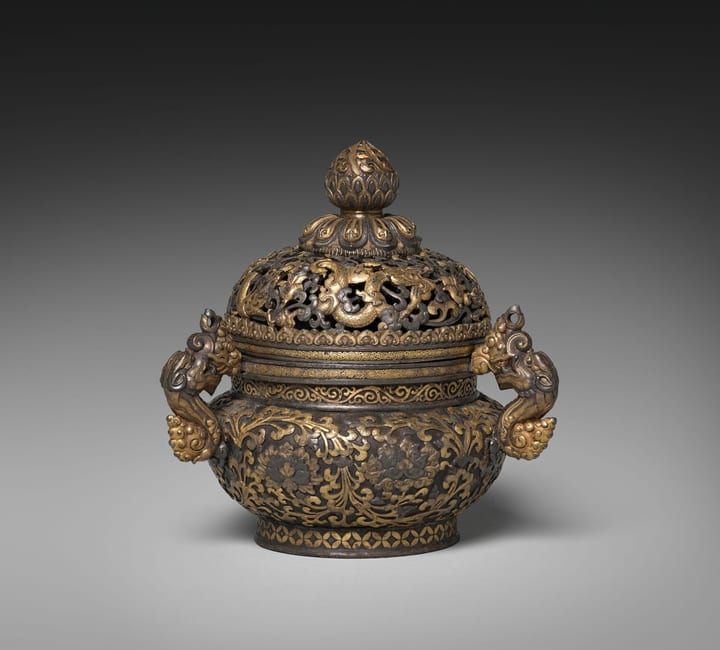
The Cleveland Museum of Art catalogues its Incense Burner, 1983.154, as iron inlaid with gold and silver, made in China in the early 1400s, during the Yongle period. Its description identifies floral decoration, dragon-head handles and a perforated cover with a dragon. This later object places the metal combination within an incense-burning form.
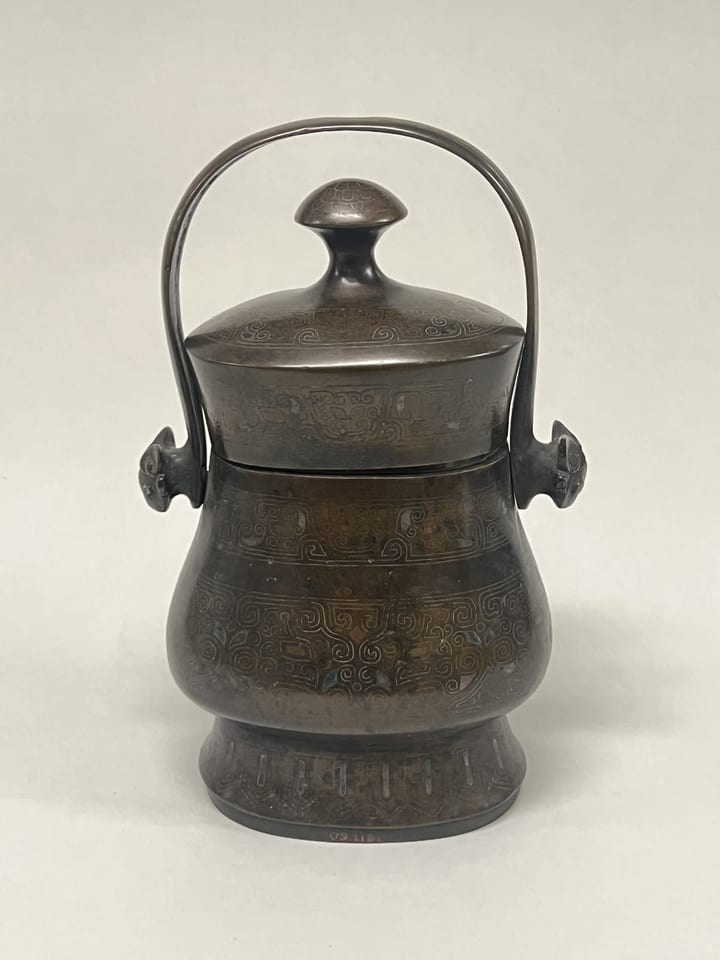
The Met’s Wine Vessel of Archaistic Design, 09.119, is dated to the sixteenth–seventeenth century and listed under the Ming dynasty. Its bronze is inlaid with gold, silver and brass. The additional brass matters: the catalogue describes a mixed-metal decoration, so a viewer should not label every yellow-toned element as gold. Its archaistic design also does not make it an ancient Warring States object.
Why damascening needs a technical description
English catalogues sometimes use damascening for related metal decoration, but the word is not a precise substitute for every instance of jinyin cuo. The V&A distinguishes metal fitted into engraved channels from gold or silver worked onto a scored surface. Both have been described as damascened work. Naming the receiving surface and attachment method is therefore more informative than relying on the English label alone.
That comparison explains terminology; it does not establish which microscopic retaining structure was used on either object photographed here. Their museum records identify inlay materials, without providing a full reconstruction of manufacture.
Distinguish inlay from four neighbouring techniques
Gilding adds a gold surface layer. Traditional liujin (鎏金), described by China’s ICH authority, uses an amalgam process to bond gold to a metal surface. Gold-leaf application, tiejin (贴金), attaches extremely thin leaf. These are coating methods, rather than the insertion of shaped metal into the patterned recesses discussed here.
Filigree, huasi (花丝), shapes fine wire into built or woven forms; its wire can define openwork instead of disappearing into a host-metal groove. Repoussé, chui die (锤揲), raises relief by working sheet metal from the reverse. It reshapes the sheet itself. A single object may combine techniques, so these names describe operations rather than mutually exclusive classes of objects.
Reading the photographs with the records
The two images show finished historical objects: the Cleveland iron incense burner and The Met’s bronze wine vessel. Their materials and dates come from the museum catalogues. Neither photograph documents a workshop stage, exposed channel or chemical analysis. Pattern, patina and reflected light can guide looking, while technical identification still depends on the record.
Museum photographs and credits
Incense Burner, China, early 1400s, Yongle period; iron inlaid with gold and silver. Cleveland Museum of Art, 1983.154; The Severance and Greta Millikin Purchase Fund. Public domain/CC0. Complete museum photograph, proportionally resized. A finished historical object; its recorded materials do not expose the channels or every attachment method.
Wine Vessel of Archaistic Design, China, 16th–17th century, Ming dynasty; bronze inlaid with gold, silver and brass. The Metropolitan Museum of Art, 09.119; Rogers Fund, 1909. Public domain/CC0. Complete photograph LC-09_119_01, proportionally resized. A finished object, not a workshop or manufacturing-stage image.