A trade name does not identify a manufacturing origin
The NGV connects the Coromandel name with merchant ships stopping along the southeastern Indian coast on their return to Europe. Its screen is identified as made in China. Separate those two places when reading the label: a trading route and a production location answer different questions.
An attractive foreign name should not replace the catalogue’s geographical evidence. Nor does a European collecting history establish that every example was commissioned for export. Look for the object’s own date, imagery, inscriptions and provenance before assigning its intended audience.
The wooden support is part of the craft
Gulbenkian’s late-seventeenth-century Chinese screen, inventory 1023, consists of twelve independent panels joined with fittings of copper alloy. Its account distinguishes wooden peg construction, the prepared surface and the later lacquer decoration. These are separate parts of an assembled furnishing.
Ten panels have paper mouldings at the top and calligraphy on the back, features the museum describes as unusual. Preserve those qualifications: the record is evidence for this screen’s construction, not a standard checklist that all Coromandel screens must satisfy.
Kehui and kuancai describe cutting and colour
The Palace Museum’s kehui, 刻灰, entry describes cutting the planned decoration through the lacquer until the preparation below becomes visible. Colour is then applied within the cut design. The decorated areas remain lower than the surrounding ground; the same account also uses kuancai, 款彩, for the technique.
Read the central scene, borders and reverse separately
Penn Museum catalogues C153.7 as one panel of a twelve-panel Chinese folding screen. Its front presents palace activities, with borders containing vessels, jade ornaments, fruit and flowers. On the reverse, each panel has a separate arrangement of flowers, rocks and birds.
The record shows why one attractive detail cannot represent the whole screen. A central narrative may cross joins, while borders and reverse panels organize different subjects. Start by locating the photographed side and the surviving leaves; then relate the individual figures to the larger layout. A cropped panel view should remain identified as a part.
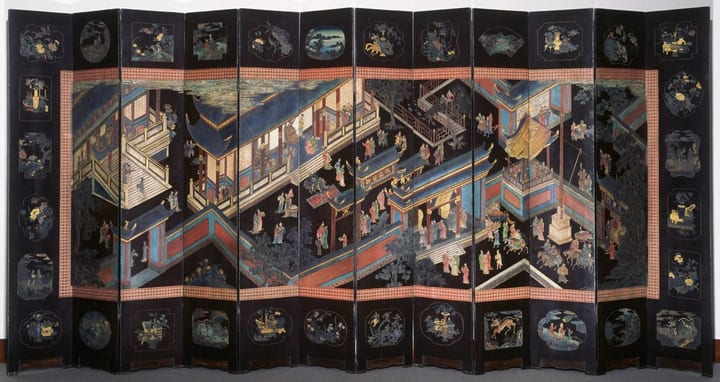
The illustrated example is a complete twelve-panel front
The photograph shows Princeton’s Coromandel lacquer twelve-panel screen, 2005-238 a–l, dated to the late nineteenth century and identified as Chinese. Its recorded medium is wood with lacquer pigments and metal attachments. All twelve leaves appear in this front view.
The broad architectural composition continues across the joins, enclosed by smaller decorative fields. This photograph shows the finished furnishing, not the ground beneath its coating or a making demonstration. The late date should also remain distinct from seventeenth-century examples discussed elsewhere in this guide.
The coloured recesses need their own material description
In The Conservation of Asian Lacquer, Marianne Webb distinguishes the lacquer surface from the paint in the recesses. She reports water-based binding media in the screens she examined and questions untested descriptions of oil paint. That is a finding about her examined material, not proof of one binder in every screen.
The study also distinguishes structural damage, damage to lacquer and damage to painted recesses. This makes the construction useful for understanding condition: a crack in the support and loss of colour are different observations. A glossy dark photograph cannot settle the composition or restoration history of every layer.
Keep the catalogue’s levels of certainty
The Ashmolean records China as the place of creation for EAX.5331, a seventeenth-century Coromandel screen with a palace scene. The Coromandel coast is listed separately as a probable former location. The word probable should travel with that second statement.
Its medium includes brown lacquer with carved, painted and incised decoration and traces of gilding. Those particulars are more useful than turning every dark screen into the same object. Our carved-lacquer, gold-incised-lacquer and mother-of-pearl guides follow other decorative operations within the wider lacquer tradition.
Images and credits
Coromandel lacquer twelve-panel screen, China, late nineteenth century. Princeton 2005-238 a–l; gift of Mr. and Mrs. William M. Lese. Image courtesy of the Princeton University Art Museum. Public domain; uncropped, resized.