How Chinese gold filigree is constructed
The V&A describes filigree as wire twisted into intricate patterns, which can be attached to a support or made sufficiently coherent to stand without a backing. Open space is therefore part of the design, but a completely unsupported lace-like network is not a requirement for every example.
In the Chinese craft described as huasi xiangqian, filigree and setting are related but distinguishable operations. The Chinese Arts and Crafts Society explains wire shaping, filling, assembly, and joining alongside the separate work of preparing settings for pearls or stones. A gem set within an ornament is not itself filigree; the term identifies the metal-wire work around it.
From a drawn wire to a patterned component
A Beijing government report from a working filigree studio describes wire being pulled through successively smaller holes in a drawing plate. After drawing, two or more wires can be twisted together before shaping. This makes preparation an active part of the design: plain wire and twisted wire offer different linear textures.
The craft society’s technical account describes making an outline, then fitting prepared wire patterns inside it with tweezers. Elements may be joined side by side, built in layers, or woven where the design requires it. Soldering secures the prepared assembly while preserving the fine spaces. These are construction stages, rather than a surface that merely looks woven.
Two museum objects, with their differences intact
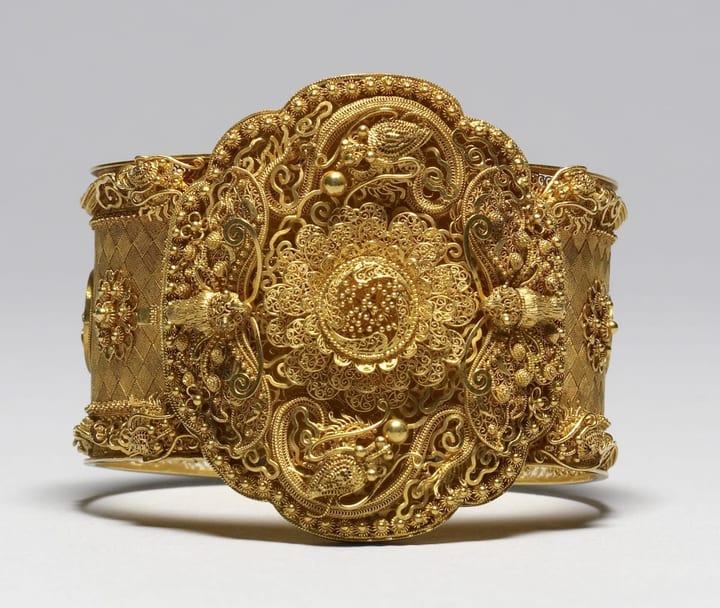
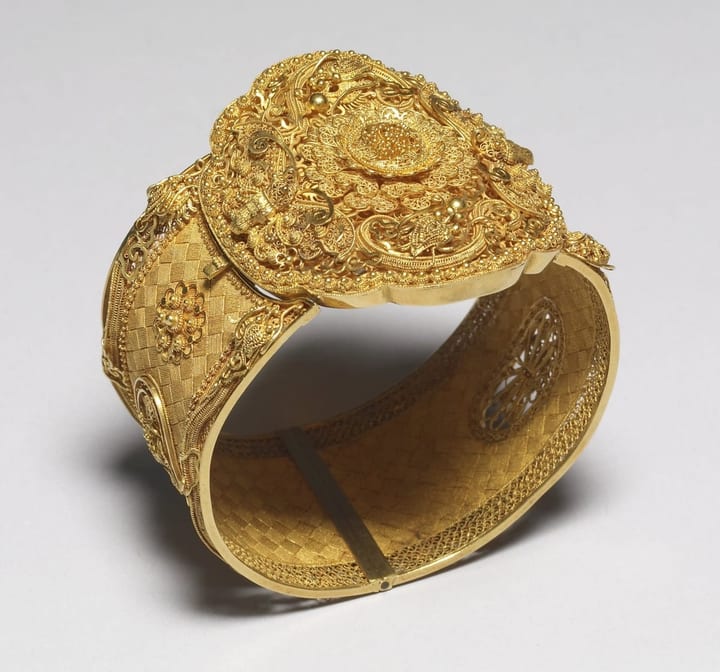
The Walters Art Museum’s Filigree Bracelet, accession 57.2332, is catalogued as gold, made in Guangzhou, China, around 1840. Its title establishes the technique and its record identifies a specific place and approximate date. Neither the original owner nor the gold’s exact purity is established by those fields.
An earlier example is The Met’s eighth-century Hair Ornament, accession 31.54.1, from Tang-dynasty China. The museum explicitly describes the surviving top as filigree set with carved turquoise. Its prongs are missing, so it should not be presented as an intact hairpin. The turquoise and the gold have different roles: a carved inlay and a fine-metal structure.
Wire patterns are not gold granules
Granulation uses small metal grains attached to decorate a surface. Filigree uses wire. They can occur on the same object, but tiny round elements are not automatically short pieces of wire, and a museum may identify both techniques separately. A photograph alone may not show enough to distinguish a real attached grain from a bead-like texture made in another way.
Likewise, the wires in cloisonné enamel define compartments for enamel. The related cloisonné guide explains that different use of a metal outline. Calling every fine-wire object filigree would hide the role that the wire actually performs.
Reading the craft across places and periods
The Guangzhou bracelet and Tang ornament provide dated examples, rather than a continuous family history. The Beijing workshop report documents another place where wire drawing and pattern assembly are practiced.
The companion guide to Chinese repoussé metalwork follows decoration raised from a metal sheet by hammering. The Miao silver ornaments guide instead centres a particular community’s dress and making traditions. Those connections allow readers to explore metalwork without treating a technique, a material, and a cultural identity as interchangeable.
Museum photographs and credits
Filigree Bracelet, Guangzhou, China, ca. 1840. Gold. The Walters Art Museum, 57.2332; Gift of Mrs. Elizabeth Edgell, 2010. CC0; cropped from the museum photograph without enlargement.
Front view of the same Filigree Bracelet, The Walters Art Museum, 57.2332. This is a second museum photograph of the same object, not another bracelet or a process step. CC0; cropped and resized.