How Chinese repoussé metalwork differs from chasing
The Met defines repoussé as raising a design from inside a metal plate so that it appears in relief outside. Chasing adds detail from the outside. Think of the first operation as establishing projecting forms and the second as defining their surfaces, contours, and surrounding areas.
The V&A distinguishes chasing from engraving: chasing displaces metal with repeated tool pressure rather than cutting it away. Engraving removes material to make a line. A finished surface may combine these techniques, so a line, a stippled field, and a raised animal need not all result from the same operation.
A silver mirror back, rather than a complete mirror
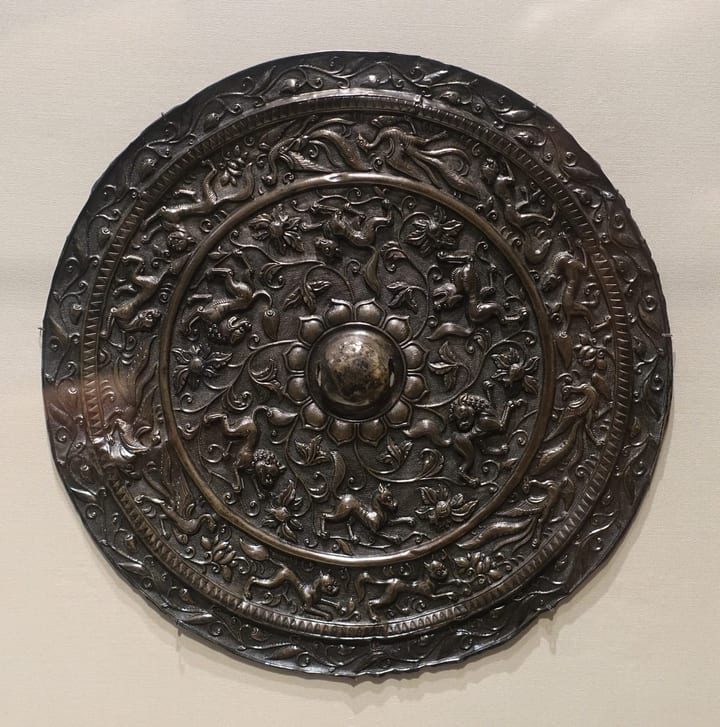
The Met’s eighth-century Mirror Back with Birds and Animals in Repoussé, accession 1985.214.22, is explicitly identified as a Chinese silver disk. The museum explains that it was originally attached to the back of a bronze mirror. The surviving component is therefore the decorated backing, not the reflective face.
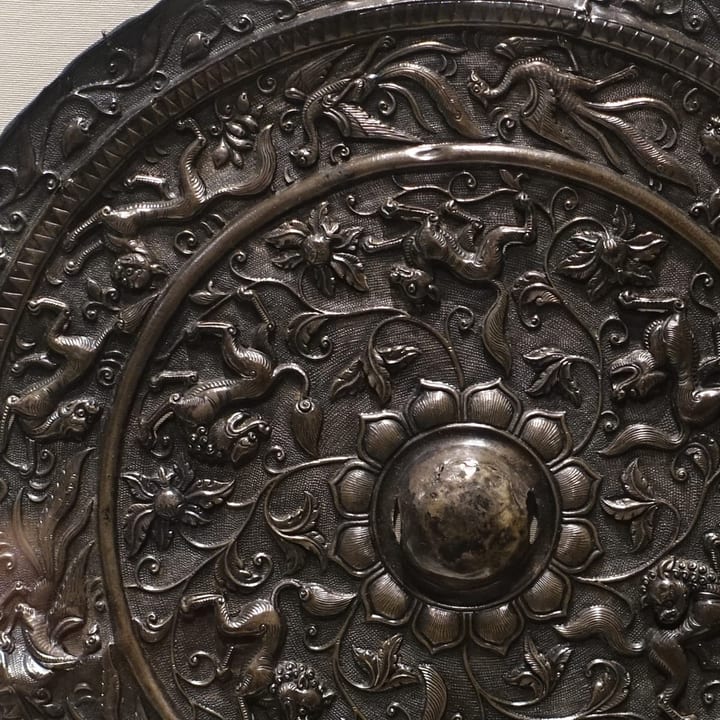
Its design includes fantastic birds and felines among lotus tendrils, with a finely ring-punched background. The title supplies a direct basis for identifying repoussé; the description records another kind of surface work. Distinguishing the projecting design from the background texture makes the object more informative than simply calling the whole surface hammered.
A Yuan cup stand with worked relief
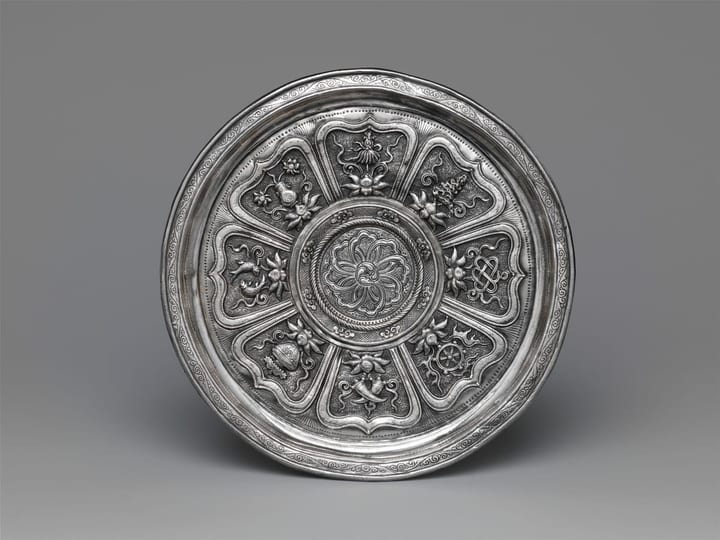
The Met’s fourteenth-century Cup stand with eight treasures, accession 2007.187, is catalogued as Chinese, Yuan dynasty, and silver with repoussé decoration. This provides a second clearly documented form, quite different from the earlier mirror backing. The technique can therefore serve both an applied decorative component and a vessel accessory.
The current museum description identifies Buddhist treasures alongside a rhinoceros-horn motif, an auspicious symbol found on Yuan artworks. Those motifs give this particular stand its subject; they do not establish a universal religious or regional identity for silver relief.
Support and direction matter during making
The sheet needs support that holds it while allowing the intended movement. Experimental research published by EXARC describes working on supports including pitch and explains the role of annealing when metal stiffens through hammering. This supplies a general account of the mechanics, not a recovered recipe from either Chinese object.
Broader forms are developed from the reverse, then the object is turned for front-side refinement. The exact tools and heating cycles require workshop or artifact evidence; finished photographs do not document those decisions.
Relief is an appearance; repoussé is a process
Casting, pressing, and cutting can also produce projecting designs. The Met’s discussion of metal decoration notes that dies and molds can shape sheet ornament as well. A domed or patterned metal surface should therefore be called repoussé only when its record or technical study supports that description.
Compare Chinese gold filigree, where shaped wires are joined into a design, and Miao silver ornaments, which centres a community’s dress and making traditions. A material, a technique, and a cultural identity describe different aspects of metalwork.
Museum photographs and credits
Mirror Back with Birds and Animals in Repoussé, China, 8th century, Tang dynasty. Silver. The Met, 1985.214.22; Gift of Ernest Erickson Foundation, 1985. Originally attached to a bronze mirror; this is the decorated back, not the reflecting face. Public domain/CC0; resized.
Cup stand with eight treasures, China, 14th century, Yuan dynasty. Silver with repoussé decoration. The Met, 2007.187; Purchase, 2006 Benefit Fund, 2007. Public domain/CC0; resized.
Detail crop from the same photograph of The Met’s 1985.214.22 mirror back shown above. The raised birds and tendrils stand against a patterned ground. Public domain/CC0; cropped and resized.