Chinese gilt bronze: distinguish the form from its surface
Getty’s technical guidelines separate the metal substrate from a coating and distinguish several ways to add gold. Gilt bronze therefore should not be described as a solid-gold object. The full medium line can also identify pigments, lacquer or other additions that occupy different parts of a finished work.
The same distinction applies to making. A casting method explains how the metal form was produced; it does not automatically establish how gold reached its surface. Reading those two questions separately prevents a familiar gilding term from concealing a more complex construction.
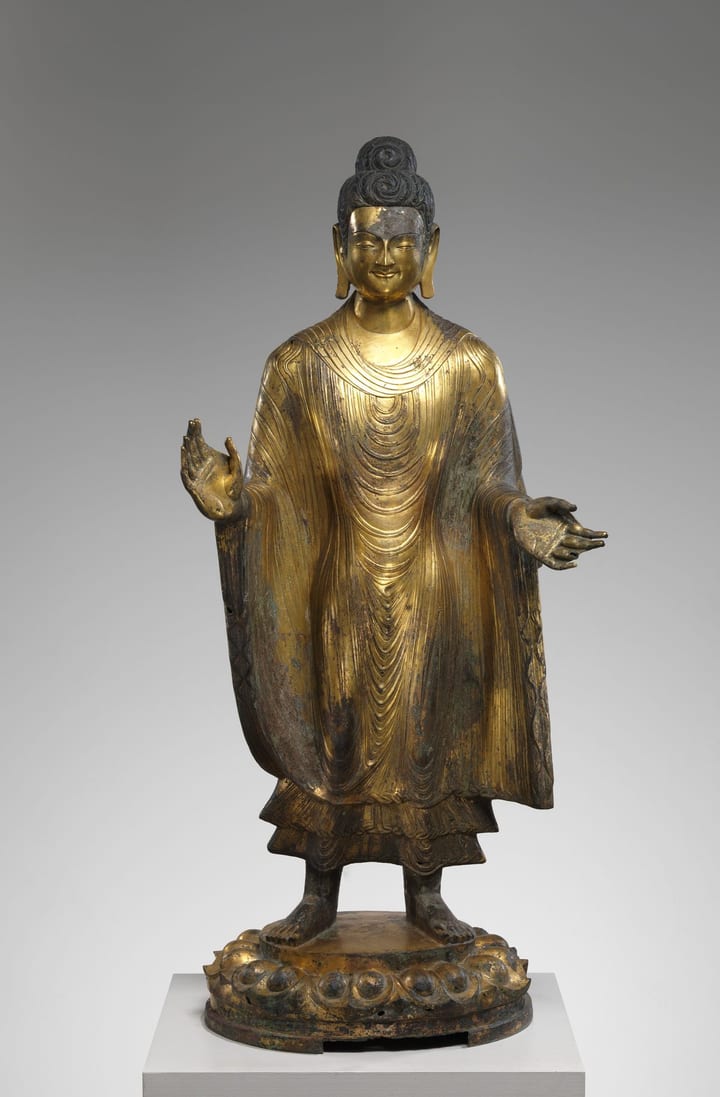
A dated Maitreya records one particular casting method
The Met’s Buddha Maitreya, 26.123, is dated 486, in the Northern Wei dynasty. Its medium is gilt bronze with traces of pigment, piece-mould cast. The inscription at the back of the base supports the identification and date and records a commission in honour of empress dowager Wenming.
Piece-mould casting names the method used for this figure’s body. It should not be replaced by a generic lost-wax account, and it leaves the gilding method as a separate question.
Liujin describes an important historical gilding route
The Chinese University of Hong Kong’s Art Museum explains liujin, 鎏金, as fire or mercury gilding. In that historical route, a gold-mercury amalgam transferred gold to the metal surface. The account distinguishes gilding from gold inlay, another relationship between precious metal and its support.
Getty discusses leaf gilding as another route, attaching thin gold to a surface. These accounts explain a family of surface treatments. An English catalogue’s word gilding does not, on its own, establish one application method for every Chinese object.
Technical study can identify more than appearance
A study published in Archaeometry examined a Han-dynasty plated fragment from Wushan County Museum using microscopy and several compositional methods. Its findings supported mercury gilding and silvering on the studied material. This is evidence from a particular sample, not a visual diagnosis of every golden bronze.
The value of such work is the connection between the layer and the metal beneath it. A photograph can help locate a decorated area, but analysis can investigate its composition and bonding. The fragment’s results should remain separate from an untested claim about the Maitreya.
Gilding can accompany other decoration
The Met’s mid-seventeenth-century Fang-shaped vase, 2015.500.6.108, is catalogued as bronze with gilding and black lacquer with mother-of-pearl inlay. Here a single medium statement records several surface materials. Follow the identified regions rather than treating the complete vessel as one uniform gold coating.
The National Museum of History’s Qing belt clasp, 90-00076, supplies a related gilt-copper example. Its record describes an entirely gilded, openwork design incorporating bats, longevity and double-happiness characters. The support, pierced design and golden finish contribute different aspects of the ornament; the Chinese copper label does not supply a precise alloy analysis.
Compare surface treatment with wire work and raised sheet
Our gold-filigree guide follows fine wires shaped and joined into patterns. Repoussé instead concerns relief raised from a metal sheet. Neither name identifies a gold coating: an object’s form, its assembled components and its finish require their own descriptions.
The gold-and-silver-inlay guide provides another comparison with metal fitted into a prepared support. Use these distinctions to read an object in stages—body, shaping or assembly, surface treatment and additional decoration. The result is a more precise account than grouping objects by shine or apparent expense.
Images and credits
Buddha Maitreya (Mile), China, dated 486, Northern Wei dynasty. Gilt bronze with traces of pigment; piece-mold cast. The Metropolitan Museum of Art, 26.123, John Stewart Kennedy Fund, 1926. CC0. Background cropped with the complete figure and base retained; resized for display.