Which side of a Chinese bronze mirror reflects?
The Rijksmuseum distinguishes originally silvery, tin-rich metal from later green and blue corrosion. Its decorated back is separate from the reflecting face.
UMMA describes a braided silk cord passing through a knob on the back and serving as a handle. Its examples join a polished front to relief cast on the reverse. Look for the relationship between that central attachment and the surrounding design, rather than assuming every raised element was made by hammering.
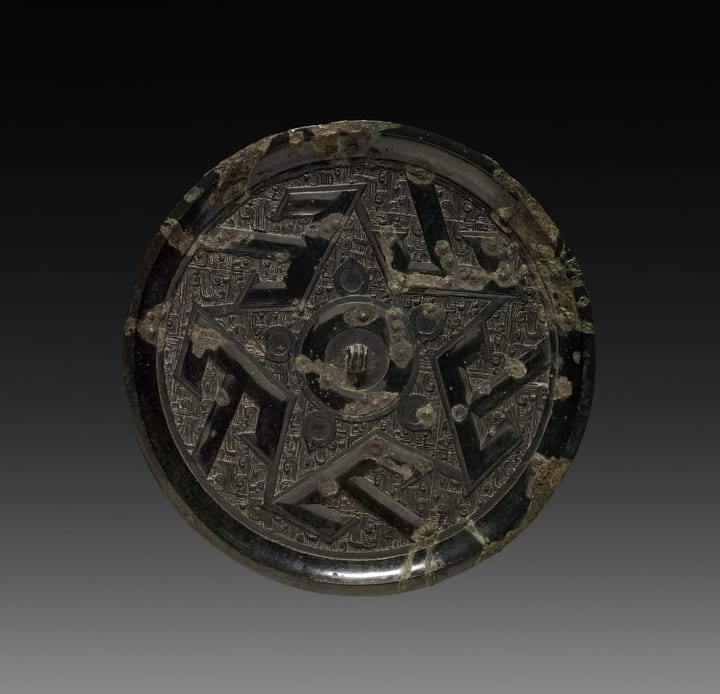
A Shan-pattern mirror records work in the mould
The photographed Cleveland mirror, 1972.34, dates to the 200s BCE. Its Chinese origin is qualified as probably the State of Chu, possibly Hunan. The museum describes repeated stamps making the fine background, followed by larger slanting forms in the clay mould.
Those forms resemble the modern character shan, 山, meaning mountain. Cleveland explicitly leaves their ancient symbolic or decorative purpose unresolved. A recognisable modern label helps describe the pattern; it does not recover a certain belief held by its original users.
Casting and reflective finishing are different operations
Liang and Parker's 2021 study explains clay-mould casting and the polishing that follows it. The relief belongs to the design and moulding stage, while the face needs finishing for reflection. Their account does not justify describing all mirrors with one alloy recipe or one finishing treatment.
The researchers examined four unprovenanced mirrors using several methods. They caution that surface corrosion and the shallow penetration of portable X-ray fluorescence prevented straightforward identification of the underlying alloy. A surface reading, a dark patina and an attractive pattern are different kinds of evidence, not interchangeable guarantees of age.
TLV designs and auspicious inscriptions need specific readings
Seattle's Han mirror 48.157 illustrates the type now called TLV, after markings resembling the Latin letters T, L and V around a square. The museum interprets the design as probably cosmological: the square may represent earth and the circle heaven, while creatures and markings may relate to celestial movements and seasons. Those qualifications matter.
UMMA's separate Eastern Han mirror 1974/1.168 combines stylised tigers with an inscription expressing hopes for descendants to attain high office. This is a particular wish addressed through a particular object. It differs from treating every animal, circular outline or short inscription as one fixed explanation of all Chinese mirrors.
Tang lions and grapevines connect decoration with exchange
The Walters' Mirror with Lions Among Grapevines, 54.470, dates to the seventh or eighth century. Its recorded material is high-tin bronze and its diameter is 23.5 centimetres. The museum connects the imagery with China's contacts beyond its borders during the Tang dynasty.
Lions were not native to China, and grape wine came from Central Asia. On this mirror, those subjects participate in a decorated Chinese object. Motifs can travel without making the place of manufacture identical to their place of origin; the museum's Chinese attribution and its account of exchange answer different questions.
Later copies complicate dating by appearance
The Australian Museum's E69912 looks typical of Han mirrors but is identified as probably a thirteenth- or fourteenth-century replica. The distinction separates a design's historical reference from the making date of the surviving object. An older-looking pattern is not sufficient to date the metal.
The same account notes greater variety of form in Song and Yuan mirrors, including oblong and octagonal examples, followed by the gradual replacement of bronze mirrors by glass during the Qing. Round disks are familiar, but they are not the only documented outline.
Ezhou preserves restoration and replication knowledge
Hubei's provincial intangible-heritage list includes bronze-mirror restoration and replication within bronze-making techniques, associated with Ezhou. This is a specific provincial listing of a craft practice, rather than a claim that every ancient mirror has a separate national heritage designation.
An Ezhou government account published in 2018 describes research and reconstruction using excavated Warring States-to-Tang mirrors as models. Its sequence includes model and clay-mould preparation, mould firing, alloy preparation and casting, then work after casting. Reconstructing a technique through research is distinct from proving an uninterrupted workshop lineage for every ancient object.
Images and credits
Mirror with 'Shan' Pattern, China, 200s BCE; probably Chu, possibly Hunan. Bronze. Cleveland Museum of Art, 1972.34, Edward L. Whittemore Fund. CC0. Complete back view, uncropped and resized for display.