Chinese ewers combine a body with projecting parts
A Yuan Longquan ewer in the Palace Museum, 故00145036, has a long spout opposite a curved handle. Its upper body is slender above a fuller lower portion, and a cover with a round knob completes the opening. Celadon glaze covers the vessel, with exposed body at the mouth and foot.
Follow the handle and spout separately, then return to the container between them. Their placement changes the silhouette and the space available for decoration. This provides a useful starting point even when the original contents are unknown.
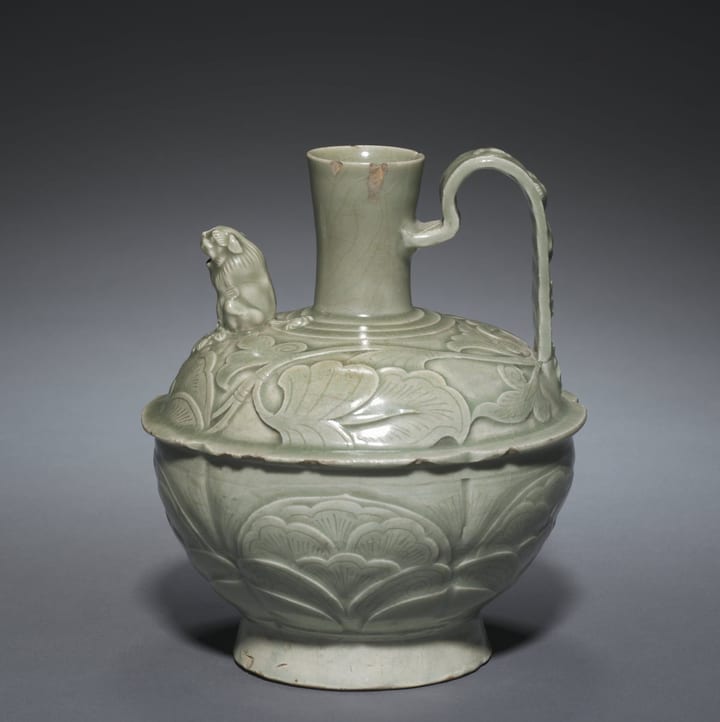
The illustrated spout takes the form of a lion
Cleveland’s Ewer with a Lion-shaped Spout, 1948.220, dates to the 900s–1000s, Five Dynasties or Northern Song. It is catalogued as Yaozhou porcelaneous stoneware with green glaze and modeled, carved and incised decoration.
The museum compares its shape and decoration with Tang metalwork. That is a historical comparison, not a claim that the pictured object is metal. The photograph shows the finished ceramic ewer from one angle.
A fruit-shaped body can begin on the wheel
LACMA’s Ewer (Zhihu) in the Form of a Fruit, M.78.152, belongs to the Northern Song, 960–1127. Its place attribution is China, probably Henan Province. The technical record identifies wheel-thrown Northern Black stoneware with applied decoration and black glaze with brown spots.
The wheel-thrown body and the applied ornament are separate operations in the record. Treating the whole vessel as a single sculpted lump would hide that distinction. The probable production region also remains different from a securely named individual kiln.
A Qing ewer revisits an early-Ming design
The Palace Museum’s Qianlong-period ewer, 故00160312-4/70, imitates a Xuande blue-and-white design. Its pear-shaped body carries a curved spout and handle. A shaped strut connects the neck and spout; small loops on the cover and handle allow a cord to connect them.
Painted fruit appears within diamond-shaped panels on the body. The record’s Qing date and its description of a Ming model answer different questions. A vessel can quote an earlier decorative arrangement without belonging to that earlier reign.
Surface work can divide the body into panels
A Song green-glazed ewer in the Palace Museum, 新00126337, has a cylindrical body divided into six floral panels through carved bands. Its long, curved spout stands opposite a handle. The catalogue links its relief effect with contrasts between glaze and exposed body.
Compare the panels with the positions of the projecting parts. A pattern can repeat around the body while the handle and spout establish a different front-to-back relationship. These are complementary ways of organizing the same object.
Place the pouring form beside a named ware
Our Yue ware guide follows a regional ceramic tradition through jars, bowls and ewers. An ewer guide instead compares the pouring form across different wares. Yaozhou and Longquan supply other green-glazed contexts; Jingdezhen contributes porcelain examples.
Read each label in that order: vessel type, material, surface treatment, date and production attribution. This keeps a shared function from becoming a claim that all ewers used the same clay, were formed identically or carried the same liquid.
Images and credits
Ewer with a Lion-shaped Spout, China, 900s–1000s. Green-glazed Yaozhou porcelaneous stoneware with modeled, carved and incised decoration. Cleveland Museum of Art, 1948.220; Purchase from the J. H. Wade Fund. CC0. Complete photograph, resized.