Chinese covered jars bring two rims together
A Northern Song Ding jar in the Palace Museum has a straight mouth, deep body and white glaze. Its umbrella-shaped cover has a shaped edge and a flat, rounded knob. The catalogue describes a matching rim arrangement where the lid meets the body.
Look for the meeting point between the cover and the opening. The lid may spread beyond the neck, and its shape also changes how the top of the vessel looks. The knob gives a hand a place to lift the cover.
The cover contributes to the painted design
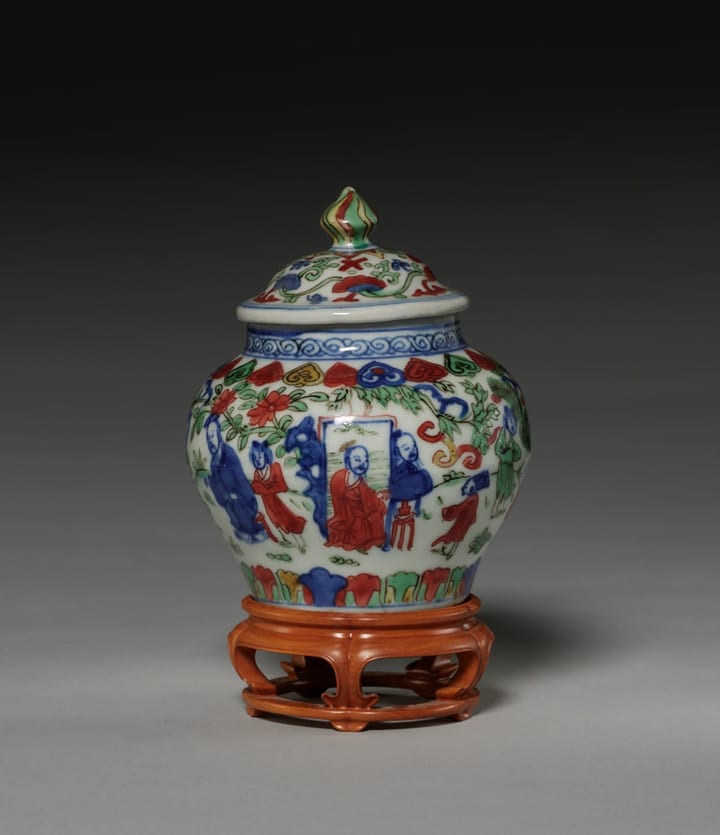
Cleveland’s Covered Jar, 1957.62, is Jingdezhen porcelain from the Wanli reign, 1573–1620. Its record identifies blue decoration under glaze and colored enamels above it. The museum describes sixteen figures in a garden across the jar.
The photograph shows the jar and its domed cover on a stand. A blue band defines the neck below the lid. Flowers and scrolls on the cover make a smaller field above the broader figure scene on the body.
An original cover can survive with parts missing
Cleveland’s Northern Dynasties stoneware jar, 2017.16, retains its original cover. The knob is missing, and the museum proposes that it resembled a lotus bud. Carved petals extend across the shoulder and cover beneath translucent green glaze.
The museum also suggests that cloth could have been attached to the loop handles and folded over the lid to keep it in place. That proposed fastening comes from the arrangement of the surviving parts.
A later cover can fit an older vessel
A Rijksmuseum conservation study identifies a Delft pottery replacement lid on Chinese porcelain jar AK-MAK-554, whose body is dated 1700–1720. The study records other Dutch examples of locally made replacement pieces for Asian ceramics.
A photograph of a jar with its cover shows how those pieces are presented today. The dates and materials of each part come from object records and conservation examination. A close fit by itself gives limited information about when the pieces came together.
Court records identify a use for tea
The National Palace Museum’s Kangxi tea jar 中瓷001287N000000000 has a deep body and a flat round lid. Its catalogue identifies this pale green jar type as a Qing palace tea container. It cites a later inventory name for a related Qianlong example that also specifies tea.
An inventory name provides evidence of intended or recorded use for that kind of vessel. A surviving substance can provide evidence of what a particular jar held. The pictured Wanli jar’s record describes its decoration and leaves its original contents open.
Excavated contents answer a more specific question
Michael Flecker’s report on the Belitung shipwreck records star anise found inside several smaller green-glazed storage jars with spouts. Another small jar held nine lead ingots. Those finds identify contents for individual containers in that cargo.
Our ewer guide follows the placement of a pouring spout and handle. For covered jars, start with the opening and lid, then check what the record says about use. A catalogue name, a surviving cover and recovered contents each answer a different question.
Images and credits
Covered Jar, China, Wanli reign, 1573–1620. Jingdezhen porcelain with underglaze blue and overglaze enamels. Cleveland Museum of Art, 1957.62. John L. Severance Fund. Shown on a stand. CC0. Complete photograph, resized.