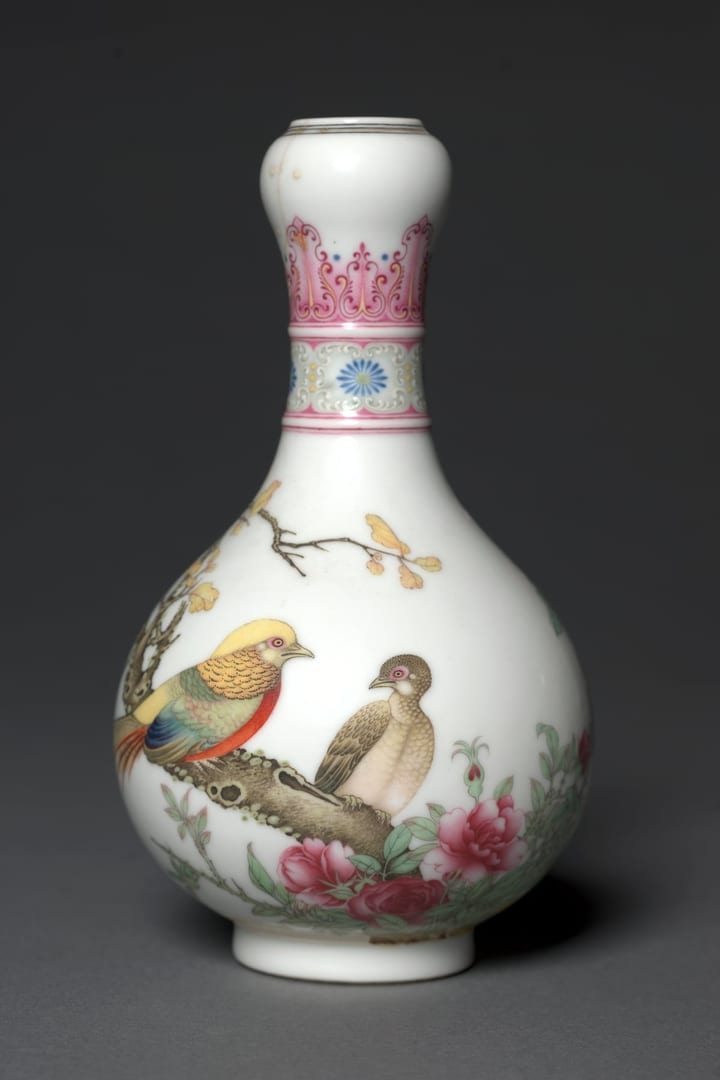
Chinese garlic-head vases are named at the mouth
The Palace Museum’s terminology entry explains suantouping through a mouth resembling a garlic head. It relates the form to Qin–Han bronze vessels. This is a historical design reference, rather than evidence that a later porcelain vase was made during those earlier periods.
Follow the outline from the opening down through the swelling, then along the neck to the shoulder. The upper enlargement belongs to the mouth-and-neck arrangement. It should not be confused with a second large belly, as in a double-gourd vessel.
The illustrated example uses painted enamels
Cleveland’s Vase with Golden Pheasants, 1971.145, carries the Chinese title 珐琅彩錦雞花卉蒜頭瓶. It is dated to the Qianlong mark and period, 1736–95. The catalogue identifies Jingdezhen porcelain and polychrome enamels over transparent glaze.
In the photograph, the broad lower body holds a bird-and-flower scene while smaller borders encircle the neck. Trace the changing widths above that scene: the neck narrows before expanding toward the mouth. The whole profile remains visible in this finished-object photograph.
A Zhangzhou vase records throwing and impressed detail
Seventeenth-century vase LI1301.179 in the Ashmolean is attributed to Zhangzhou, Fujian. Its technical record lists thrown porcelain, incised and stamped decoration, and white glaze.
Incised hibiscus and bamboo cover the body; stamping forms the key-fret border on the neck. Engraved leaves flank that border, and grooves and ridges articulate the mouth.
A Palace vase places color over a gold-patterned ground
The Palace Museum’s small Qianlong example is eighteen centimeters high. Its long neck, sloping shoulder and full belly end in a ring foot. Green glaze covers the interior and the inside of the foot.
Gold-painted patterning forms the ground for scrolling enamel flowers, with further gold around the mouth, neck and foot. Compare this distribution with the white-glazed Zhangzhou vase: a similar mouth profile can accompany very different decorative systems.
A larger example combines elephant handles and a dark band
Pingdu Museum describes a mid-Qing blue-and-white vase standing 57.5 centimeters high. Elephant-trunk handles flank the neck, below which a dark decorative band carries incised scale-like patterning. The catalogue calls that material tiegu ni.
The body is painted with a tall tree, bamboo and rocks. Its size, projecting handles and strongly marked neck make it a useful comparison with the small enamel example. A shape name alone does not define the proportions or ornament of every member.
Compare the opening with a pouring arrangement
Our Chinese ewers guide follows the relationship between a spout, handle and container. Garlic-head describes the upper profile instead. Reading the mouth separately from the body and any attachments makes these two kinds of label easier to compare.
For each example, keep the museum’s medium beside its technique. Incised lines beneath glaze and enamel painting above glaze belong to different surface treatments; neither is established merely by recognizing the vessel’s outline.
Images and credits
Vase with Golden Pheasants, China, Qianlong mark and period, 1736–95. Porcelain with polychrome enamels over transparent glaze. Cleveland Museum of Art, 1971.145; John L. Severance Fund. CC0. Complete photograph, resized.