Chinese Yue ware: a regional tradition rather than one kiln
The Palace Museum uses Yue for historic kilns in northeastern Zhejiang, particularly the Ningbo–Shaoxing area. The name therefore points to a regional tradition with several production sites. It should not be assigned to an unfamiliar ceramic solely because its glaze looks green.
The examples discussed here have different dates: an Eastern Jin jar, a Tang ewer and later works of the Five Dynasties and Northern Song periods. Comparing them gives a useful view of change without pretending that one shape, glaze shade or decorating method represents the whole history.
An early jar exposes decisions about glaze coverage
The Palace Museum’s four-lugged jar with brown splashes, 新00005595, is assigned to the Eastern Jin and explicitly described as belonging to the Yue kiln system. It has glaze over part of its body, an unglazed base and traces of firing supports. Brown splashes interrupt the yellow-green glazed surface.
These features make several making decisions visible at once: how much of the vessel was glazed, where it contacted support and how a contrasting effect was distributed. They belong to this particular jar. Its partial coverage is not a rule to impose on every later Yue vessel.
A dated ewer combines inscription with practical form
Shanghai Museum’s green-glazed floral ewer carries an inscription identifying the first year of the Dazhong reign. The museum treats it as a reference object for dating Tang Yue ewers. Its description also records shallow floral incision and two lugs on the shoulder.
The writing adds a kind of evidence that glaze colour cannot supply: a date expressed on the object itself. Compare it with the vessel’s functional parts, including the opening, spout and handle. Decoration and inscription share the body of a container designed to be filled and poured from.
A parrot ewer gives incision a recognisable subject
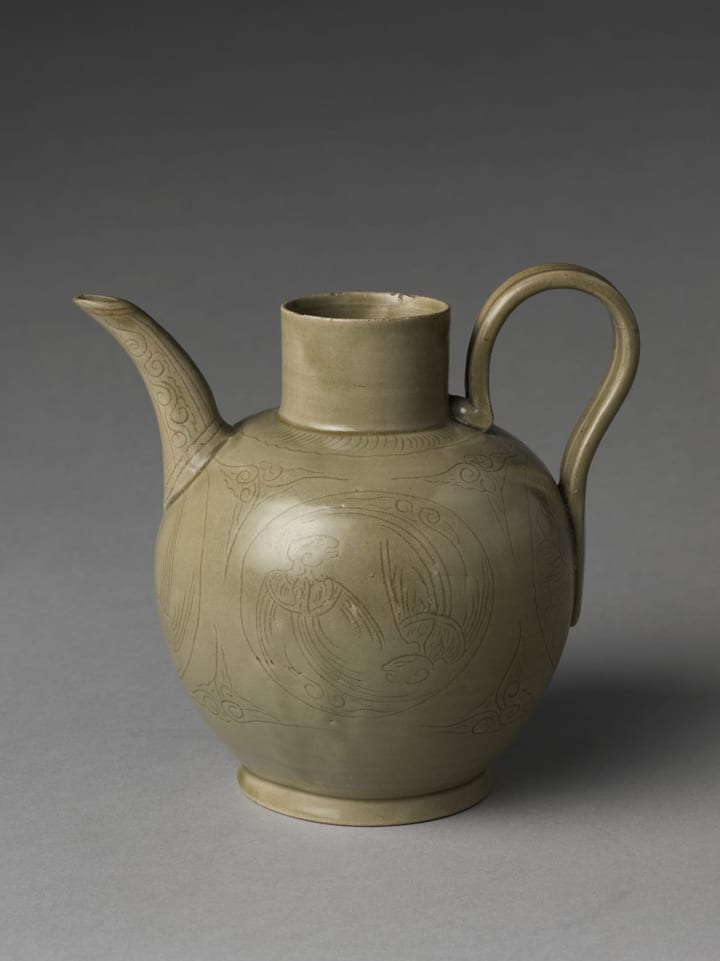
The Met’s Ewer with Parrots, 1979.502, dates to the tenth century, Five Dynasties. It is catalogued as Yue stoneware with incised decoration beneath celadon glaze. A bird subject is therefore established by the museum’s title and technical record, rather than guessed from a patch of colour.
The Met also places parrots within the history of decorative motifs, noting the appeal of birds brought from Southeast Asia. On the ceramic, the incised image has to work around a rounded container and its projecting parts. Considering the whole ewer prevents the subject from becoming detached from the vessel that carries it.
A dragon bowl turns the interior into a continuous field
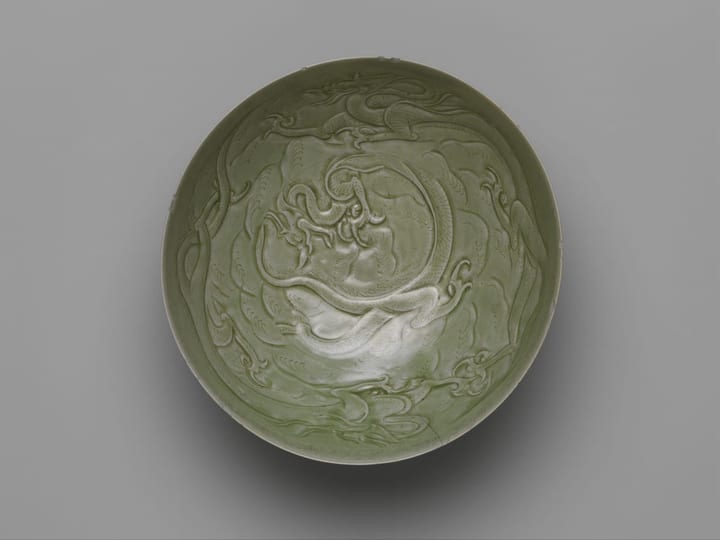
The Met’s Bowl with dragons amid waves, 18.56.36, is dated to the tenth–eleventh century, Five Dynasties to Northern Song. Its record specifies carved and incised decoration beneath celadon glaze and identifies three dragons moving through waves.
The broad interior gives those figures and water patterns a different setting from a ewer’s outer wall. Trace the relation between a dragon and the surrounding wave lines, then consider how the composition occupies the bowl. Carved and incised marks establish the design in the body; the glaze covers that prepared surface.
Different vessel profiles organise decoration differently
The Met’s Ewer with lug handles, 18.56.45, is another tenth-century Five Dynasties Yue work with incision beneath celadon glaze. Its structural title offers a useful comparison with the subject-based title Ewer with Parrots. One directs attention to the vessel’s fittings, the other to its ornament.
The National Museum of China’s Yue bottle with a dish-shaped mouth gives a further variation. Its body is divided into five lobes, each bearing an incised peony. Here the shaped wall provides separate fields for the flower design. The museum also notes the exposed body at the foot, another place where the glazed surface meets a working part of the vessel.
Place Yue beside other named ceramic traditions
Our Longquan celadon and Yaozhou ware guides provide other regional contexts for green-glazed ceramics. They share a useful comparison through form and surface, while their kiln histories and documented methods remain distinct. A firing account for one should not be transferred automatically to another.
The Qingbai companion explores pale-glazed porcelain, including Jingdezhen examples; the broader Jingdezhen guide gives that production centre’s context. Together these comparisons encourage a precise vocabulary: identify the ware and material, describe where the decoration sits, and keep the object’s date and attribution attached to the explanation.
Museum photographs and credits
Bowl with dragons amid waves, Yue kilns, Zhejiang, China, 10th–11th century, Five Dynasties to Northern Song dynasty; stoneware with carved and incised decoration under celadon glaze (Yue ware). The Metropolitan Museum of Art, 18.56.36. CC0.
Ewer with Parrots, China, Five Dynasties, 10th century; stoneware with incised decoration under celadon glaze (Yue ware). The Metropolitan Museum of Art, 1979.502. CC0.