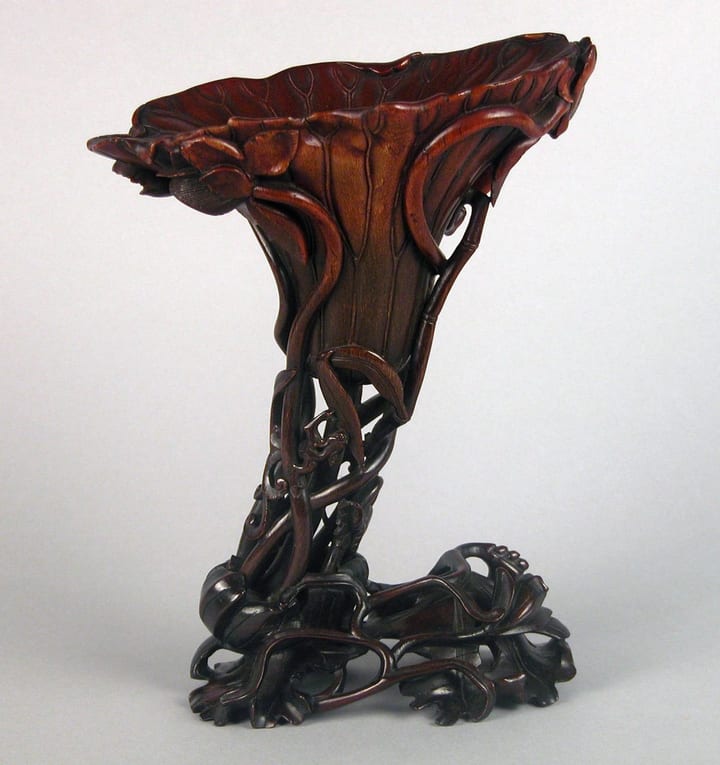
Chinese carved rhinoceros-horn cups: vessels with sculptural form
The Met’s Cup in the shape of a magnolia blossom, 37.139a, b, is an eighteenth-century Qing object. Its title connects the vessel’s overall shape with a flower. The museum’s account places elaborate cups within the history of wine drinking and libations, giving a useful functional context for their sculptural surfaces.
Read the rim, cavity and outer profile together. The blossom is not merely a flat motif placed on an unrelated wall: it informs the shape of the container. This relationship between image and volume is a central question when comparing the cups.
A photographed cup and its stand need separate descriptions
The Met’s Cup, 08.212.12, is another eighteenth-century Chinese Qing example, catalogued as rhinoceros horn. The museum photograph shows it with a stand. Its general title supplies less iconographic information than the magnolia cup’s, so the material and date should remain distinct from a viewer’s proposed interpretation of the scene.
The cup’s medium does not identify the stand’s material or age. Notice where the vessel ends and its support begins: a coherent display can contain components with different, or unrecorded, histories.
A dragon handle joins an image with a structural role
The Palace Museum’s early Qing water-creature cup, 新00195477, follows a broad upper form narrowing toward the base. Its exterior is deeply carved with animals and fantastic beings among cloud and water imagery. A dragon serves as the handle, reaching toward the rim and looking into the cup.
The museum tentatively associates this work with Jiangsu and records staining that changed the material’s colour. Those points belong to this object. In particular, a dark surface should not be turned into an age test or a universal account of how all historical cups were finished.
Floral and archaic forms offer different comparisons
The Ashmolean’s cup, 1685 B no. 465, takes the form of a five-petalled hibiscus. Its published description follows overlapping petals carved inside and outside and notes a polished, translucent surface. The same flower image is developed across the vessel rather than confined to its exterior.
The British Museum’s eighteenth-century cup, OA+.1127, instead combines mallow and chrysanthemum flowers in high relief with a base shaped like an ancient bronze gu vessel. Floral sculpture and an archaic vessel reference coexist. This is more precise than assigning every carved cup either to nature imagery or to bronze imitation alone.
Relief, openwork and sculpture can work together
A Shanghai Museum exhibition account published in 2025 explains how historical flower-and-fruit cups combined relief, openwork and carving in the round. It also relates their designs to earlier work in other materials. These terms describe different relationships between the image, the surrounding material and open space.
In relief, a motif stands above a lower background; openwork creates openings; a fully modelled feature extends into three-dimensional space. Comparing these roles helps distinguish a cut line from a projecting stem or a pierced passage. They need not occur in equal measure on every cup.
Forms could travel into porcelain
The Shanghai Museum account also documents Dehua white porcelain imitating the forms and carving styles of horn cups. The comparison demonstrates how a recognisable shape can be remade through another material and another set of forming operations.
Our Dehua guide supplies the ceramic context, including modelling and moulded details. The bamboo-carving guide follows a separate material with stems, skin and roots, while jade carving centres abrasive stoneworking. Those links help distinguish material-specific workmanship without assuming that similarly coloured or similarly shaped objects were made in the same way.
Images and credits
Cup shown with a stand, China, 18th century, Qing dynasty. The museum catalogues the cup material as rhinoceros horn; the stand’s material and date are not specified here. The Metropolitan Museum of Art, 08.212.12, Gift of J. Pierpont Morgan, 1908. CC0. Uncropped museum photograph, resized for display.