Silk reeling vs spinning: follow the material entering the thread
The decisive difference is the material being handled. In reeling, the worker finds and draws filament from cocoons. In staple-fiber spinning, fibers are fed from a prepared supply into a forming yarn. A turning reel or bobbin can appear in several operations, so identify what feeds it.
The China National Silk Museum distinguishes long filament reeled from a complete cocoon from silk yarn spun from fibers of broken cocoons. Its explanation confirms that spun silk is still silk: the preparation route has changed, not necessarily the fiber material.
What happens during a documented reeling demonstration?
A museum account of a Zhejiang practitioner's demonstration describes cooking prepared cocoons in water, using a brush to find filament ends, gathering them, and guiding them onto reeling equipment. Several fine ends are managed together to produce an even strand.
The skilled work is not simply turning a handle. Finding ends, guiding the material, and maintaining an even result all matter. This documented demonstration provides a concrete example; it should not be treated as the exact apparatus or preparation method used for every type of silk.
Spinning joins fibers through controlled feeding and twist
Drawing out the fiber supply is often called drafting. The spinner controls how much material enters the yarn while twist brings the fibers together. Winding collects the resulting thread. These actions need to work together, whether the tool is simple or mechanically elaborate.
The Science Museum Group's Saxony-wheel record explains this coordination through a historic wheel used mainly for flax and wool. It is evidence for the general mechanics of spinning, rather than a Chinese silk-spinning tool. For silk specifically, the Chinese museum's broken-cocoon example establishes the separate spun route.
Twisting reeled silk is another operation
Reeled filaments can undergo further preparation. The Science Museum Group describes a historic silk machine that doubled filaments and twisted them together, an operation called throwing. Its record also uses the historical expression spinning silk for the machine's broader activity.
That terminology can confuse a modern comparison. A twisted silk thread does not prove that it was spun from shorter fibers, and a machine's old name may not describe every stage precisely. Ask whether the worker is unwinding cocoons, drafting fibers, or combining already prepared threads.
Thread preparation does not identify the finished fabric
Reeling and spinning answer a question about making thread. Brocade, embroidery, and other textile terms answer different questions about structure or decoration. A label reading silk therefore needs further information before it can explain how the yarn or finished object was made.
Avoid ranking every reeled yarn above every spun yarn. Ask what the thread was intended to do, how it was prepared afterward, and what the documented object requires. A single close-up or a smooth-looking surface cannot establish the full production history.
The same museum demonstration report also describes opening cocoons and stretching silk wadding for quilts. That is a different route to a silk product, so reeling and spinning should not be presented as the only possible uses of a cocoon.
Learn the stages without losing their wider context
UNESCO's account of Chinese sericulture connects cocoon processing and thread making with mulberry cultivation, silkworm raising, weaving, and transmitted knowledge. Reeling is one operation within that larger system, rather than a synonym for the whole tradition.
The China National Silk Museum documented reeling and cloth-weaving experiences in its 2025 Hanfu program. Such teaching helps visitors see transitions between materials. It is a dated example of public learning, not a promise that the same activity is available on a future visit.
Photographs, credits and reading boundaries
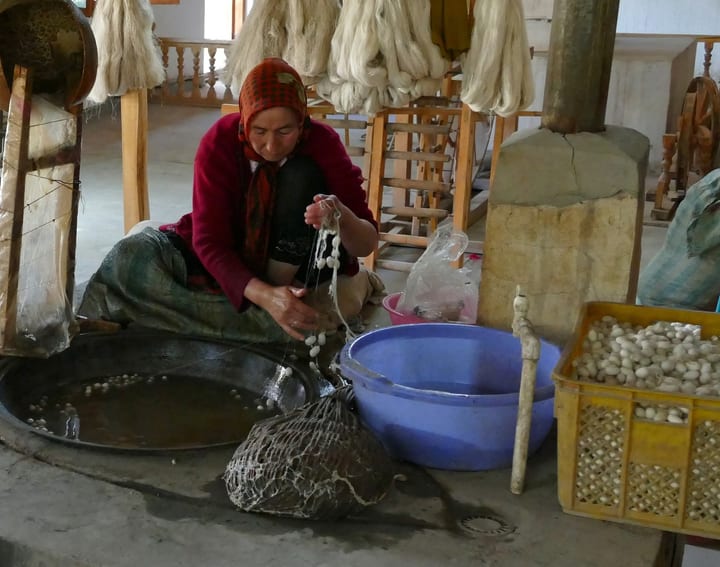
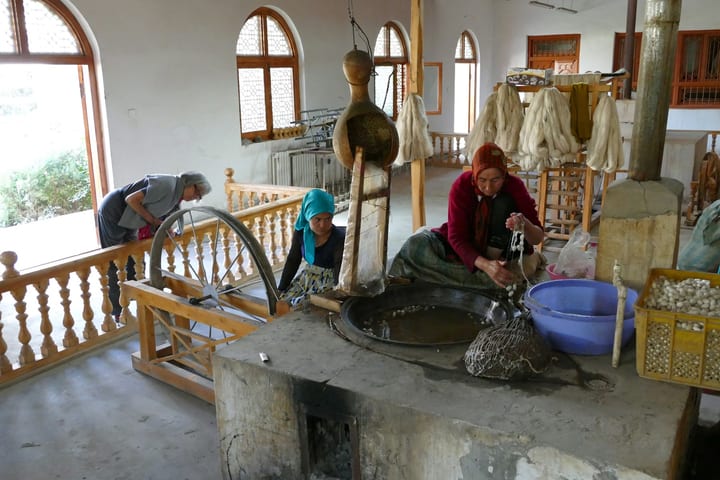
Silk production near Hotan, Xinjiang, photographed in 2015. Cocoons, a basin and a winding reel are visible. Photo: Zossolino, Wikimedia Commons, CC BY-SA 4.0; resized. EXIF orientation applied, resized without upscaling, metadata stripped and JPEG optimized. Source and license links are below. Responsive derivatives remain under CC BY-SA 4.0. No photographer or museum endorsement is implied.
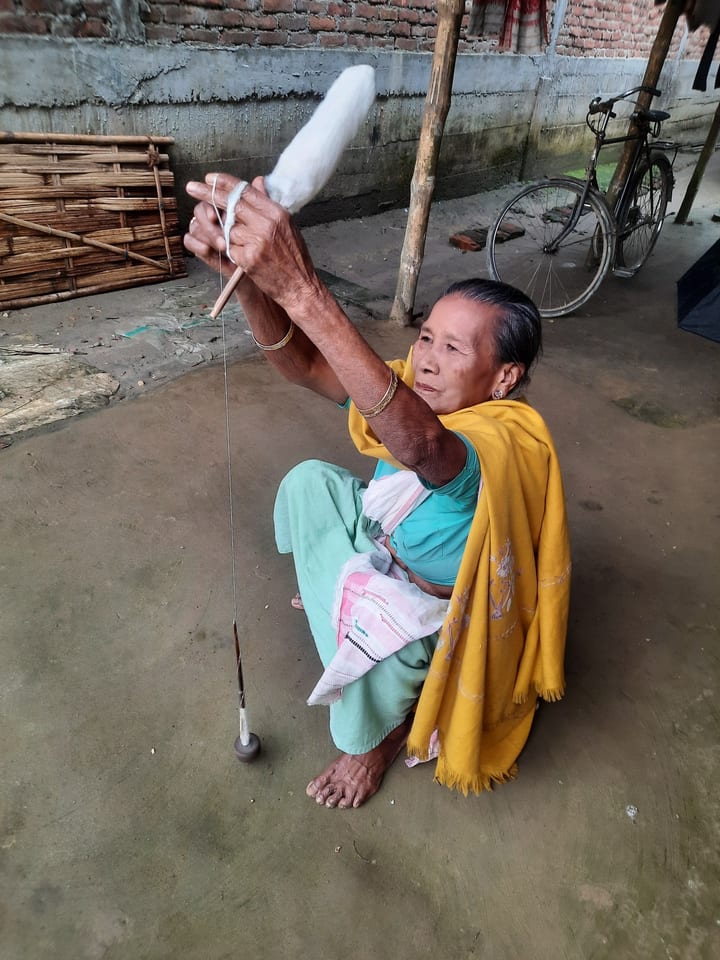
Technical comparison from Assam, India: Eri silk fibers are spun with a Takuri spindle. This is not a Chinese workshop. Photo: Jyoti Chiring, Wikimedia Commons, CC BY 4.0; oriented and resized. EXIF orientation applied, resized without upscaling, metadata stripped and JPEG optimized. Source and license links are below. No photographer or museum endorsement is implied.
Detail crop from the same Hotan photograph, showing cocoons, the basin and silk handling. This is the same scene as the main image. Photo: Zossolino, Wikimedia Commons, CC BY-SA 4.0; cropped and resized. Cropped, EXIF orientation applied, resized without upscaling, metadata stripped and JPEG optimized. Source and license links are below. Responsive derivatives remain under CC BY-SA 4.0. No photographer or museum endorsement is implied.
The spindle photograph shows Eri silk spinning in Assam, India, as an explicitly identified technical comparison. It is not evidence for a Chinese regional silk-spinning practice. The two Hotan views are the same photographed scene.