Chinese pewter craft begins with a material distinction
In English, pewter names a tin-based alloy, rather than silver. The Canadian Conservation Institute distinguishes modern tin alloys from older pewter that may contain lead. The Chinese term xiqi, or tinware, is used across the regional accounts here. Those names should be retained without assigning every historical object the composition of a modern product.
Sheet describes a form of material prepared for working. It does not mean tin-plated iron. The V&A explains tinning as a thin tin coating fused to another metal; that differs from shaping a tin-rich sheet into the body itself. A pale surface alone cannot identify the body, its purity or its joining material.
From a flat piece to a shaped component
A February 2023 Wenzhou University Folk Museum account records teaching at the Lude tin-art studio. Its sequence includes casting plates, marking and cutting material, hammer shaping, joining and finishing. These are documented modern stages, rather than a reconstruction assigned to every old vessel.
Participants used round hammers on precut circular pieces to produce texture. This isolates one skill within the longer craft: a patterned disc does not itself explain the construction of a complete vessel.
Joining and finishing ask different kinds of control
A 2015 workshop interview published on China’s official intangible-heritage website describes Jinzhou maker Shi Yan working with wooden mallets and chisels. He explains how repeated adjustment changes the proportions of a vessel. The account also records his particular practice of joining with strips cut from leftover tin material, requiring careful control of heat.
Keep that practice attached to the named maker. It establishes neither a universal solder formula nor the method used for an unexamined antique. The V&A’s general metalworking guide likewise distinguishes assembling parts from casting them and describes several ways of attaching components. Joining belongs to construction; filing, scraping and polishing then refine the surface and the meeting of parts.
Engraving turns a vessel into a field for pictures and words
The Met’s Hexagonal teapot, accession 2023.581a–c, gives a specific historical example. Dated to the late nineteenth or early twentieth century, it is attributed to the workshop of Chen Wanfeng in Jiaxing. Its recorded medium is pewter, copper and brass. The museum bases the workshop attribution on seals on the base and lid, rather than on a silvery appearance.
Its incised ornament brings together plants, animals, still lifes, poems and inscriptions drawn from ancient bronzes. The Met interprets this combination as an interaction between popular culture and scholarly antiquarian taste. A useful teapot could therefore offer a sequence of images and texts as it was handled and viewed.
Surface engraving is one part of metalworking. Repoussé develops relief by working metal from the reverse, while filigree builds patterns from wire. The related guides explain those other approaches. A hammered body, an incised picture and a wire ornament describe different operations, even when several techniques can belong to one wider craft tradition.
A dated plate combines pewter with coconut shell
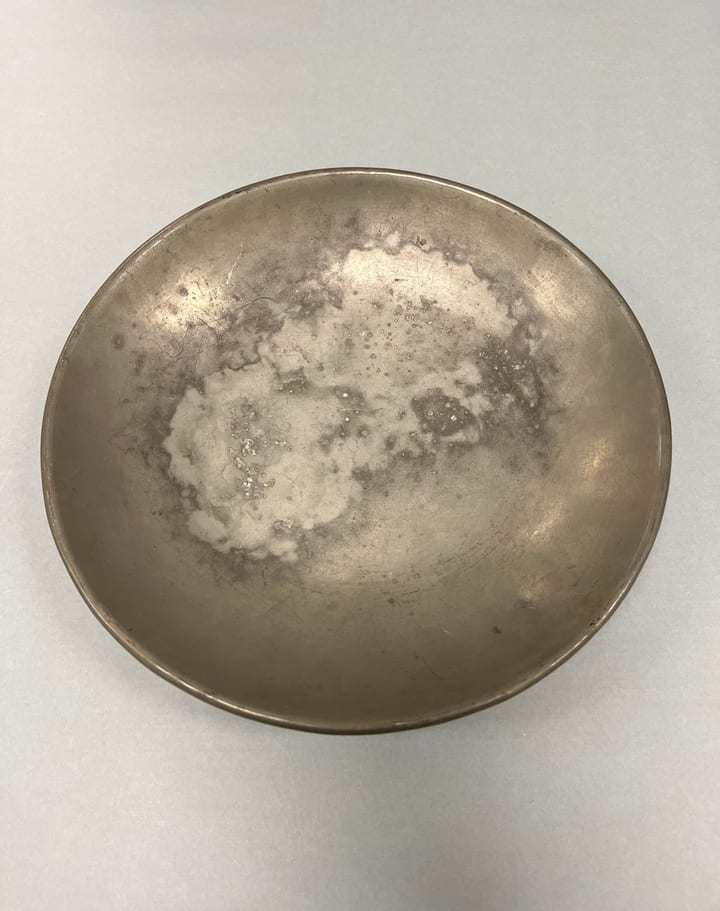
The illustrated Round Plate at the Met, accession 1993.480.6, is catalogued as Chinese and dated 1917. Its medium is explicitly pewter and coconut shell. The selected photograph shows its broad metal interior. The complete material description matters even when this particular view gives greater prominence to one component.
A rounded outline and broad interior make this photograph useful for studying a finished metal surface. They do not identify the precise alloy or reveal whether a particular joint was cast, soldered or otherwise assembled. The museum record assigns the object to China without specifying Gejiu or another regional workshop.
The photograph documents the surviving plate, rather than demonstrating the modern making sequence above. The related coconut-shell-carving guide considers the same composite object from the perspective of its other material.
Regional traditions keep their own histories
Gejiu belongs to a different setting in Yunnan. A 2024 account from Honghe’s culture and tourism bureau describes itinerant repairers and later specialist shops, alongside tinware for tea, wine, writing and display. It also records floral, animal and bird subjects in decorative tin pictures, drawing on local customs and relief and painting traditions.
The bureau identifies Gejiu tinware-making as a Yunnan provincial heritage project listed in 2009. That specific designation should not be extended to every pewter object in China. Wenzhou’s workshop teaching, Jiaxing’s historical teapot and Gejiu’s local account provide complementary evidence, rather than one interchangeable regional history.
Museum photographs and credits
Round Plate, China, dated 1917; pewter and coconut shell. The Metropolitan Museum of Art, Gift of Paul Singer, 1993, 1993.480.6. Public Domain / CC0. Uncropped museum photograph of the metal interior; resized for this page. This composite finished object is not attributed to Gejiu, Wenzhou or Hainan, and is not a process photograph.