An opening for brushes, a surface for stories
The Palace Museum describes bitong as an implement for inserting brushes. Its examples include cylindrical, square, waisted and bamboo-joint forms. A brush pot therefore has a recognizable task without one compulsory outline.
Look at the opening and enclosing wall, then follow the imagery. The working container remains visible beside its decoration.
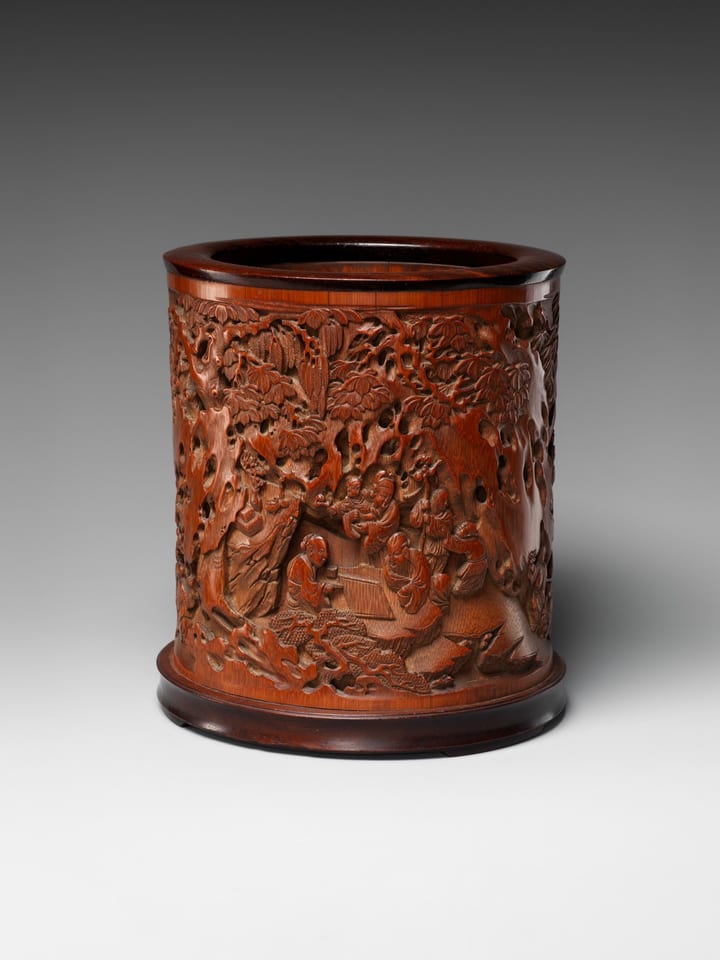
The photograph shows a carved bamboo landscape
The Met’s brush holder 2011.7 is dated to the late seventeenth or early eighteenth century. Its catalogue distinguishes the bamboo body from its wooden rim and stand. Carved immortal figures occupy the landscape around the vessel.
The complete view shows the open top and a dense arrangement of trees, rocks and figures. It records the finished object, rather than the order of workshop operations.
Keeping the skin can create a lighter image
A different Met pot, 1994.208, is attributed to Zhang Xihuang and dated to the early seventeenth century. The maker cut the lighter bamboo skin so that the design stands against the darker, fibrous stalk.
Its scene refers to a gathering hosted by Ouyang Xiu in 1045 and the ode he later wrote about it. The text and the carved container belong to different centuries. The older literary subject does not date the carving, and this technique should not be inferred for the photographed landscape pot.
A horseman reveals another bamboo construction
The Palace Museum’s early-Qing rider pot, 新00091986, has a round body, horn base and three short feet. Shallow relief shows a mounted warrior turning and pouring from a vessel; incised lines suggest dust.
A porcelain pot belongs to its own kiln setting
Cleveland’s porcelain holder 1940.709 is assigned to Jingdezhen in Jiangxi and dated to 1628–44, the Chongzhen reign. The museum situates it within the broader Transitional period, when imperial oversight of the official kilns was disrupted.
That historical label spans a wider interval than this particular object’s date. Keep the two scales separate when comparing a catalogue entry with a general ceramics history. Porcelain construction also requires a different account from cutting images into bamboo; a shared desk function does not imply a shared making sequence.
Jade changes the material without changing the category
Cleveland’s holder 1990.36 supplies a nineteenth-century Chinese Qing example catalogued as spinach jade. It measures 12.5 centimetres high and 8.4 centimetres in diameter. The material label identifies this vessel; it does not make every green brush pot the same stone.
Use the catalogue’s date, dimensions and material together when comparing containers. A similar cylindrical silhouette can connect their purpose while concealing major differences in substance, working methods and historical setting.
A pot is one accessory in a larger study
Spurlock’s bamboo bitong 2003.14.0002A is dated to the late eighteenth or early nineteenth century. Its record distinguishes brush pots from the four treasures—brush, ink, paper and inkstone—and places them alongside additional desk furnishings.
The related bamboo-root guide follows irregular sculptural material; the water-dropper guide follows a separate supply of water for ink preparation. Here the organizing question is where the brushes are kept.
Images and credits
Brush holder with immortals in landscape, China, late 17th–early 18th century; bamboo, wooden rim and stand. The Met, 2011.7; Purchase, The Vincent Astor Foundation Gift, 2011. CC0. Complete photograph, uncropped and resized.