The handle belongs to a complete writing implement
Mia’s Calligraphy brush, 2015.14.3, is Chinese and dated to the late nineteenth century. Its catalogue records wood and hair, without naming a wood species. The museum places the brush among the four treasures of the study, alongside inkstick, inkstone and paper.
That description joins a working implement to a collecting culture. A handle may carry visual interest of its own, but the catalogue still identifies a brush: material description, complete object name and decorative interpretation should be read together.
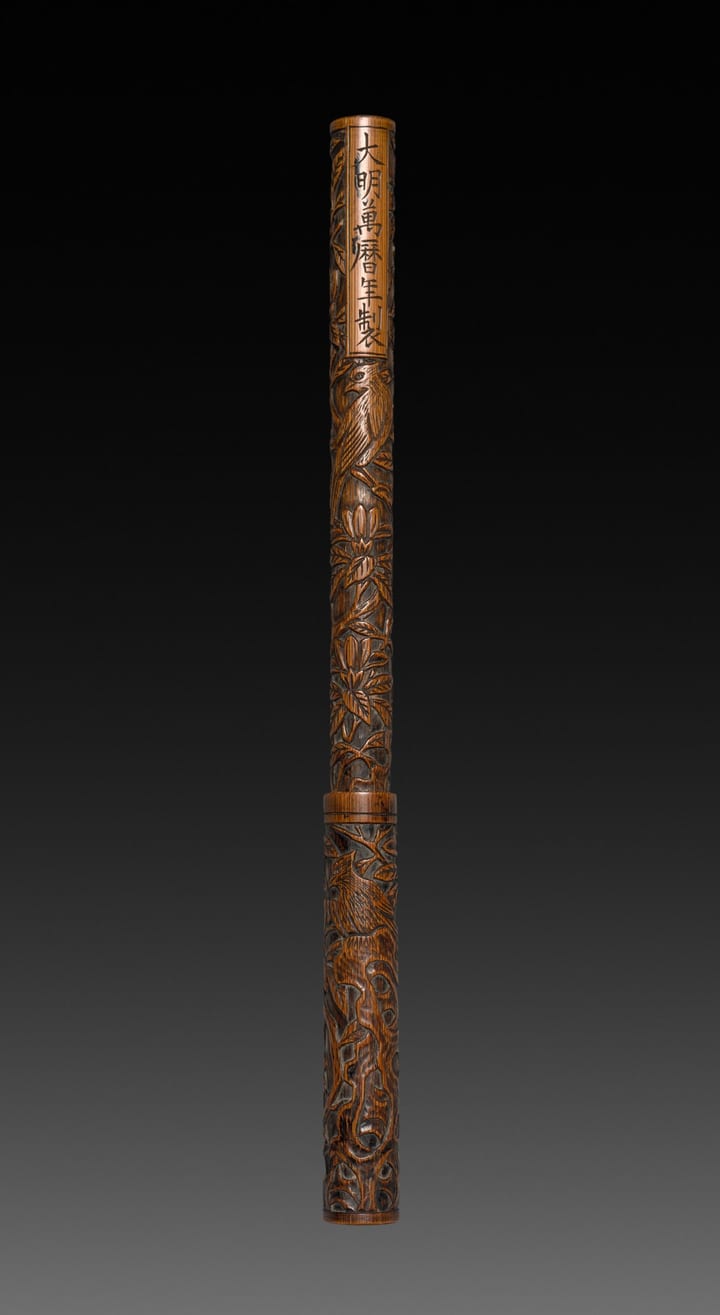
A fitted bamboo cap continues the decoration
The pictured Cleveland brush, 1967.194, is catalogued to the Wanli mark and reign, 1573–1619. Its bamboo handle and cap carry shallow-relief branches, leaves, birds and flowers. The inscription identifies the Ming Wanli era.
The closed photograph lets the carved surfaces be compared along the assembled object. The cap conceals the brush tip; Cleveland’s written description, rather than this view, identifies fine white animal hairs.
Carving, lettering and a contrasting rim
The Palace Museum’s bamboo brush 故00132386 bears paired dragons and a pearl. Its retained-skin carving keeps the bamboo’s outer skin as raised pattern against areas where that skin has been removed.
The shaft also carries raised clerical-script characters and an incised, blue-filled Wanli mark. A mother-of-pearl rim introduces another material at the top. These details invite comparison between patterned surface, lettering and applied ornament; they do not describe every bamboo brush.
Plain jade makes finish the main feature
The Palace Museum’s Qing white-jade brush 故00096405 has an undecorated shaft polished smooth. The whole brush measures 17.8 centimetres, with a shaft diameter of 1.4 centimetres.
Its catalogue distinguishes plain jade handles from carved ones and lists several other Qing handle materials. Dense ornament is therefore not a useful definition of a fine brush handle. In this example the continuous smooth surface, rather than a carved scene, is the documented feature to notice.
Porcelain gives the shaft a painted surface
Shanghai Museum catalogues a Jingdezhen blue-and-white brush shaft with scrolling flowers and a dragon, assigned to the Ming Wanli period. The object is classified as porcelain, rather than bamboo or wood.
Its concise record is useful for a focused comparison: identify the material, the decorative vocabulary and the component being catalogued. A ceramic shaft need not be confused with a ceramic brush pot. One is named as part of a brush; the other is a separate storage vessel. The existing brush-pot guide develops that different function.
A red-lacquer brush survives with its cover
The Met records Brush and cover, 2015.500.1.107a, b, as Chinese red lacquer, 23.5 centimetres long. The catalogue names both components but supplies no manufacturing date in its current display.
This example broadens the comparison from carved and polished materials to a lacquer surface. Its accession number identifies the collection entry, not a production year. The brief medium label also leaves the underlying support unspecified. Read that limit alongside the named cover rather than inventing a construction sequence from the colour alone.
Images and credits
Brush with Carved Design, China, Wanli mark and reign, 1573–1619; carved bamboo. Cleveland Museum of Art, 1967.194; Anonymous Gift. CC0. Complete photograph, uncropped and resized; the cap covers the tip.