The support is for the writer rather than the brush
The Palace Museum describes a thin, hollow-backed implement used beneath the arm. Its function concerns the writer’s contact with the sheet.
The brush-rest guide instead follows peaks and hollows that support a resting brush. The brush-pot guide follows the open container used to hold brushes. These neighboring objects belong around the same activity, while their shapes answer different practical questions.
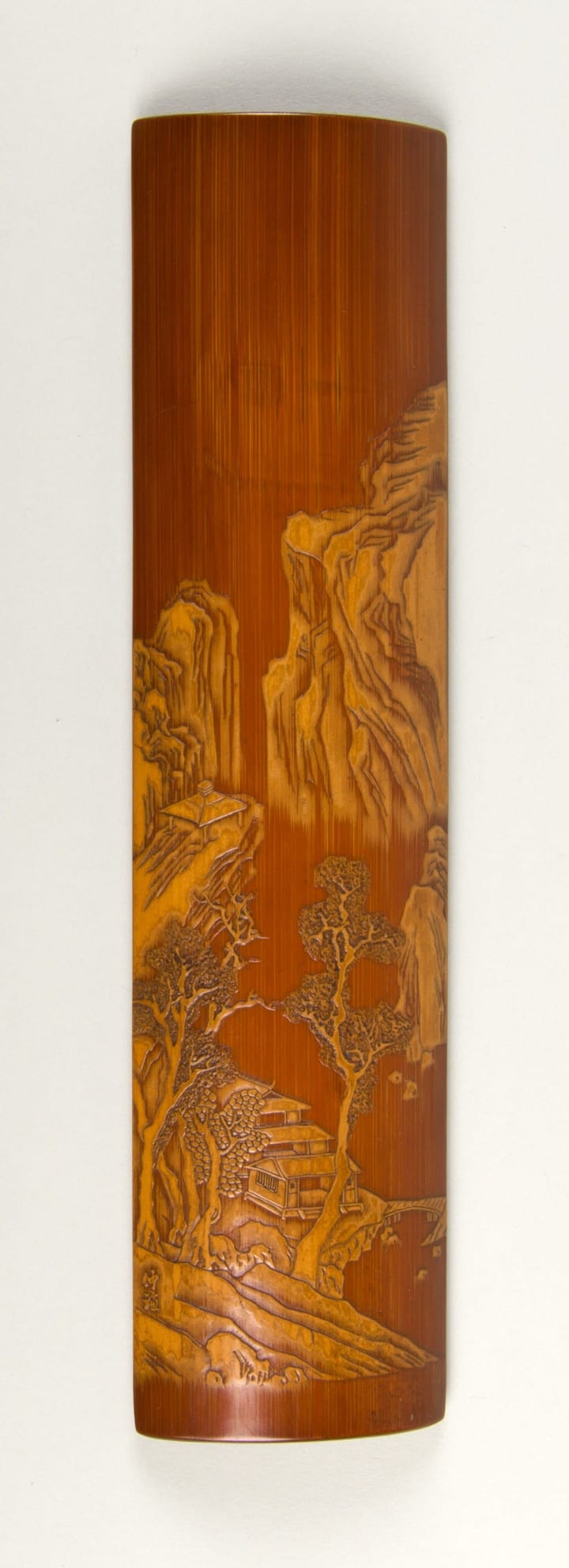
The photograph shows a Qianlong-period bamboo example
The Met identifies the illustrated rest, 58.64.2, as Chinese bamboo from the Qianlong period, 1736–1795. It is 20.8 centimetres long. Its carved landscape occupies only part of the long surface.
The museum explains how the retained outer skin creates light highlights against darker inner bamboo. In the photograph, follow the small buildings, tree forms and steep rocky slopes. This view records the completed carving; it does not demonstrate the original tools or the sequence of individual cuts.
A herd boy gives another curved support a scene
The Palace Museum’s Qing rest 新00074748 shows a boy lying over a strong-bodied ox below a pine tree and clouds. Its elongated, roof-tile-like form carries shallow relief. The image and curved support belong to one bamboo object, rather than an illustration pasted onto an unrelated implement.
A literary image can begin with a printed model
Shanghai Museum attributes a bamboo rest showing Su Wu to Fang Jie and dates it to the tenth Daoguang year. Its description identifies Jin Guliang’s Wushuang pu as the model for the seated figure.
The museum associates Fang’s shallow carving with the Jinling school and describes his development of figural work from an earlier approach linked to Pu Zhongqian. This is evidence for a named maker and lineage, not the origin of every Chinese wrist rest. The inscribed scene and poem also show why a long, narrow working surface could reward reading as well as viewing.
Three named artists can contribute to one rest
Hong Kong Museum of Art presents a Qianlong-period bamboo rest as a collaboration among Li Shan, Huang Shen and Pan Xifeng. Its lower area carries a lightly engraved God of Longevity, while writing occupies the upper part.
The museum credits Pan with the engraving and his Xifeng seal, and connects the image and inscription with Huang’s painting and Li’s calligraphy. Read the stated roles together. They provide more precise evidence than treating every mark on a collaborative object as the work of a single anonymous hand.
A ceramic rest can imitate bamboo rather than be bamboo
The Palace Museum’s Kangxi-period porcelain example is rectangular, 17.2 centimetres long and 6.9 centimetres wide. White glaze covers the surface; black decoration depicts bamboo leaves between modeled bamboo joints, accompanied by a short inscription.
Its form makes a material comparison useful: bamboo appears both as an imitated structure and as a painted subject, while the actual body is ceramic. A bamboo-like outline therefore does not establish bamboo as the material. Keep the catalogue’s medium beside the photograph when comparing similar writing accessories.
An autumn landscape joins imagery with writing
The Lowe Art Museum’s bamboo rest 2003.23.1 is dated to the late eighteenth or early nineteenth century. Its account describes windswept trees, a house in a rocky valley and mountains beyond.
A cursive inscription evokes the autumn scene. The museum identifies Biwen as a studio name and distinguishes it from the Wu Yu seal. This makes a useful reading exercise: identify the scene, the writing and the recorded names separately before relating them. A poetic subject can enrich a practical object without settling every question about its maker or earlier ownership.
Images and credits
Wrist rest, China, Qianlong period, 1736–1795; bamboo. The Met, 58.64.2; Gift of A. W. Bahr, 1958. CC0. Complete museum photograph, uncropped and resized.