Chinese bamboo root carving begins with a different shape
A bamboo stalk supplies the hollow tube familiar from brush pots. A root presents a different starting form, with bends, projections and changes of volume. The Asian Art Museum describes bamboo root as dense and hard enough to carry fine details, including the small travelers in its Mountain scene (procession).
Consider the overall shape before inspecting a face or a leaf. Where does a broad mass become a cliff, and where does a narrowing section help form a peak? These viewing questions connect the carved subject with its support without treating every surface as untouched natural growth.
An entire root becomes an upright mountain
The Asian Art Museum’s Qing-dynasty Mountain scene (procession), B62M85, was carved from an entire bamboo root placed upside down. The museum records it as 35.6 centimeters high. Travelers, pack animals, paths and buildings populate its steep landscape.
One side includes a plank road carried along a cliff. Other passages lead toward a city gate or down to water. The composition makes the viewer follow routes through a compact volume. Its mountain shape therefore organizes a sequence of human activities, rather than merely providing a background behind one central figure.
A root can also become a container
The National Palace Museum’s Bamboo water holder carved in the shape of a lotus leaf gives the root a practical hollow. The leaf’s curling edges surround a pool intended for washing a brush. A crab sits at one end, and carved veins extend across the outside.
The catalogue also describes a Sansong signature among those veins. It is useful evidence about the object’s inscription, without requiring a viewer to identify a maker from carving style alone. Follow the vessel’s opening and enclosing rim as well as its decorative details: the leaf shape does the work of containing water.
A small immortal landscape in The Met
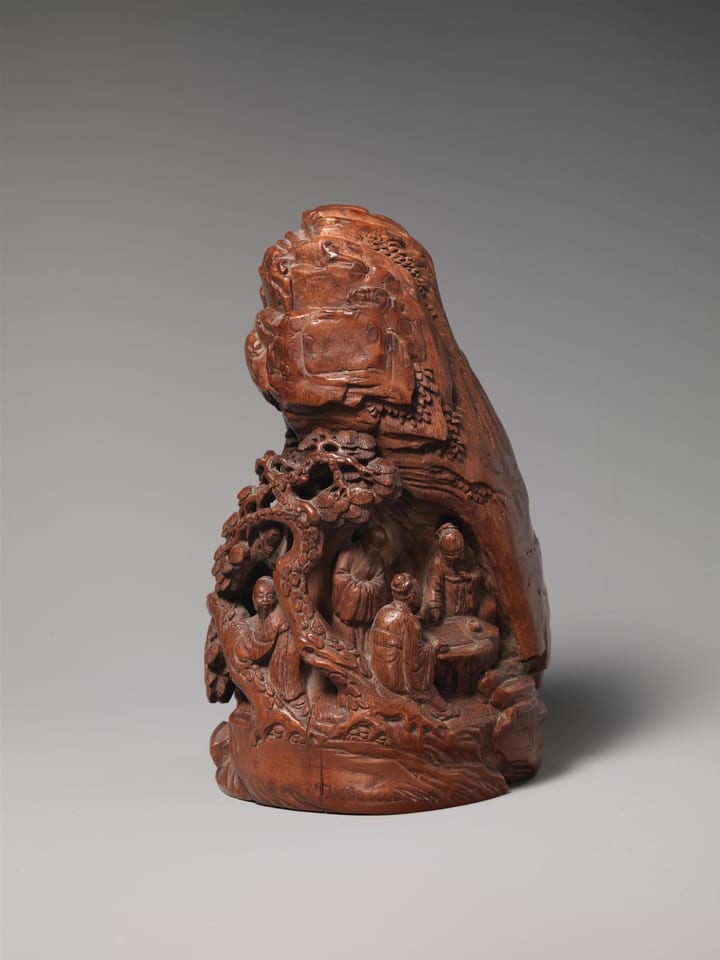
The Met’s Chess playing in an immortal realm, accession 2015.500.6.1, is a nineteenth-century Chinese Qing work explicitly catalogued as bamboo-root carving. At 19.7 centimeters high, it brings a rocky setting, figures and trees into a compact sculpture.
The full museum photograph offers one view of the completed object. Its figures occupy recesses beneath larger rock forms, making the surrounding volume part of the scene. The catalogue establishes the root material and historical scope; the photograph does not identify the original tools, finishing compound or order of cuts.
The iron brush and the scholarly setting
HKU’s University Museum and Art Gallery places Ming and Qing bamboo carving within scholarly and imperial patronage. Its account names Jiading, now in Shanghai, and Jinling, now Nanjing, as centers producing miniature landscapes, figures and desk objects.
The museum describes the iron brush as knives and carving tools used to transfer a brushwork aesthetic into other materials. This gives a useful cultural context for the close attention paid to a branch, robe or rocky contour. It also explains why bamboo, boxwood and other carving materials could share related subjects without becoming interchangeable substances.
A documented Xiangshan working sequence
Ningbo’s cultural center describes a modern Xiangshan practice that observes structure and texture before selecting the subject. It then treats the root and rootlets, marks a design, and develops rough and finer forms.
Smoothing, sandpaper, resin and wax complete the published sequence. This local account provides a useful working example; the finish of an older museum object requires its own evidence.
Compare root sculpture with other carving approaches
The broader bamboo guide explains retained-skin work and relief around cylindrical brush holders. Here the emphasis is on composing a three-dimensional root, including its conversion into a vessel. The boxwood guide follows another material and its regional approaches; the woodcarving-techniques guide introduces relief, openwork and carving in the round for further comparison.
Images and credits
Chess playing in an immortal realm, maker unrecorded, China, nineteenth century, Qing dynasty. Bamboo-root carving. The Metropolitan Museum of Art, 2015.500.6.1; Gift of Florence and Herbert Irving, 2015. CC0. Complete museum photograph, uncropped and resized for display.